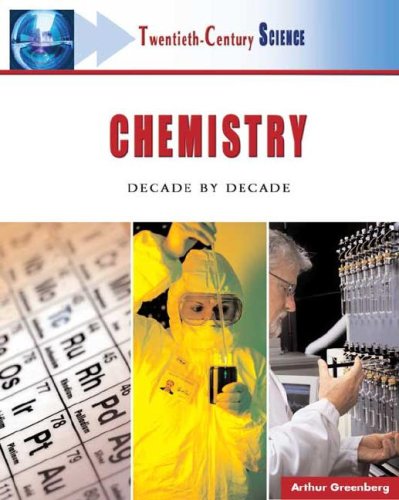
Chemistry Decade by Decade 1st Edition by Arthur Greenberg- Ebook PDF Instant Download/Delivery: 978-0816055319, 0816055319
Full download Chemistry Decade by Decade 1st Edition after payment

Product details:
ISBN 10: 0816055319
ISBN 13: 978-0816055319
Author: Arthur Greenberg
The history of science presented in this set teaches students about the benefits of making careful observations, of pursuing paths and ideas that others have neglected or have not ventured to tread, and of always questioning the world around them.
Table of contents:
1. 1901-1910:
Atoms Are Real but Not the Smallest Bits of Matter
Physics Begins to Dramatically Impact Chemistry.
The Periodic Table on the Eve and Early Dawn
of the Twentieth Century
Milestones.
Analysis of Elements by Their Emission Spectra:
Enter Quantum Theory
The Rare Earths Are Really Not So Rare
Atoms Are Real: So Say Einstein and Perrin
Hints of Subatomic Structure: Mass and Charge of the Electron.
Development of the pH Concept
Transformations of Natural Radioelements: “Nature’s Alchemy”.
The Earliest Perceptions of Isotopes
Thermodynamics, Kinetics, and the Dream of “Fixing”
Atmospheric Nitrogen.
Octahedral Coordination Compounds? Stereochemistry to the
Rescue!
Column Chromatography: The Beginnings of Modern
Separation Science.
Advances in Organic Synthesis
A Surprise and a Hint of a New Century of Adventure in Mechanism..
Beginnings of Biochemistry as “Super-Organic Chemistry”:
Sugars and Proteins.
“Ferments” and Enzymes.
Nucleic Acids
Macromolecules and Colloids: Insights and Confusions
Hormones and Synthetic Drugs
Industrial Processes: Sulfur and Sulfuric Acid
Industrial Processes: Artificial Rubber
Bakelite: The Age of Plastics Begins..
Conclusion
Scientist of the Decade: Marie Curie (1867-1934).
Further Reading.
2. 1911-1920:
Discovering the Atomic Nucleus and Understanding the
Octet Rule.
Insights into the Periodic Table
The Atomic Nucleus: “The Fly in the Cathedral”.
Milestones.
Measuring Accurate Distances between Atoms or Ions
The Bohr Atom: The Quantum Makes Its Chemical Debut.
The “Roll Call” of Elements: The Atomic Number
Valence Electrons: The Octet Rule and Lewis Structures.
Hydrogen Bonds between Polar Molecules
Family Relationships between Radioactive Isotopes
Isotopes of Light, Nonradioactive Elements: The Mass Spectrometer..
Manipulating Volatile Compounds That React Violently with
Air or Water.
Rates of Reaction and the Basis for Reaction Mechanisms
Chemical Kinetics of Enzyme-Catalyzed Reactions.
Thin Films, Monolayers, and a Foretaste of Modern Nanotechnology
Organic Chemistry Spawns Biochemistry.
The Origins of the Mole and Avogadro’s Number
The Vitamin Concept
World War I and Aftermath: Explosives, Chemical Warfare, and the Flu Pandemic.
Rubber Is a Macromolecule: Understanding Plastics, Proteins,
and DNA
Scientist of the Decade: Niels Bobr (1885-1962)
Conclusion
Further Reading.
3. 1921-1930:
The New Quantum Theory and the Rise of Polymer Chemistry..
New Theories of Chemical Bonding and Early Mechanistic
Chemistry.
Discovery of the Final Two Natural Chemical Elements.
Milestones.
Why Do Electrons Behave As Particles on Mondays but As
Waves on Tuesdays?
Atoms and Molecules in the Roaring Twenties: Transition to
Quantum Mechanics
Newer Views on Chemical Bonding
Radioactive “Tags”: Following Trace Amounts of Metals in
Their Travels
Understanding the Explosive Reaction: H₂ + ½ O₂→ H2O..
Releasing and Recapturing Short-Lived Free Radicals in a
Glass Tube
Carbocation Intermediates: Their Formation and Rearrangements.
The Ultracentrifuge: Separating and Measuring Masses of
Colloidal Particles..
Other New Instrumental Techniques: Raman Spectroscopy and Polarography.
Synthesizing Nature’s Favorite Ring System
Highly Colored Natural Products: Conjugated Polyenes
“Curly Arrows”: Hieroglyphics of the Organic Chemist
The Cyclic Structure of Glucose: The Most Abundant Organic Unit in Nature
Six-Membered Rings.
Intermediary Metabolism: Fermentation and Respiration.
All Enzymes Are Proteins
Understanding and Exploiting Giant Molecules
Making the Most of Coal.
Scientist of the Decade: Hermann Staudinger (1881-1965)
Conclusion
Further Reading
4. 1931-1940:
Nuclear Physics, Natural Products, and the Nature of the Chemical Bond.
Artificial Isotopes and the Structures of Important Biological
Molecules.
Discovery of the Neutron
Milestones.
Artificial Radioisotopes: A New World of Tracers.
Discovery and Separation of Deuterium.
New Elements
Applications of Quantum Theory to Common Chemical Problems..
Electronegativity
Approaching Absolute Zero.
Step-by-Step Transformations of Molecules: Mechanism and Theory.
Mechanisms Applied to Organic Chemistry.
Enzyme Kinetics Simplified: Probing How Enzymes Work
Let a Thousand Natural Products Bloom: Terpenes, Steroids,
and Vitamins
Early Hints about the Structures of Proteins
Intermediary Metabolism of Carbohydrates.
The Beckman pH Meter and DU Spectrometer
Sulfa Drugs: Antibacterials Discovered in the Nick of Time
The Discovery of Nylon
Discovery of Nuclear Fission.
Scientist of the Decade: Linus Pauling (1901-1994).
Conclusion
Further Reading.
5. 1941-1950:
Triumph and Tragedy: Antibiotics and Atom Bombs.
Nuclear Chemistry Provides New Elements and a Clock for
Archaeologists
New Elements and a New Series in the Periodic Table.
Milestones.
A Philosopher-Scientist Applies Thermodynamics to Life Processes
Short-Lived Free Radicals in the Laboratory and in
Interstellar Space
The First Modern Spectrometers: Accurate Analysis in a “Box”.
A New Day in Chromatography and the Dawn of Protein Sequencing.
The Analysis of Peptide and Protein Sequences.
Linus Pauling, the Alpha-Helix, “Complementarity,” and
Sickle-Cell Anemia
A Revolution in Pharmaceuticals: Making the Old Doctor’s Bag
Truly Potent.
Intermediary Metabolism: Connecting Glycolysis to the Krebs Cycle.
The Genetic Material Is DNA?!… Not Proteins?
Making Benzenes: From Acetylenes and via Zeolites.
Chemistry and World War II
Chemistry and the Manhattan Project
Carbon 14: Probing Photosynthesis and Measuring Archaeological
Time.
Scientist of the Decade: Dorothy Crowfoot Hodgkin (1910-1994).
Conclusion
Further Reading.
6. 1951-1960:
Unveiling the Structures of Fabulous Biological Molecules
Discoveries of Biosynthetic Pathways and the Structures of DNA and Proteins.
A Man-Made Supernova on the Surface of Our Planet.
Milestones.
Serendipity and “The Renaissance of Inorganic Chemistry”.
Novel Structures and New Theories of Bonding.
Three New Spectroscopies for Chemical Elements.
New Theories of Reactivity in Organic Chemistry
Predicting Reactivities of Organic Molecules.
The Absolute Positions in Space of Atoms in Molecules.
Measuring Rates of Reactions That Last Microseconds
Exchanging Electrons between Fe2+ and Fe3+: What Could
Be Simpler?
NMR Takes the Field
“Nonclassical” Carbocations: Real or Are Our “Chemical Clocks”
Too Slow?.
Clarifying the Biosynthesis of Steroids.
Development of the Birth Control Pill.
Vitamin B12: “The ‘Sound Barrier’ Was Broken”.
Chromatography and Crystallography Converge: Protein Structures
Emerge.
Hydrophobic Molecules Do Not “Fear” Water
Stereochemical Subtleties of Enzymes: Surprises and New Insights.
The Beginnings of Exobiology
Controlling the Stereochemistry of Polymers
The DNA Double Helix: Function Follows Form and Form
Follows Function
Rosalind Franklin and The Double Helix
Scientist of the Decade: Glenn T. Seaborg (1912-1999)
Conclusion
Further Reading.
7. 1961-1970:
Chemicals in the Environment: Hidden Messages.
Instrumentation Coupled with Computers Enables Exploration of
New Frontiers
Three New Chemical Elements: Uncertainties When Yields Are but a Few Atoms.
Milestones.
Not All Rare Gases Are “Noble”
Quadruple Bonds between Transition Metal Atoms
The Roles of Simple Numbers and Symmetry in Chemical
Reactivity
Computational Chemistry.
Computers “Hook Up” with Instrumentation
What Happens When Individual Atoms and Molecules Collide?.
Transition Metals: New Compounds, New Reactions, and New
Insights.
Simple Carbocations Are Stable in Magic Acid
Stretching, Bending, and Twisting the Rules of Bonding
Computer-Aided Design of Organic Syntheses
Synthesizing Proteins in Solid Beads
Three-Dimensional Views of Enzymes and How They Work
The Structures and Functions of Antibodies
The Road to the Genetic Code and Chemical Synthesis of a
Working Gene.
Cisplatin: Luck Leads to a Simple and Powerful Anticancer Drug.
Pheromones: Chemical Communication between Individuals of the
Same Species
Thalidomide and Taxol: Lessons Learned from Two Drugs.
The Environmental Movement Is Born
More and Higher Octane Gasoline from Petroleum: New Zeolites.
Scientist of the Decade: Robert Burns Woodward (1917-1979).
The LCD (Liquid Crystal Display) Is Born..
Conclusion
Further Reading.
8. 1971-1980:
Chemical Breakthroughs in Medicine, Biotechnology, and
Materials Science
The Age of a New Materials Science and Biotechnology Begins
Seaborgium (Element 106) and Bohrium (Element 107).
Milestones.
Two-Dimensional NMR: Structures of Large Molecules in Solution.
Applications of NMR to Solids and to Magnetic Resonance Imaging
(MRI)
A Bridge between Organic and Inorganic Chemistries
“Organic Metals”
Olefin Metathesis: Custom Design of Industrial Chemical Feedstocks.
Surprising Reactivities in the Gas Phase.
High-Energy Organic Molecules: Caught in Frozen Matrices and
Some Surprises.
Supramolecular Chemistry: Molecular Hosts and Their Guests.
Conquering Vitamin B12
New Synthetic Routes to Pure Enantiomers
How Does Aspirin Work?
Designing New Drugs: Structure-Activity Relationships and
Molecular Modeling
“Polywater”: Science Nearly Imitates Fiction.
Atoms and Molecules in Space
Crash-Landing of the Murchison Meteorite: The Miller Experiment Revisited.
NASA’s Viking Mission: Two Laboratories on the Surface of Mars
The Molecular Machine That Stores Energy as ATP
The Beginnings of Genetic Engineering
Cleaning Up Automobile Emissions.
An Unimagined but Very Real Threat to the Earth’s Stratospheric
Ozone.
Conclusion.
Scientist of the Decade: Roald Hoffmann (1937-).
Further Reading.
9. 1981-1990:
Powerful Instruments Advance Materials Science and Biochemistry.
Nanotechnology, High-Temperature Superconductors, and Analyses of Huge Molecules.
Hassium (element 108) and Meitnerium (element 109).
Milestones.
The Scanning Tunneling Microscope (STM): Images of Individual
Atoms on Surfaces
Confirming the Marcus “Inversion Region” for Electron Transfer.
“High-Temperature” Superconductors.
“Seeing” Activated Complexes on the Femtosecond (fs) Timescale
Carbon’s Genius: C, Buckyballs, and Buckytubes
Activating Unactivated Carbon-Hydrogen Bonds
Triumphs in the Synthesis of Unnatural and Natural Products
Dendrimers: From Exotic Curiosities to More Than 100 Patents a Year
Nitric Oxide (NO): A Simple but Powerful Physiological Regulator The Bhopal Disaster.
Combinatorial Chemistry: Thousands of Candidate Drugs in a Few Easy Steps
“Wings for Molecular Elephants” and the Beginnings of
Proteomics.
How Regulatory Proteins Are “Marked for Destruction”
Total Structure and Function of a Complete Photosynthesis Reaction Center.
Catalytic RNA (“Ribozymes”) and Conjectures about a Prebiotic “RNA World”
PCR: A “Printing Press” for Genes
Site-Directed Mutagenesis: Substituting Individual Amino Acids in
Proteins
AIDS: A Worldwide Crisis and a Race to Find Effective
Treatment..
Scientist of the Decade: Richard E. Smalley (1943-2005).
Conclusion
Further Reading.
10. 1991-2000:
Understanding and Designing Supermolecular Systems
Syntheses, Analysis, and Computational Studies of Large Molecules and Supermolecular Complexes
Testing the Periodic Table Near the “Island of Stability”
Milestones.
Quantum Chemical Studies of Very Large Molecules.
The First Stable Argon Compound
New Nitrogen Chemistry
The Hubble Space Telescope
“There’s Plenty of Room at the Bottom”: Nanotechnology
Organic Synthesis: Challenging Natural Products and New
Frontiers.
Is the Universe Biased (Toward L-Amino Acids and D-Sugars)?
Membrane Transport Proteins
Protein Folding: Chaperoned and Unchaperoned
What Is the Molecular Mass of a Protein?
The Atomic-Scale Structure of a Ribosome
If There Was an “RNA World,” What Preceded It?
Aptamers as Substitutes for Antibodies in Research
A Chemical Taxonomy of Life: Genomics and Proteomics.
“Green Chemistry”
Scientist of the Decade: Ahmed H. Zewail (1946-).
Conclusion
Further Reading.
10. 1991-2000:
Understanding and Designing Supermolecular Systems
Syntheses, Analysis, and Computational Studies of Large Molecules and Supermolecular Complexes
Testing the Periodic Table Near the “Island of Stability”
Milestones.
Quantum Chemical Studies of Very Large Molecules.
The First Stable Argon Compound
New Nitrogen Chemistry
The Hubble Space Telescope
“There’s Plenty of Room at the Bottom”: Nanotechnology
Organic Synthesis: Challenging Natural Products and New
Frontiers.
Is the Universe Biased (Toward L-Amino Acids and D-Sugars)?
Membrane Transport Proteins
Protein Folding: Chaperoned and Unchaperoned
What Is the Molecular Mass of a Protein?
The Atomic-Scale Structure of a Ribosome
If There Was an “RNA World,” What Preceded It?
Aptamers as Substitutes for Antibodies in Research
A Chemical Taxonomy of Life: Genomics and Proteomics.
“Green Chemistry”
Scientist of the Decade: Ahmed H. Zewail (1946-).
Conclusion
Further Reading.
11. The Early Twenty-first Century:
A Chemistry Odyssey.
Introduction.
New Superheavy Elements and Their Chemistries.
Chemical Bonding and Theory
Materials and Nanotechnology
Medicinal Chemistry
Space Exploration and the Origins of Life.
Introduction.
New Superheavy Elements and Their Chemistries.
Chemical Bonding and Theory
Materials and Nanotechnology
Medicinal Chemistry
Space Exploration and the Origins of Life.
Future of Fuel and Energy
Conclusion
Further Reading.
The Periodic Table.
A Quick Orientation to the Modern Periodic Table
A Closer Look at the Atomic Weights of Natural and
Artificial Elements
Nobel Prize Winners in Chemistry
Glossary.
Further Resources
Index.
People also search for:
old chemistry books
physical chemistry discoveries
q chemistry symbol
recent chemistry developments
chemistry discoveries in the 21st century
Tags: Arthur Greenberg, Chemistry Decade