
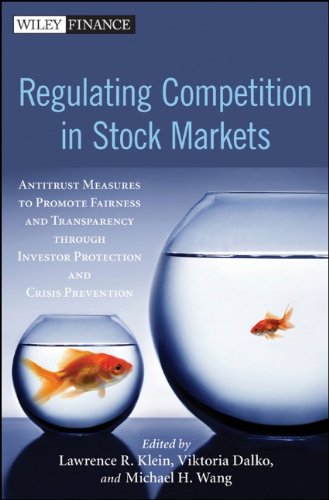
Regulating competition in stock markets antitrust measures to promote fairness and transparency through investor protection and crisis prevention 1st Edition by Lawrence Klein, Viktoria Dalko, Michael Wang ISBN 978-1118094815 1118094816


Original price was: $50.00.$35.00Current price is: $35.00.
Regulating competition in stock markets antitrust measures to promote fairness and transparency through investor protection and crisis prevention 1st Edition by Lawrence R. Klein , Viktoria Dalko , Michael H. Wang – Ebook PDF Instant Download/Delivery: 978-1118094815, 1118094816
Full download Regulating competition in stock markets antitrust measures to promote fairness and transparency through investor protection and crisis prevention 1st Edition after payment
Product details:
ISBN 10: 1118094816
ISBN 13: 978-1118094815
Author: Lawrence R. Klein , Viktoria Dalko , Michael H. Wang
A guide to curbing monopoly power in stock markets
Engaging and informative, Regulating Competition in Stock Markets skillfully analyzes the impact of the recent global financial crisis on health and happiness, and uses this opportunity to put regulatory systems in perspective. Happiness is lost because of emotional and physical health deterioration resulting from the crisis. Therefore, the authors conclude that financial crisis prevention should be the focus of public policy.
This book is the most comprehensive study so far on potential risks to the stock market, especially various forms of market manipulation that lead to mania and eventual crisis. Based on litigation cases from international stock markets, and borrowing multidisciplinary findings in the fields of finance, economics, accounting, media studies, criminology, legal studies, psychology, and medicine, this book is the first to provide thorough micro-level regulatory proposals rooted in financial reality. By focusing on securities trading, they apply antitrust measures to limiting monopolistic power that is used for the manipulation of investors’ perception and monopolistic profit. These proposals are quantifiable, adjustable, inexpensive, and can be easily implemented by any securities regulating agency for real-time oversight and daily operations.
- The recommendations found here are intended to improve the fairness and transparency of the financial markets, thereby perfecting the market competition, protecting investors, stabilizing the market, and preventing crises
- Explores how avoiding crises can to contribute to a more scientific, health aware, and civilized economic and social development
- Written by a team of authors who have extensive experience in this dynamic field, including Nobel Laureate Lawrence R. Klein
Since the founding of the first, organized stock exchange in Amsterdam 400 years ago, no systematic economic research results on stock markets have been implemented in stock market regulation around the world. Regulating Competition in Stock Markets aims to fill this void.
Table of contents:
Part 1. Happiness, Health, and Longevity during the 2008 Global Financial Crisis
Chapter 1. Does the Recent Financial Crisis Impact Health and Happiness?
Xin Yan, Lawrence R. Klein, Viktoria Dalko, Ferenc Gyurcsany, Michael H. Wang, and Christine Huang
-
Concepts of Happiness
-
The History of Modeling Health and Financial Crisis
-
Our Three Objectives
-
Our Financial Crisis–Impact Model
-
Results
-
Financial Crisis as a Major International Traumatic Event
-
Can We Just Wait for the Next Financial Crisis?
-
Notes
Chapter 2. Profound Unhappiness in the International Recession: The Case of Suicide in Industrialized Countries
M. Harvey Brenner
-
Background
-
Two Concepts of Happiness
-
A Psychological Viewpoint
-
Unhappiness, Hopelessness, and Depression
-
Hypothesis: Happiness as Accomplishment Predicts Happiness as Pleasure
-
Analysis
-
Conclusions
Part 2. Imperfect Competition and Antitrust Regulations in the Stock Markets
Chapter 3. Preventing Stock Market Crises (I): Regulating Shareholding Concentration
Xin Yan, Lawrence R. Klein, Viktoria Dalko, Ferenc Gyurcsany, and Michael H. Wang
-
Is Perfect Competition Possible in the Stock Market?
-
Concentration, Manipulation, and Monopoly
-
Can Stock Markets Still Be Manipulated?
-
Theoretical Literature on Market Manipulation
-
The Accumulation-Lift-Distribution (ALD) Scheme
-
Manipulative Objective of Each Stage of the ALD Scheme
-
Are Monopolistic Practices Involved in the ALD Scheme?
-
Antitrust Against ALD Manipulation
-
Existing Approach and Our Proposal
-
Regulatory Proposal: A Generic Recommendation
-
Benefits of Regulating Concentration
-
Concluding Remarks and Future Research
-
Notes
Chapter 4. Preventing Stock Market Crises (II): Regulating Trade-Based Price-Lifting
Xin Yan, Lawrence R. Klein, Viktoria Dalko, Ferenc Gyurcsany, and Michael H. Wang
-
Large Price Impact by Investors
-
Empirical Research on Volume-Based Price Impact
-
The SEBI Prosecution Cases
-
Manipulation Tactics in Price Lifting
-
Anatomy of an Investor’s Trades in a Stock
-
Unified Approach to Surveillance and Regulatory Measures
-
Selling Speed in Distribution and Short Selling
-
Concluding Remarks
-
Notes
Chapter 5. Preventing Stock Market Crises (III): Regulating Earnings Manipulation
Xin Yan, Lawrence R. Klein, Viktoria Dalko, Ferenc Gyurcsany, and Michael H. Wang
-
Importance of Earnings Information
-
Earnings Manipulation in Practice
-
Pervasiveness and Persistence of Earnings Manipulation
-
Auditors’ Failures
-
Proposals for Regulation
-
Concluding Remarks
-
Notes
Chapter 6. Preventing Stock Market Crises (IV): Regulating Trading by Corporate Insiders
Xin Yan, Lawrence R. Klein, Viktoria Dalko, Ferenc Gyurcsany, and Michael H. Wang
-
Purpose of Insider Trading
-
Link to Earnings Manipulation
-
Ineffective Regulation of Insider Trading
-
Information Monopoly and Asymmetry
-
Proposals for Regulation
-
Discussion of Proposed Measures
-
Conclusion
-
Notes
Chapter 7. Preventing Stock Market Crises (V): Regulating Information Manipulation by Sell-Side Analysts
Xin Yan, Lawrence R. Klein, Viktoria Dalko, Ferenc Gyurcsany, and Michael H. Wang
-
Role of Sell-Side Analysts
-
Value of Analysts’ Work
-
Public vs. Private Interests
-
Benefits to Issuers, Banks, and Brokerage Firms
-
Comparison with Corporate Insiders
-
Legal Difficulties
-
Regulatory Proposals and Discussion
-
Concluding Remarks
-
Notes
Chapter 8. Preventing Stock Market Crises (VI): Regulating Information-Based Manipulation
Xin Yan, Lawrence R. Klein, Viktoria Dalko, Ferenc Gyurcsany, and Michael H. Wang
-
Perception Manipulation
-
SEC Litigation Cases (1999–2009)
-
Information-Based Manipulation Schemes in Practice and on the Internet
-
Analysis of Schemes
-
Regulatory Recommendations
-
Information Monopoly in Reality
-
Concluding Remarks
-
A Perspective for Future Research
-
Notes
Chapter 9. Preventing Stock Market Crises (VII): Principles of Regulating News Reporting That Cultivates Long-Run Manias and Triggers Short-Run Panics
Xin Yan, Lawrence R. Klein, Viktoria Dalko, Ferenc Gyurcsany, and Michael H. Wang
-
Information Monopoly and Business News Reporting
-
Prolonged Mania in Stock Buying
-
Short-Run Impact of Business News
-
Why News Reporting Is Upward-Biased
-
Proposed Principles for Regulation of Journalists and Media
-
Empirical Research on Breaking News and Stock Markets
-
Trading Halts, Circuit Breakers, and Price Limits
-
Regulatory Principles for Breaking News
-
Concluding Remarks
People also search for:
a decrease in competition within an industry
a decrease in competition within an industry often results in
regulating competition in stock markets
laws regulating competition
competition regulation examples
Tags: Lawrence Klein, Viktoria Dalko, Michael Wang, Regulating competition, markets antitrust measures