
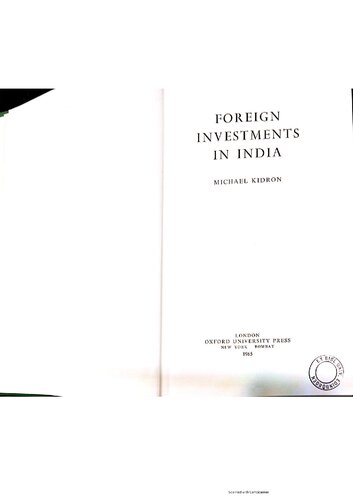
Foreign Investments In India The Rise of International Business 1st Edition by Michael Kidron ISBN 978-0415190404 0415190401


Original price was: $50.00.$35.00Current price is: $35.00.
Foreign Investments In India The Rise of International Business 1st Edition by Michael Kidron – Ebook PDF Instant Download/Delivery: 978-0415190404, 0415190401
Full download Foreign Investments In India The Rise of International Business 1st Edition after payment
Product details:
ISBN 10: 0415190401
ISBN 13: 978-0415190404
Author: Michael Kidron
First published in 2000. Routledge is an imprint of Taylor & Francis, an informa company.
Table of contents:
PART I-EMPIRE AND DECLINE
1. EMPIRE
I FOREIGN CAPITAL
(a) Distribution and domination
(b) Managing agency
(c) Interlocking character
(d) The use of indigenous capital
(e) The sources of power
II FOREIGN RULE
(a) Tariff policy
(b) Industrial policy
(c) Transport policy
(d) Monetary policy
(e) Staffing policy
(f)The Second World War
III INDIAN CAPITAL
(a) Spasmodic growth
(b) Unbalanced growth
(c) Concentration
(d) Diversification
(e) Technological backwardness
(f) Political and economic programmes
2. DECLINE OF EMPIRE
I INTERNATIONAL FACTORS
(a) Investment at home
The flow of capital
Identity of investors
Indian experience
(b) Trade
(c) Skills
II INDIAN COMPETITION
III INDEPENDENCE AND THE STATE
(a) Independence (b) State competition
Demand
Supply
(c) Regulation
PART 11-INDIAN AND FOREIGN CAPITAL
A HOSTILITY
PREPARING FOR WER
(a) Degrellenes of Peshitty
Discrimmalveys restrictions
(Some improteus of collaboration
(2) 2nd June
(4) Support of state enterprise
FROM INDEPENDENCE TO THE SECOND PLAN
(a) Domestic background
Partition
Industrial unrest
Government response
Congress propaganda and policy
Capital hesitant
Recovery 1953-
Decline in labour umrest
(5)
The diminishing stare
Setting the limits
Doctrinal retreat
Practical concessions
Private capital relenis
(c) Official policy towards foreign capital
Initial hostility
Change and its reasons
Change-free choice
New policy of encouragement
Lack of success (d) Neo-Swadeshism
Initial tolerance
Reaction to the new official policy
Climax 1952-3
Trend to liberalism
(e) Uneasy triangle
COLLABORATION
I INTERNATIONAL BACKGROUND
(a) Russian policy
(b) Western policy
(c) The flow of aid
II DOMESTIC BACKGROUND
SWING THE
(2) Background
(Pacers and Practice
(e) Economic strategy
IN SWING RIGHT
(a) Domestic opposition
(Climacteric 1957-8
(c)Abridgement of the public sector
(Encroachmerce by the private seeror
(e) Levlogical retreat
Plowing polished hardens
(e)
Indian capital responds
(4) Himalanan War
V GOVERNMENT AND FOREIGN CAPITAL
(a) Swing Left
(b) Swing Right
c) Non-alignment and its erities
State industry
Weakening foreign monopolies-oll
(d) Foreign critics
VI THE PRIVATE SECTOR
PART III-THE FOREIGN SECTOR TODAY
5. SCOPE AND IMPORTANCE OF FOREIGN INVESTMENT
1 SCOPE
(a) Volume
(b) Distribution
(c) Foreign-dominated industries
Plantations
Mining
Oil
Manufacturing industries
Services
Shipping
(d) Conclusions
II IMPORTANCE
(a) Scale of operations
(b) Relative profits, foreign and Indian
Official figures
Understatement of profits
Sources of higher profits
(c) Channels of influence
6. BEHAVIOUR OF FOREIGN CAPITAL
I NEW FOREIGN CAPITAL
(a) Size
(b) International scope and origins
(c) Manufacturing and technological bias
(d) The domestic market
xii
CONTENTS
THE INCENTIVE TO INVEST
(a) Profits at home and abroad International comparisons Sources of higher profits
(b) Defence of markets
(c) Subsidiary incentives
“Sweetener to government
Capital appreciation
Others
III THE INCENTIVE TO COLLABORATE
(a) Extent
(b) Government policy
(c) The need for intermediaries
(d) Rupee capital
(e) Sales outlets
(1) Sales of technique
(e) Acclimatization
(h) Staking a claim
Politics
IV THE LIMITS TO COLLABORATION
(a) Extent and growth of comrol
(b) Incentives to control
Specialization
Non-technical factors
(c) The Collaboration Agreement-instrument of control
(d) Methods of control
Ownership
Organization of research
Patents
Secrecy
Part production
Staffing
PART IV-CONCLUSIONS
7. THE COST TO INDIA
I THE FLOW OF PRIVATE CAPITAL
II EXCESS CAPITAL IMPORTS
(a) Evidence
(b) Marginal spheres
(c) Price mark-up
(d) Technology
(e) Duplication
(f) Government
III THE COST OF SERVICING
(a) Quantities
(b) Effect on the balance of payments
(c) Inflexible foreign exchange cost
(d) Paucity of foreign exchange receipts
CONTENTS
IV THE TERMS OF TRADE
TECHNOLOGICAL DEPENDENCE
VI UNEMPLOYMENT
VII PLANNING
VIII AGRICULTURE
IX ROLE OF THE STATE
(a) Shield for Indian capital
(b) Cold War brokerage
(e) Domestic brokerage
APPENDIXES
1. BRITISH MANAGING AGENCIES 1938-62
2. INDUSTRIAL DISPUTES 1945-63
3. ECONOMIC INDICATORS
(a) Index numbers of industrial production 1946-63
(b) Capital issues consents 1950-62
(c) Issue in the private sector of fresh capital by public companies, 1945/6-1963
(d) Index numbers of variable dividend industrial securities-All-India, 1945/6-1963/4
(e) Gross capital formation in the private corporate sector, 1948/9-1960/1
Trade balance, 1948/9-1963/4
(e) Import of cereals on government account, 1946-62
(h) Net terms of trade, 1948/9-1961/2
(i) Foreign exchange reserves, 1947/8-1962/3
4. BUDGETARY POSITION OF THE GOVERNMENT OF INDIA, 1948/9-1964/5
People also search for:
major foreign investments in india
types of foreign investments in india
tax on foreign investors in india
what are the top 5 foreign investments in india
foreign investments in india 2024
Tags: Michael Kidron, Foreign Investments, India The Rise, International Business