
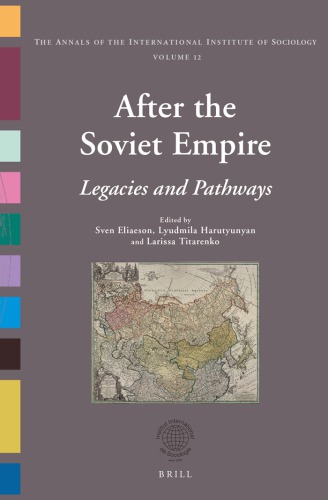
After the Soviet Empire Legacies and Pathways Annals of the International Institute of Sociology 12 1st Edition by Sven Eliaeson , Lyudmila Harutyunyan , Larissa Titarenko ISBN 900429144X 978-9004291447


Original price was: $50.00.$35.00Current price is: $35.00.
After the Soviet Empire Legacies and Pathways Annals of the International Institute of Sociology 12 1st Edition by Sven Eliaeson , Lyudmila Harutyunyan , Larissa Titarenko – Ebook PDF Instant Download/Delivery:900429144X ,978-9004291447
Full download After the Soviet Empire Legacies and Pathways Annals of the International Institute of Sociology 12 1st Edition after payment
Product details:
ISBN 10: 900429144X
ISBN 13: 978-9004291447
Author: Sven Eliaeson , Lyudmila Harutyunyan , Larissa Titarenko
The break-up of the Soviet Union is a key event of the twentieth century. The 39th IIS congress in Yerevan 2009 focused on causes and consequences of this event and on shifts in the world order that followed in its wake. This volume is an effort to chart these developments in empirical and conceptual terms. It has a focus on the lands of the former Soviet Union but also explores pathways and contexts in the Second World at large.
The Soviet Union was a full scale experiment in creating an alternative modernity. The implosion of this union gave rise to new states in search of national identity. At a time when some observers heralded the end of history, there was a rediscovery of historical legacies and a search for new paths of development across the former Second World.
In some parts of this world long-repressed legacies were rediscovered. They were sometimes, as in the case of countries in East Central Europe, built around memories of parliamentary democracy and its replacement by authoritarian rule during the interwar period. Some legacies referred to efforts at establishing statehood in the wake of the First World War, others to national upheavals in the nineteenth century and earlier.
In Central Asia and many parts of the Caucasus the cultural heritage of Islam in its different varieties gave rise to new markers of identity but also to violent contestations. In South Caucasus, Georgia, Armenia and Azerbaijan have embarked upon distinctly different, but invariably contingent, paths of development. Analogously core components of the old union have gone through tumultuous, but until the last year and a half largely bloodless, transformations. The crystallization of divergent paths of development in the two largest republics of that union, i.e. Russia and Ukraine, has ushered in divergent national imaginations but also in series of bloody confrontations.
Table of contents:
PART I. UTILITY OF THE CLASSICS
-
The Significance of Myrdal for Post-1989 Transformations: His Apocryphal Letters — Sven Eliaeson
-
On some Observations by Max Weber about Long-Term Structural Features of Russian Policy — Karl-Ludwig Ay
-
Pre- and Post-Revolutionary Situations. Legitimation of Authority and of Social Change in the Perspective of Classical Sociological Theory: The Cases of Russia and France — Christopher Schlembach
-
Heidegger within the Boundaries of Mere Reason: “Nihilism” as a Contemporary Critical Narrative? — Jon Wittrock
-
To Build a Nation: Alva Myrdal and the Role of Family Politics in the Transformation of Sweden in the 1930s — Hedvig Ekerwald
PART II. RETHINKING THE LEGACY OF THE SECOND WORLD
-
Eastern Europe as a Laboratory for Social Sciences — Nikolai Genov
-
Decommunisation and Democracy. Transitional Justice in Post-Communist Central-Eastern Europe — Adam Czarnota
-
The Large Second World and Necessary Shifts in Research Approaches to Macrosocial Dynamics — Nikolai S. Rozov
-
Zig-Zag Post-Soviet Paths to Democracy — Larissa Titarenko
PART III. THE CAUCASUS: ARMENIA AS A CASE STUDY OF THE IMPLOSION OF THE SOVIET EMPIRE
-
After the Empire: The Migration in the Post-Soviet Space — Lyudmila Harutyunyan & Maria Zaslavskaya
-
The Geography of Nationalism: Post-Soviet Reality as Post-Colonial Reality — Antranig Kasbarian
-
Symbolic Geography: Geography as a Symbol in the Post-Soviet South Caucasus — Hayk Demoyan
-
Playing Democracy: Some Peculiarities of Political Mentality and Behaviour in the Post-Communist Countries — Arthur Atanesyan
-
Globalization and Neo-Liberalism: Their Opponents and Their Application to Armenia — Levon Chorbajian
-
European Values and Cultural Identity in the Context of Social Psychological Transformations: Case of Armenia — Gohar Shahnazaryan
PART IV. WIDENING THE HORIZONS
-
Patterns of contentious activity — Henryk Domanski
-
(Im)Migrants’ Diverse Identities and Their Impact on Host-Society Ideas and Practices of National Membership — Ewa Morawska
-
The Past as Present: Foreign Relations and Russia’s Politics of History — Igor Torbakov
-
Varieties of Cosmopolitanism — Klaus Müller
People also search for:
after the soviet union
after the collapse of communism comparative lessons of transition
the soviet union and europe after 1945
describe the aftermath of the fall of the soviet union