
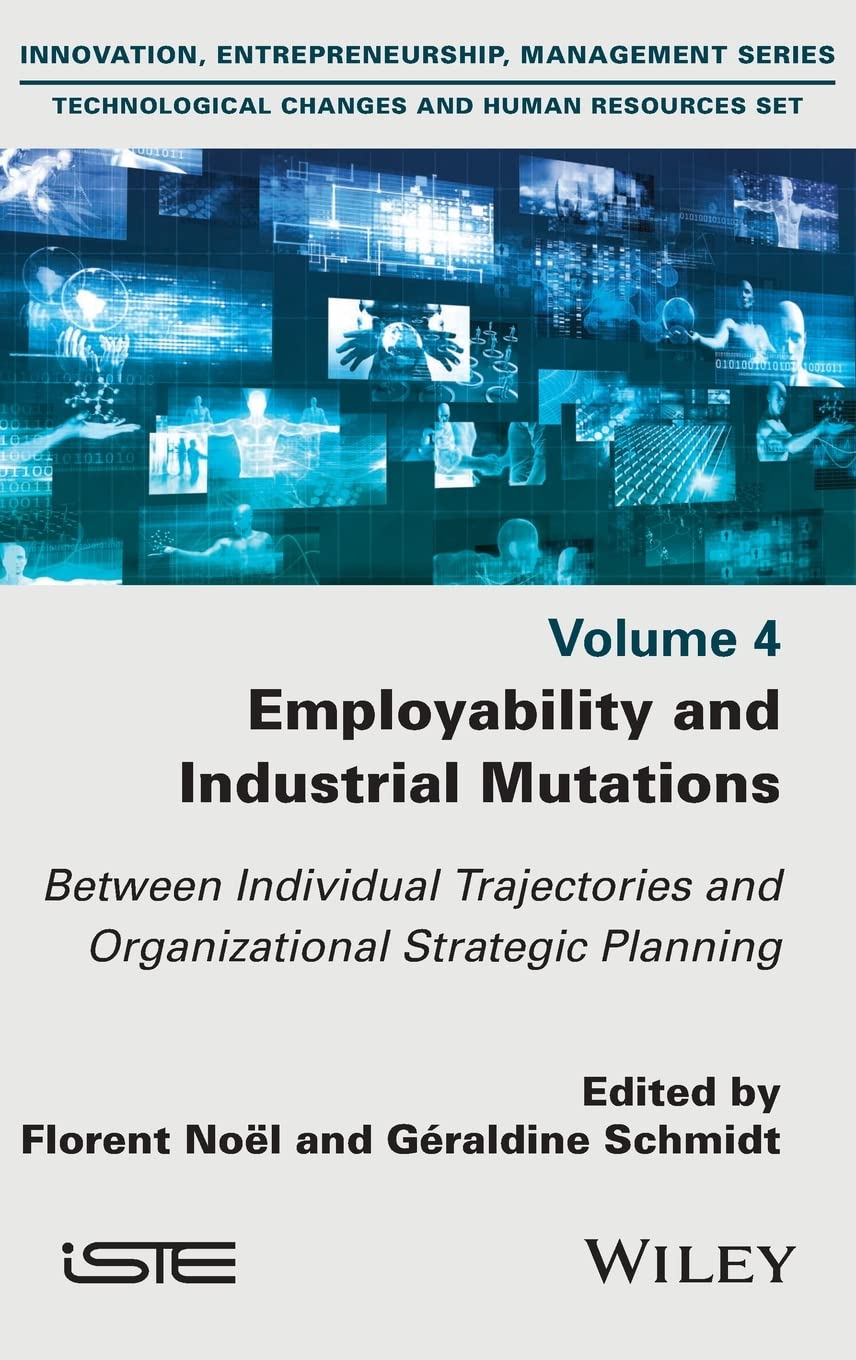
Employability and Industrial Mutations Between Individual Trajectories and Organizational Strategic Planning 1st Edition by Florent Noel ISBN 178630743X 978-1786307439


Original price was: $50.00.$35.00Current price is: $35.00.
Employability and Industrial Mutations Between Individual Trajectories and Organizational Strategic Planning 1st Edition by Florent Noel – Ebook PDF Instant Download/Delivery: 178630743X, 978-1786307439
Full download Employability and Industrial Mutations Between Individual Trajectories and Organizational Strategic Planning 1st Edition after payment
Product details:
ISBN 10: 178630743X
ISBN 13: 978-1786307439
Author: Florent Noel
Table of contents:
Part 1 Towards a General Theory of Employability.
Introduction to Part 1
Bernard GAZIER
Chapter 1. Employability and Public Policy: A Century-long Learning Process and Unfinished Process.
Bernard GAZIER
1.1. One hundred years of trial and error between the individual and the collective:
seven operational definitions of employability.
1.1.1. Seven versions in three waves during the 20th century
1.1.2. From static to dynamic and from unilateral to interactive.
1.2. Current tensions and recompositions.
1.2.1. “Profiling”, from contextual calibration to negotiated interaction
1.2.2. Employability between individual capacity and collective construction.
1.3. Conclusion
1.4. References
Chapter 2. Employability as a Managerial Imperative?..
Florent Noël and Géraldine Schmidt
2.1. Employability and change: the migration of a concept.
2.1.1. Employability, a matter of public policy
2.1.2. Employability as an employer’s responsibility in managing restructuring
2.1.3. Employability as an individual responsibility
2.1.4. Employability for the development of organizations and individuals?.
2.2. Employability management practices
2.2.1. Assessing employability
2.2.2. Developing employability
2.3. Conclusion.
2.4. References
Chapter 3. Capability-based Employability: A Total
Organizational Fact.
Benedicte ZIMMERMANN
3.1. Employability: being able and enabled to
3.1.1. Qualification, skills and competence: what it means to be capable.
3.1.2. Being able to: a condition for the exercise of responsibility
3.2. Skill-based employability, capability-based employability
3.2.1. Employability based on skill maintenance
3.2.2. Employability based on skill development
3.2.3. Employability based on capability.
3.3. A total organizational fact.
3.4. The five traits of the capability-enhancing organization
3.5. Conclusion
3.6. References
Part 2. Employability and Individual Trajectories.
Introduction to Part 2.
Pauline de Becdelievre
Chapter 4. The “Unemployable”: Different Figures, Between Societal Construction and Unconscious Meanings
Raymonde Ferrandi
4.1. People who are not allowed to work.
4.1.1. Migrants.
4.1.2. Persons reaching the age limit.
4.1.3. People who are still off work or declared unfit by the occupational physician
4.2. Discriminated audiences
4.2.1. Situations of discrimination in the texts.
4.2.2. Situations on the ground often ignored or denied
4.3. Audiences for cognitive remediation.
4.3.1. From the children of the Shoah to the young people of the “neighborhoods”
4.3.2. Interest and limits of the analysis in terms of “deprivation”
4.4. People who “suffer” in social work through their work
4.4.1. The unconscious and the law of repetition – the transference.
4.4.2. Transfer to the social scene and work.
4.4.3. The “opportunities” offered by the context.
4.4.4. A perpetual misunderstanding.
4.5. The generation of refusal
4.5.1. A self-definition that no longer necessarily involves work
4.5.2. The refusal of suffering at work
4.6 . Conclusion discussion.
4.6.1. Audiences, people and problems?.
4.6.2. Personal characteristics and contextual factors.
4.6.3. Evolution over time.
4.6.4. Taking invisible tools seriously
4.7. References
Chapter 5. Staying in the Game: Employability and Mobile Careers in the IT Industry
Pauline DE BECDELIÈVRE, Jean-Yves OTTMANN, and Cindy FELIO
5.1. Independence as the pinnacle of a boundaryless career orientation.
5.1.1. The choice of independence
5.1.2. Career opportunities
5.2. Maintaining employability as a condition of independence
5.2.1. Employability development
5.2.2. Choice of mission and employability
5.3. Boundaryless career success and employability.
5.3.1. A “cognitive compass”?
5.3.2. What are the factual orientations of their careers?
5.4. Conclusion.
5.4.1. Contributions and research avenues.
5.4.2. Openings and societal issues..
5.5. References
Chapter 6. Employability in the Era of Digitization of Jobs.
Martina GIANECCHINI, Paolo GUBITTA and Sara DoTTo
6.1. Introduction
6.2. Skills for the contemporary labor market
6.2.1. The T-shaped professionals
6.2.2. Employability in the changing labor market
6.2.3. Technological change and work design.
6.3. Research methods
6.3.1. Research setting and sample.
6.3.2. Variables.
6.3.3. Data analysis
6.4. Findings
6.5. Discussions and directions for future research
6.6. References
Part 3. Career Stages, HRM and Employability
Introduction to Part 3..
Benoît Grasser
Chapter 7. The MRS, a Device in Favor of Employability and Social Performance.
Anne-Laure Gatignon-Turnau and Séverine Ventolini
7.1. The MRS as a partnership practice.
7.1.1. The MRS from the point of view of Pôle emploi: placing the long-term unemployed..
7.1.2. The MRS from an organizational perspective: mass recruitment for jobs under pressure
7.1.3. The MRS from the candidate’s perspective: getting back into the labor market
7.2. MRS and employability.
7.2.1. Employability as a type of psychological contract.
7.2.2. The MRS as a mechanism for the new psychological contract.
7.2.3. The effects of MRS recruitment on employee loyalty.
7.3. Survey and main findings on MRS recruitment.
7.3.1. Survey protocol.
7.3.2. Socio-demographic characteristics of recruited candidates
7.3.3. The results of the survey: the conditions for the MRS to be a positive HR lever.
7.4. Discussion and conclusion of the results.
7.4.1. Benefits of the MRS in terms of commitment
7.4.2. Recruitment and employer brand
7.5. References
Chapter 8. Recruiting in Innovative Activities: From the Impossible Search for a Match to the Construction of Employability
Thierry COLIN, Benoît GRASSER and Fabien MEIER
8.1. Recruiting for an innovative activity in a context of rapid growth in production.
8.1.1. Initial situation and issues
8.1.2. The external dimension of the system: broadening and qualifying the recruitment base
8.1.3. The internal dimension of the system: design of a formalized tutoring approach.
8.2. The effects and actual functioning of these devices.
8.2.1. The central role of teaching tools
8.2.2. A multiplication of singular tutor-learner relationships.
8.2.3. Impact of the system on the rules of collective action.
8.3. Lessons learned in terms of employability
8.3.1. Employability, a convention to be imagined, negotiated and implemented.
8.3.2. Employability, an approach that goes beyond the search for a match between needs and resources
8.3.3. Employability, a construction around a double frontier: internal/external and training/production
8.4. Conclusion
8.5. References
Chapter 9. Reclassification and Employability: A Reading in Terms of Boundary Objects.
Eve SAINT-GERMES
9.1. Social support for company liquidations: a collective actor for the employability of those made redundant.
9.2. Studying the boundary objects of the reclassification of victims of collective dismissals
9.3. Study of an emblematic case, the reclassification cell of the Air Littoral liquidation PSE.
9.4. The boundary objects of the reclassification of victims of the Air Littoral PSE.
9.4.1. The boundary between the reclassification cell and the monitoring committee: negotiating the means, standards and results of reclassification
9.4.2. The reclassification cell individual boundary: managing categories and assessing situations.
9.5. Discussion: the infrastructure of individual and collective employability in
reclassification
9.5.1. The infrastructure for translating individual employability: profiling a psychological state and a personal situation
9.5.2. The negotiated infrastructure of collective employability: contested categories that make the unsupported invisible
9.6. Conclusion
9.7. References
Chapter 10. Being Employable, a Matter of Context.
Sara DOTTO, Patrick GILBERT, Florent NOËL and Nathalie RAULET-CROSET
10.1. Employability, an imperative between universalism and
contingency
10.1.1. The employable individual: an exceptional being?.
10.1.2. Being employable: a matter of context
10.1.3. A conventionalist interpretation of employability
10.2. Results.
10.2.1. Fabdièse: employability in the industrial world.
10.2.2. Servinfo: employability in the commercial world
10.2.3. Aidiance: employability in the interpersonal world
10.3. Conclusion
10.4. References
Part 4. Employability and Work Situations
Introduction to Part 4..
Nathalie RAULET-CROSET
Chapter 11. What are the Possible Futures in the Factories of the Future? The Case of Operators in an Aeronautics Company.
Emmanuelle GARBE and Jérémy VIGNAL
11.1. Review of the literature
11.1.1. Factories of the future: characteristics and challenges of ongoing digital transformations.
11.1.2. Digital transformation of industry and skills: the case of operators.
11.2. Methodology
11.3. Results.
11.3.1. Between skills upgrading and deskilling: a polarization that can be observed within the operator population itself..
11.3.2. Between skills upgrading and deskilling: is there a “third way” in the factories of the future?.
11.3.3. Faced with digital transformation: what HR support for operators?
11.4. Conclusion
11.5. References
Chapter 12. Digital Technologies as a Lever for Developing the Employability of Middle Managers
Anne-Laure DELAUNAY
12.1. The employability of middle managers.
12.2. Digital technology and employability of middle managers.
12.3. Research context.
12.4. Data collection and analysis.
12.5. Main results.
12.5.1. Result 1: an opportunity to tinker
12.5.2. Result 2: an opportunity to develop technical and managerial expertise
12.5.3. Result 3: digital technology as a barrier to employability?
12.6. Discussion.
12.6.1. Digital technologies and managerial leeway
12.6.2. Towards an enabling environment: digital and DIY
12.7. Conclusion
12.8. References
Chapter 13. Work as a Factor of Integration and Employability: The Case of Trisociété
Emmanuelle Begon and Michel Parlier
13.1. From employability controversies to the study problem
13.2 Professional integration and production requirements: the case of Trisociété.
13.2.1. Presentation of the case
13.2.2. Remarkable elements of the Trisociété experience.
13.3. Discussion: from employability to “employerability”.
13.3.1. Axis 1: production requirements and quality of working conditions
13.3.2. Axis 2: organizational and managerial support.
13.3.3. Axis 3: speaking work
13.3.4. Axis 4: professional support for career paths
13.3.5. Axis 5: business agility
13.4. Conclusion
13.5. References
People also search for:
questions about employability skills
quotes about employability
information about employability skills
employability skills and the future of work
employability after graduation
Tags: Florent Noel, Employability and Industrial, Between Individual