
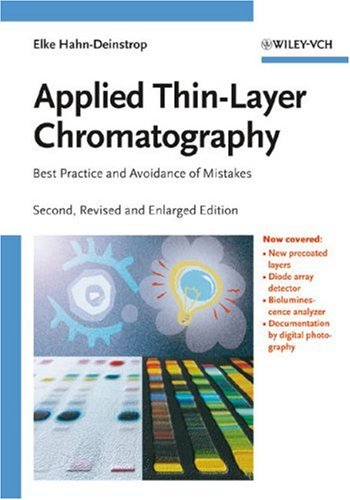
Applied Thin Layer Chromatography Best Practice and Avoidance of Mistakes 2nd Edition by Hahn Deinstrop Elke ISBN 3527315536 978-3527315536

Original price was: $50.00.$35.00Current price is: $35.00.
Applied Thin Layer Chromatography Best Practice and Avoidance of Mistakes 2nd Edition by Hahn-Deinstrop Elke – Ebook PDF Instant Download/Delivery: 3527315536, 978-3527315536
Full download Applied Thin Layer Chromatography Best Practice and Avoidance of Mistakes 2nd Edition after payment
Product details:
ISBN 10: 3527315536
ISBN 13: 978-3527315536
Author: Hahn-Deinstrop Elke
Thin-layer chromatography (TLC) is a powerful, fast and inexpensive analytical method. It has proven its usefulness in pharmaceutical, food and environmental analysis. This new edition of the practical TLC guide features a completely revised chapter on documentation, now including the use of digital cameras. Selected new sorbents and instruments are also introduced.
Why has the prior edition been successful? All steps of the analytical procedure are clearly explained, starting with the choice of a suitable TLC technique and ending with data evaluation and documentation. Special emphasis is put on the proper choice of materials for TLC. Properties and functions of various materials and the TLC equipment are described, covering e.g. precoated layers, solvents and developing chambers, including information on suppliers. Many practical hints for trouble shooting are given. All this is illustrated with numerous coloured figures.
How to use TLC in compliance with GLP/GMP regulations is described in detail, including the required documentation. Therefore the reader can very easily compile his own standard operating procedures.
Table of contents:
-
Introduction
-
What Does TLC Mean?
-
When Is TLC Used?
-
Where Is TLC Used?
-
How Is the Result of a TLC Represented?
-
What Kinds of Reference Substances Are Used in TLC?
-
The Literature on TLC
-
Precoated Layers
-
Precoated Layers—Why?
-
How Are Precoated Layers Produced?
-
What Types of Precoated Layers Are There?
-
What Are the Uses of Precoated Layers?
-
Criteria for the Selection of Stationary Phases in TLC
-
Effect of the Stationary Phase When Mobile Phases Are Identical
-
Advice on the Ordering and Storage of Precoated Layers
-
Problems in the Naming and Arrangement of Precoated Layers
-
Before the TLC Development Process
-
Handling of Precoated Layers
-
Prewashing
-
Activation
-
Conditioning
-
Impregnation
-
Application of Samples
-
Positioning of the Samples
-
Drying Before the Development
-
Solvent Systems, Developing Chambers and Development
-
Solvent Systems
-
TLC Developing Chambers
-
Development of Thin-Layer Chromatograms
-
Drying After Development
-
Evaluation Without Derivatization
-
Direct Visual Evaluation
-
Direct Optical Evaluation Using Instruments
-
Diode-Array Detection
-
Coupled Methods for Substance Identification
-
Documentation Without or Before Derivatization
-
Derivatization
-
Thermochemical Reaction
-
Irradiation with High-Energy Light
-
Reaction with Reagents
-
Special Cases of Derivatization
-
Further Treatment of Derivatized Chromatograms
-
Evaluation After Derivatization
-
Visual Evaluation
-
Evaluation Using a TLC Scanner
-
Evaluation Using a Video System
-
Evaluation by Flat-Bed Scanner
-
Evaluation Using a Digital Camera
-
Documentation
-
Description of a Thin-Layer Chromatogram
-
Documentation by Drawing, Tracing and Photocopying
-
Photographic Documentation
-
Video Documentation
-
Documentation With Digital Cameras
-
TLC Scanner Documentation
-
Flat-Bed Scanner Documentation
-
Bioluminescence Measurements
-
GMP/GLP-Conforming Operations in TLC
-
Validation of TLC Methods
-
Use of Qualified/Calibrated Equipment
-
GMP/GLP-Conforming Raw Data Sheets
-
Examples of GMP/GLP-Conforming Testing Procedures (TPs)
-
Effects of Stress
-
Controlled Stress on a Substance
-
TLC-Sensitive Substances
-
Special Methods in TLC
-
AMD—Automated Multiple Development
-
OPLC—Overpressured Layer Chromatography
-
HPPLC—High Pressure Planar Liquid Chromatography
-
TLC-FID/FTID—Combination of TLC and Flame-Ionization Detector or Flame-Thermionic Ionization Detector
-
TLC-NDIR
-
RPC—Rotation Planar Chromatography
-
Appendix
-
CHROMart
-
References
-
Abbreviations
-
Acknowledgements
-
Market Overview
-
Photograph Section
-
Subject Index
People also search for:
applied thin-layer chromatography best practice and avoidance of mistakes
applied thin layer chromatography elke hahn deinstrop
thin layer chromatography btec applied science
thin layer chromatography applied science
how does thin layer chromatography work
Tags: Hahn Deinstrop Elke, Applied Thin Layer, Chromatography Best Practice, Avoidance of Mistakes