
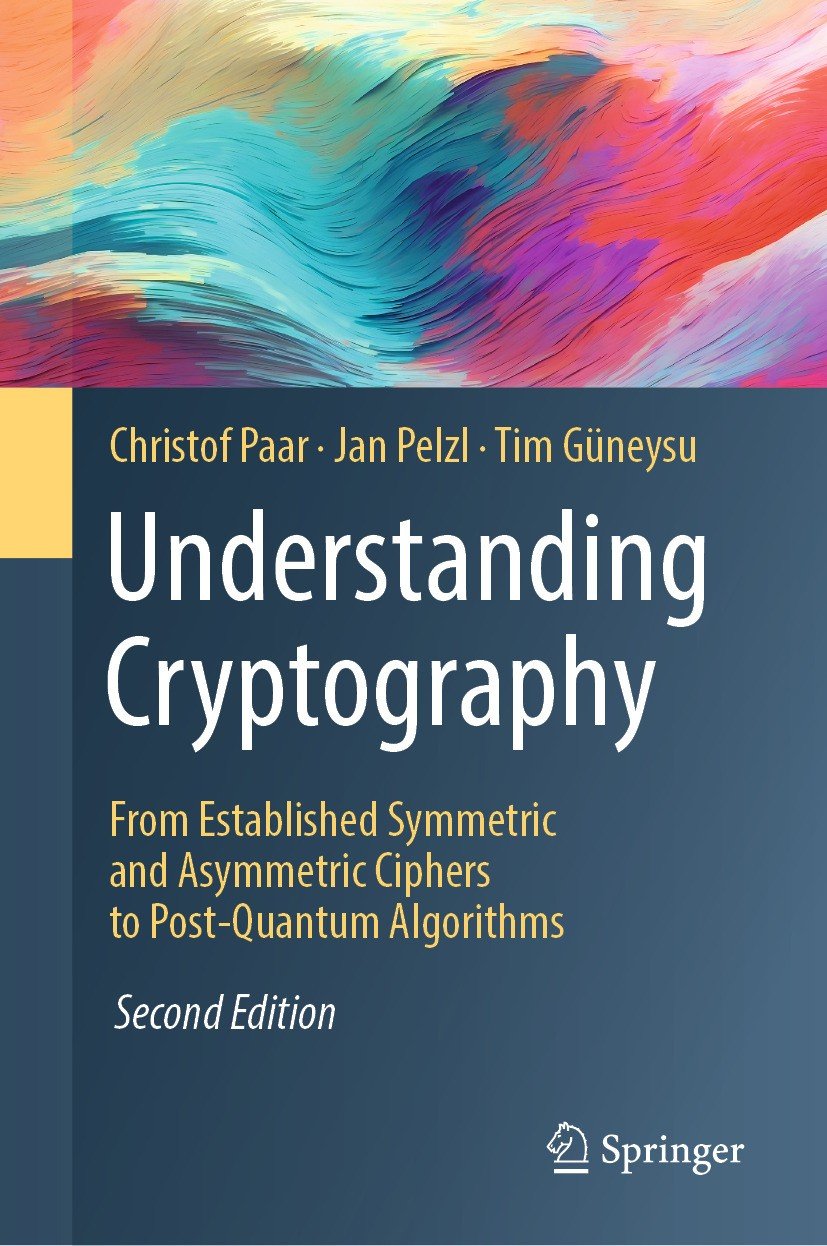
Understanding Cryptography From Established Symmetric and Asymmetric Ciphers to Post Quantum Algorithms 2nd Edition by Christof Paar, Jan Pelzl, Tim Güneysu ISBN 978-3662690062 3662690063


Original price was: $50.00.$35.00Current price is: $35.00.
Understanding Cryptography From Established Symmetric and Asymmetric Ciphers to Post Quantum Algorithms 2nd Edition by Christof Paar, Jan Pelzl, Tim Güneysu- Ebook PDF Instant Download/Delivery: 978-3662690062, 3662690063
Full download Understanding Cryptography From Established Symmetric and Asymmetric Ciphers to Post Quantum Algorithms 2nd Edition after payment
Product details:
ISBN 10: 3662690063
ISBN 13: 978-3662690062
Author: Christof Paar, Jan Pelzl, Tim Güneysu
Understanding and employing cryptography has become central for securing virtually any digital application, whether user app, cloud service, or even medical implant.
Heavily revised and updated, the long-awaited second edition of Understanding Cryptography follows the unique approach of making modern cryptography accessible to a broad audience, requiring only a minimum of prior knowledge. After introducing basic cryptography concepts, this seminal textbook covers nearly all symmetric, asymmetric, and post-quantum cryptographic algorithms currently in use in applications―ranging from cloud computing and smart phones all the way to industrial systems, block chains, and cryptocurrencies.
Topics and features:
Opens with a foreword by cryptography pioneer and Turing Award winner, Ron Rivest
Helps develop a comprehensive understanding of modern applied cryptography
Provides a thorough introduction to post-quantum cryptography consisting of the three standardized cipher families
Includes for every chapter a comprehensive problem set, extensive examples, and a further-reading discussion
Communicates, using a unique pedagogical approach, the essentials about foundations and use in practice, while keeping mathematics to a minimum
Supplies up-to-date security parameters for all cryptographic algorithms
Incorporates chapter reviews and discussion on such topics as historical and societal context
This must-have book is indispensable as a textbook for graduate and advanced undergraduate courses, as well as for self-study by designers and engineers.
The authors have more than 20 years’ experience teaching cryptography at various universities in the US and Europe. In addition to being renowned scientists, they have extensive experience with applying cryptography in industry, fromwhich they have drawn important lessons for their teaching.
Table of contents:
1 Introduction to Cryptography and Data Security
1.1 Overview of Cryptology (and This Book)
1.2 Symmetric Cryptography
1.2.1 Basics.
1.2.2 Simple Symmetric Encryption: The Substitution Cipher
1.3 Cryptanalysis
1.3.1 General Thoughts on Breaking Cryptosystems.
1.3.2 How Many Key Bits Are Enough?
1.4 Modular Arithmetic and More Historical Ciphers.
1.4.1 Modular Arithmetic
1.4.2 Integer Rings..
1.4.3 Shift Cipher (or Caesar Cipher)
1.4.4 Affine Cipher
1.5 Discussion and Further Reading
1.6 Lessons Learned
Problems
2 Stream Ciphers
2.1 Introduction
2.1.1 Stream Ciphers vs. Block Ciphers
2.1.2 Encryption and Decryption with Stream Ciphers 2.2 Random Numbers and an Unbreakable Stream Cipher.
2.2.1 Random Number Generators.
2.2.2 The One-Time Pad.
2.2.3 Towards Practical Stream Ciphers
2.3 Shift Register-Based Stream Ciphers
2.3.1 Linear Feedback Shift Registers (LFSRs)
2.3.2 Known-Plaintext Attack Against Single LFSRS
2.4 Practical Stream Ciphers
2.4.1 Salsa20
2.4.2 ChaCha
2.4.3 Trivium
2.5 Discussion and Further Reading
2.6 Lessons Learned
Problems
3 The Data Encryption Standard (DES) and Alternatives.
3.1 Introduction to DES
3.1.1 Confusion and Diffusion
3.2 Overview of the DES Algorithm
3.3 Internal Structure of DES
3.3.1 Initial and Final Permutation
3.3.2 The f Function
3.3.3 Key Schedule
3.4 Decryption
3.5 Security of DES
3.5.1 Exhaustive Key Search
3.5.2 Analytical Attacks
3.6 Implementation in Software and Hardware
3.7 Alternatives
3.7.1 The Advanced Encryption Standard (AES) and the AES Finalist Ciphers
3.7.2 Triple DES (3DES) and DESX
3.7.3 Lightweight Cipher PRESENT
3.8 Discussion and Further Reading
3.9 Lessons Learned
Problems
4 The Advanced Encryption Standard (AES)
4.1 Introduction
4.2 Overview of the AES Algorithm
4.3 Some Mathematics: A Brief Introduction to Galois Fields
4.3.1 Existence of Finite Fields
4.3.2 Prime Fields
4.3.3 Extension Fields GF (2)
4.3.4 Addition and Subtraction in GF (2)
4.3.5 Multiplication in GF(2)
4.3.6 Inversion in GF (2″)..
4.4 Internal Structure of AES
4.4.1 Byte Substitution Layer
4.4.2 Diffusion Layer.
4.4.3 Key Addition Layer
4.4.4 Key Schedule
4.5 Decryption
4.6 Implementation in Software and Hardware
4.7 Discussion and Further Reading
4.8 Lessons Learned
Problems
5 More About Block Ciphers
5.1 Modes of Operation for Encryption and Authentication
5.1.1 Electronic Codebook Mode (ECB).
5.1.2 Cipher Block Chaining Mode (CBC) and Initialization Vectors
5.1.3 Output Feedback Mode (OFB)
5.1.4 Cipher Feedback Mode (CFB)
5.1.5 Counter Mode (CTR).
5.1.6 XTS-AES
5.2 Exhaustive Key Search Revisited
5.3 Increasing the Security of Block Ciphers
5.3.1 Double Encryption and Meet-in-the-Middle Attack.
5.3.2 Triple Encryption
5.3.3 Key Whitening
5.4 Discussion and Further Reading
5.5 Lessons Learned
Problems
6 Introduction to Public-Key Cryptography
6.1 Symmetric vs. Asymmetric Cryptography
6.2 Practical Aspects of Public-Key Cryptography
6.2.1 Security Mechanisms.
6.2.2 The Remaining Problem: Authenticity of Public Keys
6.2.3 Important Public-Key Algorithms
6.2.4 Key Lengths and Security Levels
6.3 Essential Number Theory for Public-Key Algorithms
6.3.1 Euclidean Algorithm
6.3.2 Extended Euclidean Algorithm
6.3.3 Euler’s Phi Function
6.3.4 Fermat’s Little Theorem and Euler’s Theorem
6.4 Discussion and Further Reading
6.5 Lessons Learned
Problems
7 The RSA Cryptosystem
7.1 Introduction
7.2 Encryption and Decryption
7.3 Key Generation and Proof of Correctness
7.4 Encryption and Decryption: Fast Exponentiation
7.5 Speed-Up Techniques for RSA
7.5.1 Fast Encryption with Short Public Exponents
7.5.2 Fast Decryption with the Chinese Remainder Theorem
7.6 Finding Large Primes
7.6.1 How Common Are Primes?.
7.6.2 Primality Tests
7.7 RSA in Practice: Padding
7.8 Key Encapsulation.
7.9 Attacks
7.10 Implementation in Software and Hardware
7.11 Discussion and Further Reading
7.12 Lessons Learned
Problems
8 Cryptosystems Based on the Discrete Logarithm Problem
8.1 Diffie-Hellman Key Exchange
8.2 Some Abstract Algebra..
8.2.1 Groups.
8.2.2 Cyclic Groups
8.2.3 Subgroups
8.3 The Discrete Logarithm Problem
8.3.1 The Discrete Logarithm Problem in Prime Fields.
8.3.2 The Generalized Discrete Logarithm Problem
8.3.3 Attacks Against the Discrete Logarithm Problem.
8.4 Security of the Diffie-Hellman Key Exchange
8.5 The Elgamal Encryption Scheme
8.5.1 From Diffie-Hellman Key Exchange to Elgamal Encryption
8.5.2 The Elgamal Protocol
8.5.3 Computational Aspects
8.5.4 Security
8.6 Discussion and Further Reading
8.7 Lessons Leamed
Problems
9 Elliptic Curve Cryptosystems
9.1 How to Compute with Elliptic Curves
9.1.1 Definition of Elliptic Curves..
9.1.2 Group Operations on Elliptic Curves
9.2 Building a Discrete Logarithm Problem with Elliptic Curves
9.3 Diffie-Hellman Key Exchange with Elliptic Curves
9.4 Security
9.5 Implementation in Software and Hardware
9.6 Discussion and Further Reading
9.7 Lessons Leamed
Problems
10 Digital Signatures
10.1 Introduction
10.1.1 Odd Colors for Cars, or: Why Symmetric Cryptography Is Not Sufficient
10.1.2 Principles of Digital Signatures
10.1.3 Security Services
10.1.4 Applications of Digital Signatures
10.2 The RSA Signature Scheme
10.2.1 Schoolbook RSA Digital Signature
10.2.2 Computational Aspects
10.2.3 Security
10.3 The Elgamal Digital Signature Scheme
10.3.1 Schoolbook Elgamal Digital Signature
10.3.2 Computational Aspects
10.3.3 Security
10.4 The Digital Signature Algorithm (DSA).
10.4.1 The DSA Algorithm
10.4.2 Computational Aspects
10.4.3 Security
10.5 The Elliptic Curve Digital Signature Algorithm (ECDSA)
10.5.1 The ECDSA Algorithm
10.5.2 Computational Aspects
10.5.3 Security
10.6 Discussion and Further Reading
10.7 Lessons Learned
Problems
11 Hash Functions
11.1 Motivation: Signing Long Messages
11.2 Security Requirements of Hash Functions
11.2.1 Preimage Resistance or One-Wayness
11.2.2 Second Preimage Resistance or Weak Collision Resistance
11.2.3 Collision Resistance and the Birthday Attack
11.3 Overview of Hash Algorithms
11.3.1 Hash Functions from Block Ciphers
11.3.2 The Dedicated Hash Functions SHA-1, SHA-2 and SHA-3
11.4 The Secure Hash Algorithm SHA-2
11.4.1 SHA-256 Preprocessing.
11.4.2 The SHA-256 Compression Function
11.4.3 Implementation in Software and Hardware
11.5 The Secure Hash Algorithm SHA-3
11.5.1 High-Level View of SHA-3
11.5.2 Suffix, Padding and Output Generation
11.5.3 The Function Keccak-f (or the Keccak-f Permutation)
11.5.4 Other Cryptographic Functions Based on Keccak
11.5.5 Implementation in Software and Hardware
11.6 Discussion and Further Reading
11.7 Lessons Learned
Problems
12 Post-Quantum Cryptography.
12.1 Introduction
12.1.1 Quantum Computing and Cryptography
12.1.2 Quantum-Secure Asymmetric Cryptosystems.
12.1.3 The Use of Uncertainty in Cryptography
12.2 Lattice-Based Cryptography
12.2.1 The Learning With Errors (LWE) Problem
12.2.2 A Simple LWE-Based Encryption System
12.2.3 The Ring Learning With Errors Problem
12.2.4 Ring-LWE Encryption Scheme.
12.2.5 LWE in Practice
12.2.6 Final Remarks.
12.3 Code-Based Cryptography
12.3.1 Linear Codes.
12.3.2 The Syndrome Decoding Problem
12.3.3 Encryption Schemes.
12.3.4 Suitable Choices of Codes
12.3.5 Final Remarks
12.4 Hash-Based Cryptography
12.4.1 One-Time Signatures
12.4.2 Many-Time Signatures.
12.4.3 Final Remarks
12.5 PQC Standardization.
12.6 Discussion and Further Reading
12.7 Lessons Learned
Problems
13 Message Authentication Codes (MACs)
13.1 Principles of Message Authentication Codes
13.2 MACs from Hash Functions: HMAC
13.3 MACs from Block Ciphers.
13.3.1 CBC-MAC
13.3.2 Cipher-based MAC (CMAC)
13.3.3 Authenticated Encryption: The Counter with Cipher Block Chaining-Message Authentication Code (CCM)
13.3.4 Authenticated Encryption: The Galois Counter Mode (GCM)4
13.3.5 Galois Counter Message Authentication Code (GMAC)
13.4 Discussion and Further Reading
13.5 Lessons Learned
Problems
14 Key Management
14.1 Introduction
14.2 Key Derivation.
14.3 Key Establishment Using Symmetric-Key Techniques
14.3.1 Key Establishment with a Key Distribution Center
14.3.2 Needham-Schroeder Protocol
14.3.3 Remaining Problems with Symmetric-Key Distribution
14.4 Key Establishment Using Asymmetric Techniques.
14.4.1 Man-in-the-Middle Attack.
14.4.2 Certificates
14.5 Public-Key Infrastructures (PKIs) and CAs
14.5.1 Certificate Chains.
14.5.2 Certificate Revocation
14.6 Practical Aspects of Key Management
14.7 Discussion and Further Reading
14.8 Lessons Learned
People also search for:
understanding cryptography
check your understanding cryptography
christof parr’s understanding cryptography
paar pelzl understanding cryptography
understanding cryptography solutions
Tags: Christof Paar, Jan Pelzl, Tim Güneysu, Understanding Cryptography, From Established, Asymmetric Ciphers