
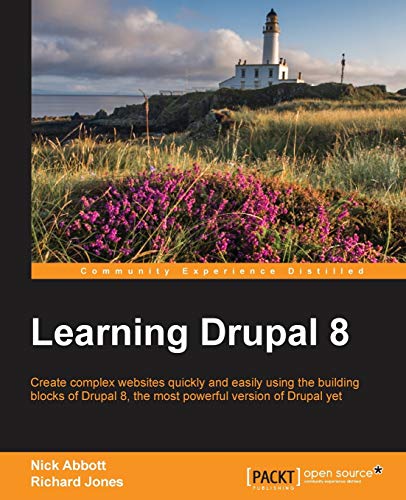
Learning Drupal 8 1st Edition by Richard Jones, Nick Abbott ISBN 978-1782168751 1782168753


Original price was: $50.00.$35.00Current price is: $35.00.
Learning Drupal 8 1st Edition by Richard Jones, Nick Abbott – Ebook PDF Instant Download/Delivery: 978-1782168751, 1782168753
Full download Learning Drupal 8 1st Edition after payment
Product details:
ISBN 10: 1782168753
ISBN 13: 978-1782168751
Author: Richard Jones, Nick Abbott
Create complex websites quickly and easily using the building blocks of Drupal 8, the most powerful version of Drupal yet
Key Features:
Build complete, complex websites with no prior knowledge of web development entirely using the intuitive Drupal user interface
Follow a practical case study chapter-by-chapter to construct a complete website as you progress
Ensure your sites are modern, responsive and mobile-friendly through utilizing the full features available in Drupal 8
Book Description:
Drupal 8 sets a new standard for ease of use, while offering countless new ways to tailor and deploy your content to the Web. Drupal 8 allows user to easily customize data structures, listings, and pages, and take advantage of new capabilities for displaying data on mobile devices, building APIs, and adapting to multilingual needs.
The book takes you step by step through building a Drupal 8 website. Start with the basics, such as setting up a local “stack” development environment and installing your first Drupal 8 site, then move on to image and media handling, and extending Drupal modules. Push your knowledge by getting to grips with the modular nature of Drupal, and learning to extend it by adding new functionalities to create your new modules. By the end of the book, you will be able to develop and manage a modern and responsive website using Drupal.
What You Will Learn:
Set up a local “stack” development environment and install your first Drupal 8 site
Find out what is available in Drupal 8 core
Define content types and taxonomies-and find out when you should do so
Use the powerful Views module
Get hands-on with image and media handling
Extend Drupal using custom community modules
Develop the look and feel of your website using Drupal themes
Manage site users and permissions
Who this book is for:
If you want to learn to use Drupal 8 for the first time, or you are transitioning over from a previous version of Drupal, this is the book for you. No knowledge of PHP, MySQL, or HTML is assumed or required
Table of contents:
Chapter 1: Introduction
What is Drupal?
Dynamic web pages a brief history
Enter the database
A worldwide community
The success of Drupal
Multiple systems integration
Technical debt
Developer knowledge
Modularity
There’s a module for that
Some Drupal history
Language choice
Is Drupal a framework or platform?
Embracing other communities’ frameworks
How an open source community works
Summary
Chapter 2: Installation
System requirements
PHP
Web server options
Database options
Browser options
Setting up a development environment
Free cloud hosting
Acquia Dev Desktop
Installing Drupal 8
Configuring your Drupal 8 site
Troubleshooting your installation
Memory settings
PHP timeouts
Trusted host patterns
Summary
Chapter 3: Basic Concepts
Modules
Core and contrib modules
Where the core modules live
Where your extension modules should live
An example community module
Evaluating new modules
Documentation
Module versions
Entities, nodes, and fields
Entities
Nodes
Node types
Fields
Adding new fields
Field types
Field settings
Field widgets
Form display
Managing the form display
Managing field display
Drupal 8 core entity types
Taxonomy
Fixed terms versus or tags
Blocks
Views
Users, roles, and permissions
Themes
Administration themes
Base themes and subthemes
Hooks
Summary
Chapter 4: Getting Started with the Ul
The Drupal 8 user interface
Logging out
Logging in
Front page
Repositioning the tray
Responsiveness
Administration theme
Contextual links
Quick content creation
Listing content
Revisiting the home page
Structure
Block layout
Comment types
Contact forms
Personal contact form
Content types
Customizing a content type
Customizing fields
Customizing content entry screens
Customizing the display
Display modes
View modes
Form modes
Menus
Taxonomy
Views
Configuration
Appearance
People
Reports
Extend
Summary
Chapter 5: Basic Content
Introducing your site-building scenario
Types of content
Pages
Articles
Clients
Services
Testimonials
FAQS
Contact information
SEO considerations
Basic pages
Creating a new page
Title
Body
Body field summary
Adding a page to the main navigation menu
Adding more pages
Articles
Creating a new article
Front page promotion
Adjusting the settings for a content type
Disabling front page promotion
Adjusting comment settings
Disabling future comments
No retrospective action
Retrospective action
Removing all comments and the ability to comment
Summary
Chapter 6: Structure
Managing menus
Reorganizing menu items
Editing menu items
Managing taxonomy
Creating a new Taxonomy vocabulary
Re-ordering Taxonomy terms
Apply a taxonomy vocabulary to content types
Adjusting the order of fields when editing
Categorizing content
Viewing categorized content
Segregating article types using taxonomy
Creating another taxonomy vocabulary
Working with the Views module
Creating a Views-powered News page
View wizard
Filtering to News only
Creating a blog page
Working with Views blocks
Creating blocks using Views
Placing the News blocks
Block position
Block visibility
Summary
Chapter 7: Advanced Content
Field types
Extending content types
Adjusting field settings
Forcing the Article type field to be mandatory
Adjusting edit form settings
Placeholder text
Customizing view modes
Removing the labels and fields from the display
Controlling image size using styles
Creating new content types
Creating the Client content type
Inherited fields
Adding a logo field
Linking clients to their web sites
Providing an e-mail address for a Client
Providing a telephone number for a Client
Marking a Client as high profile
Attaching taxonomy
Adjusting field display settings
Adding a sorted client list to the Clients page
Views sort criteria
Adding a pager to your view
Creating the Service content type
Enabling the linking of Services to Clients
Displaying services listing using Views
Creating the Testimonial content type
Listing testimonials with a view
Creating a grouped view
The FAQ content type
Content type settings
Field settings
Display settings
Creating the simple FAQ page
Adding interactive querying to a view
Summary
Chapter 8: Configuration
People – Account settings
Contact settings
Anonymous users
Administrator role
Registration and cancellation
Enable password strength indicator
Account cancelation behavior
Notification e-mail address
Emails
System
Site information
Cron
Content authoring
Text formats and editors
User interface
Shortcuts
Development
Performance
Caching
Clear cache
Bandwidth optimization
Logging and errors
Maintenance mode
Configuration synchronization
Media
File system
Image styles
Image toolkit
Search and metadata
Indexing progress
Indexing throttle
Default indexing settings
Logging
Search pages
URL Aliases
Regional and language
Regional settings
Date and time formats
People also search for:
learning drupal 9 as a framework
learning drupal as a framework
drupal learning curve
drupal learning curve meme
drupal learning management system
Tags: Richard Jones, Nick Abbott, Learning Drupal