
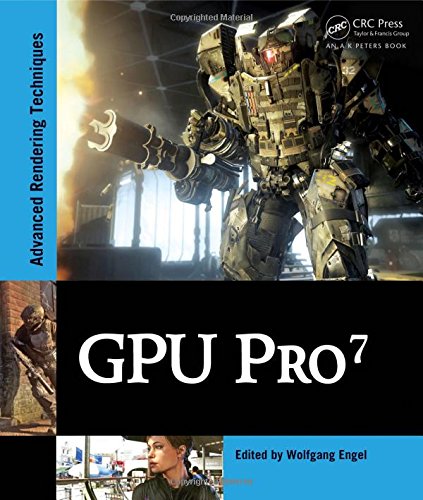
GPU Pro 7 Advanced Rendering Techniques 1st Edition by Wolfgang Engel ISBN 149874253X 978-1498742535
Original price was: $50.00.$35.00Current price is: $35.00.
GPU Pro 7 Advanced Rendering Techniques 1st Edition by Wolfgang Engel – Ebook PDF Instant Download/Delivery: 149874253X, 978-1498742535
Full download GPU Pro 7 Advanced Rendering Techniques 1st Edition after payment
Product details:
ISBN 10: 149874253X
ISBN 13: 978-1498742535
Author: Wolfgang Engel
The latest edition of this bestselling game development reference offers proven tips and techniques for the real-time rendering of special effects and visualization data that are useful for beginners and seasoned game and graphics programmers alike.
Exploring recent developments in the rapidly evolving field of real-time rendering, GPU Pro 7: Advanced Rendering Techniques assembles a high-quality collection of cutting-edge techniques for advanced graphics processing unit (GPU) programming. It incorporates contributions from more than 30 experts who cover the latest developments in graphics programming for games and movies.
The book covers advanced rendering techniques that run on the DirectX or OpenGL runtimes, as well as on any other runtime with any language available. It details the specific challenges involved in creating games across the most common consumer software platforms such as PCs, video consoles, and mobile devices.
The book includes coverage of geometry manipulation; rendering techniques, handheld devices programming, effects in image space, lighting, 3D engine design, graphics-related tools, and environmental effects. It also includes a dedicated section on general purpose GPU programming that covers CUDA and DirectCompute examples.
In color throughout, GPU Pro 7 presents ready-to-use ideas and procedures that can help solve many of your daily graphics programming challenges. Example programs with downloadable source code are also provided on the book’s CRC Press web page.
Table of contents:
1. GEOMETRY MANIPULATION
1.1. Deferred Snow Deformation in Rise of the Tomb Raider (Anton Kai Michels and Peter Sikachev)
1.1.1. Introduction
1.1.2. Terminology
1.1.3. Related Work
1.1.4. Snow Deformation: The Basic Approach
1.1.5. Deferred Deformation
1.1.6. Filling the Trail over Time
1.1.7. Hardware Tessellation and Performance
1.1.8. Future Applications
1.1.9. Acknowledgements
1.1.10. Bibliography
1.2. Catmull–Clark Subdivision Surfaces (Wade Brainerd)
1.2.1. Introduction
1.2.2. The Call of Duty Method
1.2.3. Regular Patches
1.2.4. Irregular Patches
1.2.5. Filling Cracks
1.2.6. Going Further
1.2.7. Conclusion
1.2.8. Acknowledgments
1.2.9. Bibliography
2. LIGHTING
2.1. Clustered Shading: Assigning Lights Using Conservative Rasterization in DirectX 12 (Kevin Örtegren and Emil Persson)
2.1.1. Introduction
2.1.2. Conservative Rasterization
2.1.3. Implementation
2.1.4. Shading
2.1.5. Results and Analysis
2.1.6. Conclusion
2.1.7. Bibliography
2.2. Fine Pruned Tiled Light Lists (Morten S. Mikkelsen)
2.2.1. Overview
2.2.2. Introduction
2.2.3. Our Method
2.2.4. Implementation Details
2.2.5. Engine Integration
2.2.6. Results
2.2.7. Conclusion
2.2.8. Acknowledgments
2.2.9. Bibliography
2.3. Deferred Attribute Interpolation Shading (Christoph Schied and Carsten Dachsbacher)
2.3.1. Introduction
2.3.2. Algorithm
2.3.3. Implementation
2.3.4. Results
2.3.5. Conclusion
2.3.6. Bibliography
2.4. Real-Time Volumetric Cloudscapes (Andrew Schneider)
2.4.1. Overview
2.4.2. Introduction
2.4.3. Cloud Modeling
2.4.4. Cloud Lighting
2.4.5. Cloud Rendering
2.4.6. Conclusion and Future Work
2.4.7. Acknowledgments
2.4.8. Bibliography
3. RENDERING
3.1. Adaptive Virtual Textures (Ka Chen)
3.1.1. Introduction
3.1.2. Procedural Virtual Textures Basics
3.1.3. Adaptive Virtual Textures
3.1.4. Virtual Texture Best Practices
3.1.5. Conclusion
3.1.6. Bibliography
3.2. Deferred Coarse Pixel Shading (Rahul P. Sathe and Tomasz Janczak)
3.2.1. Overview
3.2.2. Introduction and Background
3.2.3. Algorithm
3.2.4. Performance
3.2.5. Conclusion
3.2.6. Bibliography
3.3. Progressive Rendering Using Multi-Frame Sampling (Daniel Limberger, Karsten Tausche, Johannes Linke, and Jürgen Döllner)
3.3.1. Introduction
3.3.2. Approach
3.3.3. Multi-Frame Rendering Techniques
3.3.4. Conclusion and Future Work
3.3.5. Bibliography
4. MOBILE DEVICES
4.1. Efficient Soft Shadows Based on Static Local Cubemap (Sylwester Bala and Roberto Lopez Mendez)
4.1.1. Overview
4.1.2. Introduction
4.1.3. Algorithm Overview
4.1.4. What Is a Local Cubemap?
4.1.5. Creating a Shadow Cubemap
4.1.6. Applying Shadows
4.1.7. Smoothness
4.1.8. Combining the Shadow Technique with Others
4.1.9. Performance and Quality
4.1.10. Future Work
4.1.11. Conclusion
4.1.12. Bibliography
4.2. Physically Based Deferred Shading on Mobile (Ashley Vaughan Smith and Mathieu Einig)
4.2.1. Introduction
4.2.2. Physically Based Shading
4.2.3. An Efficient Physically Based Deferred Renderer
4.2.4. Experiments
4.2.5. Conclusion and Future Work
4.2.6. Bibliography
5. 3D ENGINE DESIGN
5.1. Interactive Cinematic Particles (Homam Bahnassi and Wessam Bahnassi)
5.1.1. Introduction
5.1.2. Background
5.1.3. Challenges and Previous Work
5.1.4. Interactive Cinematic Particles (ICP) System Outline
5.1.5. Data Authoring Workflow
5.1.6. Offline Build Process
5.1.7. Runtime Execution
5.1.8. Additional Notes
5.1.9. Conclusion
5.1.10. Acknowledgment
5.1.11. Bibliography
5.2. Real-Time BC6H Compression on GPU (Krzysztof Narkowicz)
5.2.1. Introduction
5.2.2. BC6H Details
5.2.3. Compression Algorithm
5.2.4. Results
5.2.5. Possible Extensions
5.2.6. Conclusion
5.2.7. Acknowledgments
5.2.8. Bibliography
5.3. A 3D Visualization Tool Used for Test Automation in the Forza Series (Gustavo Bastos Nunes)
5.3.1. Introduction
5.3.2. Collision Mesh Issues
5.3.3. Detecting the Issues
5.3.4. Visualization
5.3.5. Navigation
5.3.6. Workflow
5.3.7. Conclusion
5.3.8. Acknowledgments
5.3.9. Bibliography
5.4. Semi-Static Load Balancing for Low Latency Ray Tracing on Heterogeneous Multiple GPUs (Takahiro Harada)
5.4.1. Introduction
5.4.2. Load Balancing Methods
5.4.3. Semi-Static Load Balancing
5.4.4. Results and Discussion
5.4.5. Acknowledgment
5.4.6. Bibliography
6. COMPUTE
6.1. Octree Mapping from a Depth Camera (Dave Kotfis and Patrick Cozzi)
6.1.1. Overview
6.1.2. Previous Work and Limitations
6.1.3. Octree Scene Representation
6.1.4. Rendering Techniques
6.1.5. Results
6.1.6. Conclusion and Future Work
6.1.7. Acknowledgment
6.1.8. Bibliography
6.2. Interactive Sparse Eulerian Fluid (Alex Dunn)
6.2.1. Overview
6.2.2. Introduction
6.2.3. GPU Eulerian Fluid Simulation
6.2.4. Simulation Stages
6.2.5. Problems
6.2.6. Latency Resistant Sparse Fluid Simulation
6.2.7. Performance
6.2.8. Sparse Volume Rendering
6.2.9. Results
6.2.10. Conclusion
6.2.11. Bibliography
People also search for:
gpu pro 7 advanced rendering
gpu pro 7 advanced rendering techniques
gpu pro 7 advanced rendering techniques pdf
gpu rendering arnold
gpu pro 5
Tags:
Wolfgang Engel,GPU Pro 7,Advanced Rendering