
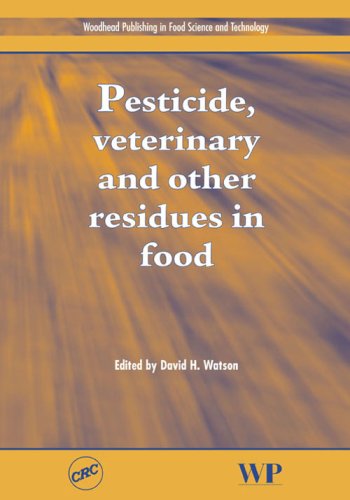
Pesticide veterinary and other residues in food 1st Edition by D Watson ISBN 978-1855737341 1855737345
Original price was: $50.00.$35.00Current price is: $35.00.
Pesticide veterinary and other residues in food 1st Edition by D Watson- Ebook PDF Instant Download/Delivery: 978-1855737341, 1855737345
Full download Pesticide veterinary and other residues in food 1st Edition after payment
Product details:
ISBN 10: 1855737345
ISBN 13: 978-1855737341
Author: D Watson
This wide-ranging text reviews the wealth of recent research on assessing and managing the risks from pesticide, veterinary and other chemical residues in food. After an introductory chapter on the key issues in food toxicology,
Part one covers the assessment and management of risks, with individual chapters on genetic susceptibility to dietary carcinogens, good agricultural practice and HACCP systems, targeted and rapid methods for analysing residues in food and ways of assessing the mutagenicity of chemicals in food. Part two looks at veterinary residues, covering their safety, toxicology and detection. Part three examines pesticides, with chapters on surveillance and detection methods for fungicides and herbicides. In the final part, there are chapters summarising a wide range of other chemical residues in food, from xenostrogens/endocrine disruptors and dietary estrogens to polycyclic aromatic hydrocarbons, dioxins and polychlorinated biphenyls.
Pesticide, veterinary and other residues in food is a standard reference for all those concerned with ensuring the safety of food.
Reviews residue detection, risk assessment and risk management
Extensive coverage of chemical residues
Indispensable resource for all food producers
Table of contents:
1 Introduction to food toxicology
S. T. Omaye, University of Nevada, USA
1.1 Introduction: defining food toxicology
1.2 Types of toxicant: contaminants
1.3 Types of toxicant: naturally-occurring toxicants
1.4 Types of toxicant: food processing toxicants
1.5 Current issues: pathogens, genetic variability and antibiotic resistance
1.6 Current issues: novel foods and natural toxicants
1.7 Conclusions
1.8 References
Part I Assessing and managing risks
2 Genetic susceptibility to dietary carcinogens
S. Peterson, J. W. Lampe and D. L. Eaton, University of Washington and Fred Hutchinson Cancer Research Center, USA
2.1 Introduction: diet and cancer
2.2 Dietary carcinogens and anticarcinogens: mycotoxins, heterocyclic amines, aromatic hydrocarbons, N-nitroso compounds and phytochemicals
2.3 Genetic influences on carcinogen-metabolizing enzymes
2.4 Evidence of gene-diet interactions
2.5 Summary and future trends
2.6 Sources of further information and advice
2.7 References
3 Assessing the mutagenicity of chemicals in food: the case of pesticides
J. M. Parry, University of Wales – Swansea, UK
3.1 Introduction: mutagenicity test programmes
3.2 Criteria for the testing of pesticides
3.3 Selecting appropriate tests
3.4 Assessing dose-response relationships
3.5 Developing test methodologies
3.6 Conclusions
3.7 Acknowledgements
3.8 References and further reading
4 The impact of chemical residues: the case of polychlorinated biphenyls (PCBs)
H. Gallagher, I. E. J. De Souza and C. M. Regan, University College Dublin, Ireland
4.1 Introduction: risks posed by organohalogen compounds
4.2 Organohalogens as neurotoxins
4.3 Neurobehavioural consequences of PCB exposure
4.4 Molecular mechanisms of organohalogen-induced toxicity
4.5 Conclusion
4.6 Acknowledgements
4.7 References
5 Targeted and rapid methods in analysing residues in food
E. P. Meulenberg, ELTI Support, The Netherlands;
M. M. Rhemrev-Boom, ResQ Lab, The Netherlands; and
C. G. J. Koopal, TNO Nutrition and Food Research, The Netherlands
5.1 Introduction
5.2 The principles of immunoassays
5.3 The use of immuno-affinity chromatography
5.4 Developing immunoassays to detect residues in food and water
5.5 Recent developments in immunoassays
5.6 Recent developments in immuno-affinity chromatography
5.7 The use of immunosensors in residue analysis
5.8 References
6 Good agricultural practice and HACCP systems in the management of pesticides and veterinary residues on the farm
R. Early, Harper Adams University College, UK
6.1 Introduction
6.2 Safety issues in the food supply chain
6.3 Good agricultural practice
6.4 The Hazard Analysis Critical Control Point (HACCP) system
6.5 The HACCP study
6.6 Implementing and maintaining HACCP systems
6.7 Future trends
6.8 Conclusion
6.9 Acknowledgements
6.10 Sources of further information and advice
6.11 References and bibliography
Part II Veterinary residues
7 Assessing the safety of veterinary drug residues
K. N. Woodward, International Federation for Animal Health, Belgium
7.1 Introduction
7.2 Types of toxicity study
7.3 Elaboration of maximum residue limits (MRLs) for veterinary drugs in the EU
7.4 Elaboration of MRLs for particular foods in the EU
7.5 International regulation: the role of the Joint Expert Committee on Food Additives (JECFA)
7.6 Conclusions
7.7 References
8 The toxicity of particular veterinary drug residues
K. N. Woodward, International Federation for Animal Health, Belgium
8.1 Introduction
8.2 Griseofulvin
8.3 B-Lactam antibiotics: penicillins and cephalosporins
8.4 Macrolide antibiotics: spiramycin, tylosin and tilmicosin
8.5 Aminoglycosides
8.6 Fluoroquinolones
8.7 Sulfadimidine (sulfamethazine)
8.8 Carbadox and olaquindox
8.9 Furazolidone and related compounds
8.10 Chloramphenicol
8.11 Ivermectin and related compounds
8.12 Tranquillisers: xylazine and azaperone
8.13 Carazolol
8.14 Conclusions
8.15 References
9 The rapid detection of veterinary drug residues
N. van Hoof, K. de Wasch, H. Noppe, S. Poelmans and
H. F. de Brabender, University of Ghent, Belgium
9.1 Introduction
9.2 Veterinary medicinal products
9.3 Methods for detecting residues
9.4 Validating detection methods
9.5 Rapid on-line confirmation of different veterinary residues
9.6 Future trends
9.7 Acknowledgements
9.8 References
10 New techniques for the rapid detection of growth promoters in farm animals
E. Magner and M. Jamal, University of Limerick, Ireland
10.1 Introduction: detecting the use of growth promoters
10.2 Existing detection techniques and their limitations
10.3 The use of immunosensors to detect growth promoters
10.4 Key issues in developing new biosensors
10.5 References
11 The rapid detection of coccidiostat drug residues in farm animals
M. Tuomola and T. Lövgren, University of Turku, Finland
11.1 Introduction
11.2 The use of anticoccidial drugs in poultry farming
11.3 The use of time-resolved fluoroimmunoassays (TR-FIAS)
11.4 Screening for coccidiostat residues by automated TR-FIAS
11.5 Future trends
11.6 Acknowledgement
11.7 References
Part III Pesticides
12 Surveillance for pesticide residues
C. K. Winter, University of California – Davis, USA
12.1 Introduction
12.2 Pesticide regulation in the United States
12.3 Sample collection, preparation and analysis
12.4 Results from pesticide residue surveillance programs
12.5 Interpreting the results of pesticide residue surveillance programs
Cone
12.6 Future trends
12.7 Sources of further information and advice
12.8 References
13 The rapid detection of pesticide residues
R. Luxton and J. Hart, University of the West of England, UK
13.1 Introduction
13.2 Detecting pesticides: physicochemical methods
13.3 Detecting pesticides: biological methods
13.4 The principles of biosensors
13.5 Developing low-cost biosensors
13.6 Using biosensors: pesticide residues in grain, fruit and vegetables
13.7 Future trends
13.8 Sources of further information and advice
13.9 Further reading
14 Detecting residues of urea and carbamate pesticides
Y. Picó, G. Font and J. Mañes, University of Valencia, Spain
14.1 Introduction: key issues in detection
14.2 Sample preparation
14.3 Techniques for rapid screening of samples
14.4 Separation techniques
14.5 Detectors used in combination with separation techniques
14.6 Future trends
14.7 Sources of further information and advice
14.8 References
15 Detecting fungicide residues
M. M. Sheehan, H. Berney and A. Matthewson, University College Cork, Ireland
15.1 Introduction
15.2 Conventional techniques and immunoassays for detecting fungicide residues
15.3 Detecting fungicide residues using biosensors
15.4 Conclusions
15.5 Sources of further information and advice
15.6 Acknowledgements
15.7 References
16 Detecting herbicide residues
J. L. Tadeo, C. Sánchez-Brunete and B. Albero, INIA, Spain
16.1 Introduction: key issues in detecting herbicide residues in food
16.2 Trends in sample preparation
16.3 Analytical methods for particular herbicide residues
16.4 Levels of herbicide residues found in food
16.5 Sources of further information and advice
16.6 References
Part IV Other chemical residues in food
17 Xenoestrogens
I. Shaw, University of Canterbury, New Zealand; B. Thompson and P. Cressey, Institute of Environmental Science and Research, New Zealand
17.1 Introduction
17.2 Mechanism of action of xenoestrogens
17.3 Assays for xenoestrogens
17.4 Measuring risks from different xenoestrogens
17.5 Health effects of xenoestrogens
17.6 Xenoestrogens in food and levels of dietary intake
17.7 Regulatory control of xenoestrogens
17.8 Future trends
17.9 Sources of further information and advice
17.10 Acknowledgement
17.11 References
18 Dietary estrogens
S. Hendrich, Iowa State University, USA
18.1 Introduction: defining dietary estrogens
18.2 The range of dietary estrogens
18.3 Assessing the estrogenicty of dietary estrogens
18.4 Assessing the toxicity of dietary estrogens
18.5 The benefits of dietary estrogens: cancer prevention
18.6 The benefits of dietary estrogens: preventing osteoporosis and atherosclerosis
18.7 Dietary intakes of estrogens
18.8 Future trends and sources of further information and advice
18.9 References
19 Polycyclic aromatic hydrocarbons (PAHs)
K. Tamakawa, Sendai City Institute of Public Health, Japan
19.1 Introduction
19.2 Physical and chemical properties of PAHs
19.3 Health effects of PAHs
19.4 Analytical methods for PAHs
19.5 The occurrence of PAHs in food
19.6 Future trends
Contents
19.7 Sources of further information and advice
19.8 Acknowledgements
19.9 References
20 Dioxins and Polychlorinated biphenyls (PCBs)
L. A. P. Hoogenboom, RIKILT Institute of Food Safety, The Netherlands
20.1 Introduction
20.2 Dioxins and PCBs
20.3 Assessing the toxic effects of dioxins and dioxin-like PCBs
20.4 Analytical methods and current exposure levels
20.5 Brominated flame retardants
20.6 Abbreviations
20.7 References
21 Detecting organic contaminants in food: the case of fish and shellfish
S. Van Leeuwen and J. de Boer, Netherlands Institute for Fisheries Research
21.1 Introduction: the problem of organic contaminants
21.2 Sources of organic contaminants
21.3 Organic contaminants in fish
21.4 Analysing particular organic contaminants in fish
21.5 Health issues for organic contaminants in fish
21.6 Future trends
21.7 Sources of further information and advice
21.8 References
22 Identifying allergenic proteins in food
E. N. Clare Mills, J. A. Jenkins and J. A. Robertson, Institute of Food Research, UK; S. Griffiths-Jones, Wellcome Trust Sanger Institute, UK; and P. R. Shewry, Institute of Arable Crops Research, UK
22.1 Introduction: the nature of allergens and allergies
22.2 Types of plant food allergens and their characteristics
22.3 Identifying potentially allergenic proteins: bioinformatics
22.4 Identifying potentially allergenic proteins: resistance to pepinolysis and IgE reactivity
22.5 Future trends
22.6 Acknowledgements
22.7 References
23 Toxicological screening of paper and board packaging
A. von Wright, University of Kuopio, Finland
23.1 Introduction
23.2 Regulatory background
23.3 Requirements for toxicological testing
23.4 Cycotoxicity tests
23.5 Genotoxicity tests
23.6 Applying tests to paper and board
23.7 Conclusions and future trends
23.8 References
24 Detecting metal contamination
R. Monoro and D. Vélrez, Institute of Agrochemistry and Technology
Alimentos (CSIC), Spain
24.1 Introduction
24.2 Methods of preparing food samples for analysis
24.3 Analytical methods for metal detection
24.4 Cadmium speciation in food
24.5 Lead speciation in food
24.6 Mercury speciation in food
24.7 Arsenic speciation in food
24.8 Future trends
24.9 References
25 Mycotoxins: detection and control
M. Miriglia, F. Debegnach and C. Brera, Italian National
Institute for Health
25.1 Introduction
25.2 Types of mycotoxin found in food and animal feed
25.3 Risk management and control of mycotoxins in food
25.4 Sampling for mycotoxins
25.5 Standardization of methods for detecting mycotoxins
25.6 The range of analytical methods for mycotoxins
25.7 Dealing with mycotoxins in developing countries
25.8 References
People also search for:
7 pesticide
vt pesticide programs
vt pesticide registration
vt pesticide license
u p veterinary hospital
Tags: D Watson, Pesticide veterinary, other residues