
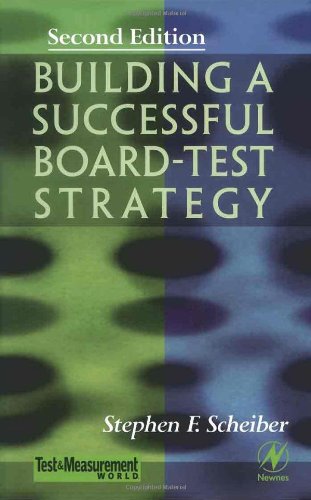
Building a Successful Building a Successful Second Edition by Stephen Scheiber ISBN 978-0750672801 0750672803


Original price was: $50.00.$35.00Current price is: $35.00.
Building a Successful Board Test Strategy Second Edition by Stephen Scheiber – Ebook PDF Instant Download/Delivery: 978-0750672801, 0750672803
Full download Building a Successful Board Test Strategy Second Edition after payment
Product details:
ISBN 10: 0750672803
ISBN 13: 978-0750672801
Author: Stephen Scheiber
Written in a clear and thoughtful style, Building a Successful Board-Test Strategy, Second Edition offers an integrated approach to the complicated process of developing the test strategies most suited to a company’s profile and philosophy. This book also provides comprehensive coverage of the specifics of electronic test equipment as well as those broader issues of management and marketing that shape a manufacturer’s “image of quality.”In this new edition, the author adds still more “war stories,” relevant examples from his own experience, which will guide his readers in their decisionmaking. He has also updated all technical aspects of the first edition, covering new device and attachment technologies, new inspection techniques including optical, infrared and x-ray, as well as vectorless methods for detecting surface-mount open-circuit board failures. The chapter on economics has been extensively revised, and the bibliography includes the latest material on this topic.
*Discusses ball-grid arrays and other new devices and attachment technologies*Adds a comprehensive new chapter on optical, infrared, and x-ray inspection*Covers vectorless techniques for detecting surface-mount open-circuit board failures
Table of contents:
Chapter 1 What Is a Test Strategy?
1.1 Why Are You Here?
1.2 It Isn’t Just Testing Anymore
1.3 Strategies and Tactics
1.3.1 The First Step
1.3.2 Life Cycles
1.4 The Design and Test Process
1.4.1 Breaking Down the Walls
1.4.2 Making the Product
1.4.3 New Challenges
1.5 Concurrent Engineering Is Not Going Away
1.6 The Newspaper Model
1.6.1 Error Functions
1.6.2 What Do You Test?
1.6.3 Board Characteristics
1.6.4 The Fault Spectrum
1.6.5 Other Considerations
1.6.6 The How of Testing
1.7 Test-Strategy Costs
1.7.1 Cost Components
1.7.2 Committed vs. Out-of-Pocket Costs
1.8 Project Scope
1.9 Statistical Process Control
1.10 Summary
Chapter 2 Test Methods
2.1 The Order-of-Magnitude Rule
2.2 A Brief (Somewhat Apocryphal) History of Test
2.3 Test Options
2.3.1 Analog Measurements
2.3.2 Shorts-and-Opens Testers
2.3.3 Manufacturing-Defects Analyzers
2.3.4 In-Circuit Testers
2.3.5 Bed-of-Nails Fixtures
2.3.6 Bed-of-Nails Probe Considerations
2.3.7 Opens Testing
2.3.8 Other Access Issues
2.3.9 Functional Testers
2.3.10 Functional Tester Architectures
2.3.11 Finding Faults with Functional Testers
2.3.12 Two Techniques, One Box
2.3.13 Hot-Mockup
2.3.14 Architectural Models
2.3.15 Other Options
2.4 Summary
Chapter 3 Inspection as Test
3.1 Striking a Balance
3.2 Post-Paste Inspection
3.3 Post-Placement/Post-Reflow
3.3.1 Manual Inspection
3.3.2 Automated Optical Inspection (AOI)
3.3.3 Design for Inspection
3.3.4 Infrared Inspection A New Look at an Old Alternative
3.3.4.1 A New Solution
3.3.4.2 Predicting Future Failures
3.3.4.3 The Infrared Test Process
3.3.4.4 No Good Deed…
3.3.5 The New Jerusalem? X-Ray Inspection
3.3.5.1 A Catalog of Techniques
3.3.5.2 X-Ray Imaging
3.3.5.3 Analyzing Ball-Grid Arrays
3.4 Summary
Chapter 4 Guidelines for a Cost-Effective “Test” Operation
4.1 Define Test Requirements
4.2 Is Automatic Test or Inspection Equipment Necessary?
4.3 Evaluate Test and Inspection Options
4.4 The Make-or-Buy Decision
4.5 Getting Ready
4.6 Programming-Another Make-or-Buy Decision
4.7 The Test Site
4.8 Training
4.9 Putting It All in Place
4.10 Managing Transition
4.11 Other Issues
4.12 Summary
Chapter 5 Reducing Test-Generation Pain with Boundary Scan
5.1 Latch-Scanning Arrangements
5.2 Enter Boundary Scan
5.3 Hardware Requirements
5.4 Modes and Instructions
5.5 Implementing Boundary Scan
5.6 Partial-Boundary-Scan Testing
5.6.1 Conventional Shorts Test
5.6.2 Boundary-Scan Integrity Test
5.6.3 Interactions Tests
5.6.4 Interconnect Test
5.7 Other Alternatives
5.8 Summary
Chapter 6 The VMEbus eXtension for Instrumentation
6.1 VME Background
6.2 VXI Extensions
6.3 Assembling VXI Systems
6.4 Configuration Techniques
6.5 Software Issues
6.6 Testing Boards
6.7 The VXIbus Project
6.8 Yin and Yang
6.9 Summary
Chapter 7 Environmental-Stress Screening
7.1 The “Bathtub Curve”
7.2 What Is Environmental-Stress Screening?
7.3 Screening Levels
7.4 Screening Methods
7.4.1 Burn-in
7.4.2 Temperature Cycling
7.4.3 Burn-in and Temperature-Cycling Equipment
7.4.4 Thermal Shock
7.4.5 Mechanical Shock and Vibration
7.4.6 Other Techniques
7.4.7 Combined Screens
7.5 Failure Analysis
7.6 ESS Costs
7.7 To Screen or Not to Screen
7.8 Implementation Realities
7.9 Long-Term Effects
7.10 Case Studies
7.10.1 Analogous
7.10.2 Bendix
7.10.3 Hewlett-Packard (now Agilent Technologies)
7.11 Summary
Chapter 8 Evaluating Real Tester Speeds
8.1 Resolution and Skew
8.2 Voltage vs. Time
8.3 Other Uncertainties
8.4 Impact of Test-Method Choices
8.5 Summary
Chapter 9 Test-Program Development and Simulation
9.1 The Program-Generation Process
9.2 Cutting Test-Programming Time and Costs
9.3 Simulation vs. Prototyping
9.4 Design for Testability
9.5 Summary
Chapter 10 Test-Strategy Economics
10.1 Manufacturing Costs
10.2 Test-Cost Breakdown
10.2.1 Startup costs
10.2.2 Operating costs
10.2.3 Maintenance and Repair
10.3 Workload Analysis
10.4 An Order-of-Magnitude Rule Counterexample
10.5 Comparing Test Strategies
10.6 Break-Even Analysis
10.6.1 Payback Period
10.6.2 Accounting Rate of Return
10.6.3 The Time Value of Money
10.6.4 Net Present Value
10.6.5 Internal Rate of Return
10.7 Estimating Cash Flows
10.8 Assessing the Costs
10.9 Summary
Chapter 11 Formulating a Board-Test Strategy
11.1 Modern Tester Classifications
11.2 Establishing and Monitoring Test Goals
11.3 Data Analysis and Management
11.4 Indicators of an Effective Strategy
11.5 Yin and Yang in Ease of Tester Operation
11.6 More “Make-or-Buy” Considerations
11.7 General-Purpose vs. Dedicated Testers
11.8 Used Equipment
11.9 Leasing
11.10 “Pay as You Go”
11.11 Other Considerations
11.12 The Ultimate “Buy” Decision-Contract Manufacturing
11.13 Summary
Chapter 12 Test-Strategy Decisions
12.1 A Sample Test Philosophy
12.2 Big vs. Small
12.3 Do You Need a High-End Tester?
12.4 Assembling the Strategy
12.5 The Benefits of Sampling
12.6
Tester Trends
12.7 Sample Strategies
12.8
A Real-Life Example
12.9
Changing Horses
12.10 Summary
Chapter 13 Conclusions
Appendix A Time-Value-of-Money Tables
Appendix B Acronym Glossary
Works Cited and Additional Readings
Index
People also search for:
successful school boards
how to build a strong board of directors
qualities of a board member
how to build your own slant board
success board ideas
Tags: Stephen Scheiber, Building a Successful, Building a Successful