
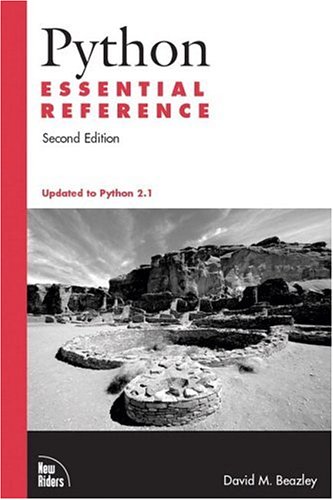
Python essential reference 2nd Edition by David Beazley ISBN 978-0735710917 0735710910
Original price was: $50.00.$35.00Current price is: $35.00.
Python essential reference 2nd Edition by David Beazley – Ebook PDF Instant Download/Delivery: 978-0735710917, 0735710910
Full download Python essential reference 2nd Edition after payment
Product details:
ISBN 10: 0735710910
ISBN 13: 978-0735710917
Author: David Beazley
Python Essential Reference, Second Edition, is the definitive guide to the Python programming language. Designed for programmers, it covers the core language, more than 100 modules in the standard library, and the techniques used to extend Python with compiled procedures in C or C++. Coverage expands upon and clarifies existing Python documentation – especially for advanced topics, including operating system interfaces, threads, network programming, and Unicode.
Concise, to the point, and extensively indexed, readers will find this volume packed with information not previously available in any other single reference source. Updated for Python 2.1, it is a must-have for any serious programmer wanting to develop advanced Python applications.
As a comprehensive reference to the Python programming language, this book will help you:
- Learn about the features in Python 2.0 and 2.1
- Master the details of Python types, operators, and the execution model
- Discover the details of Unicode and internationalization support
- Learn the details of operating system interfaces, threads, and network-programming modules
- Build C/C++ extensions to Python
- Make effective use of the Python library
- Find the information you need to start developing advanced Python applications
Table of contents:
-
Copyright
-
About the Author
-
About the Technical Reviewers
-
Acknowledgments
-
Tell Us What You Think
-
Introduction
-
A Tutorial Introduction
-
Running Python
-
Variables and Arithmetic Expressions
-
Conditionals
-
File Input and Output
-
Strings
-
Lists and Tuples
-
Loops
-
Dictionaries
-
Functions
-
Classes
-
Exceptions
-
Modules
-
Lexical Conventions and Syntax
-
Line Structure and Indentation
-
Identifiers and Reserved Words
-
Literals
-
Operators, Delimiters, and Special Symbols
-
Documentation Strings
-
Types and Objects
-
Terminology
-
Object Identity and Type
-
Reference Counting and Garbage Collection
-
References and Copies
-
Built-in Types
-
Special Methods
-
Performance and Memory Considerations
-
Operators and Expressions
-
Operations on Numbers
-
Operations on Sequences
-
Operations on Dictionaries
-
Augmented Assignment
-
The Attribute (.) Operator
-
Type Conversion
-
Unicode Strings
-
Boolean Expressions and Truth Values
-
Object Equality and Identity
-
Order of Evaluation
-
Control Flow
-
Conditionals
-
Loops
-
Exceptions
-
Defining New Exceptions
-
Assertions and debug
-
Functions and Functional Programming
-
Functions
-
Parameter Passing and Return Values
-
Scoping Rules
-
Recursion
-
The apply() Function
-
The lambda Operator
-
map(), zip(), reduce(), and filter()
-
List Comprehensions
-
eval(), exec, execfile(), and compile()
-
Classes and Object-Oriented Programming
-
The class Statement
-
Class Instances
-
Reference Counting and Instance Destruction
-
Inheritance
-
Polymorphism
-
Information Hiding
-
Operator Overloading
-
Classes, Types, and Membership Tests
-
Modules and Packages
-
Modules
-
The Module Search Path
-
Module Loading and Compilation
-
Module Reloading
-
Packages
-
Input and Output
-
Reading Options and Environment Variables
-
Files
-
Standard Input, Output, and Error
-
The print Statement
-
Persistence
-
Unicode I/O
-
Execution Environment
-
Interpreter Options and Environment
-
Interactive Sessions
-
Launching Python Applications
-
Site Configuration Files
-
Enabling Future Features
-
Program Termination
-
The Python Library
-
Built-in Functions and Exceptions
-
Python Services
-
Mathematics
-
String Handling
-
Data Management and Object Persistence
-
Operating System Services
-
Threads
-
Network Programming
-
Internet Data Handling and Encoding
-
Restricted Execution
-
Miscellaneous Modules
-
The Python Debugger
-
The Python Profiler
-
Undocumented Modules
-
Extending and Embedding Python
-
Enabling Optional Modules
-
Compilation of Extensions
-
Converting Data from Python to C
-
Converting Data from C to Python
-
Error Handling
-
Reference Counting
-
Calling Python from C
-
Abstract Object Layer
-
Low-Level Functions on Built-in Types
-
Defining New Types
-
Special Methods for Types
-
Threads
-
Embedding
-
Extension Building Tools
-
Summary of Changes
-
Python 1.6
-
Python 2.0
-
Python 2.1
People also search for:
python essential reference
python essential reference 6th edition pdf
python essential reference by david beazley
python essential reference latest edition
python essential reference 5th edition pdf