
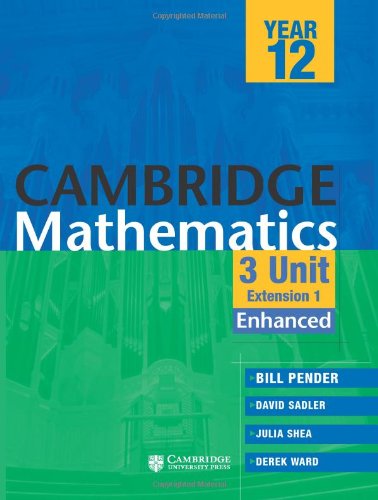
Cambridge 3 Unit Mathematics Year 12 Enhanced Version 2nd Edition by William Pender, David Saddler, Julia Shea, Derek Ward ISBN 978-1107616042 1107616042

Original price was: $50.00.$35.00Current price is: $35.00.
Cambridge 3 Unit Mathematics Year 12 Enhanced Version 2nd Edition by William Pender, David Saddler, Julia Shea, Derek Ward – Ebook PDF Instant Download/Delivery: 978-1107616042, 1107616042
Full download Cambridge 3 Unit Mathematics Year 12 Enhanced Version 2nd Edition after payment
Product details:
ISBN 10: 1107616042
ISBN 13: 978-1107616042
Author: William Pender, David Saddler, Julia Shea, Derek Ward
Cambridge 3 Unit Mathematics Year 12 Enhanced Version contains the following features: * A large number of fully worked examples demonstrate mathematical processes and encourage independent learning. Exercises are carefully graded to suit the range of students undertaking each mathematics course * Online self-marking objective response quizzes provide further opportunities to practice the multiple choice style questions included in HSC Maths exams. 2 Unit / 3 Unit Mathematics: * Foundation questions consolidate fluency and understanding, development questions encourage students to apply their understanding to a particular context. * Extension or Challenge questions inspire further thought and development for advanced students. * The wealth of questions in these three categories enables teachers to make a selection to be attempted by students of differing abilities and provides students with opportunities to practice questions of the standard they will encounter in their HSC exams.
Table of contents:
Chapter One – The Inverse Trigonometric Functions
1A Restricting the Domain
1B Defining the Inverse Trigonometric Functions
1C Graphs Involving Inverse Trigonometric Functions
1D Differentiation
1E Integration
1F General Solutions of Trigonometric Equations
Chapter Two – Further Trigonometry
2A Trigonometric Identities
2B The t-Formulae
2C Applications of Trigonometric Identities
2D Trigonometric Equations
2E The Sum of Sine and Cosine Functions
2F Extension Products to Sums and Sums to Products
2G Three-Dimensional Trigonometry
2H Further Three-Dimensional Trigonometry
Chapter Three – Motion
3A Average Velocity and Speed
3B Velocity and Acceleration as Derivatives
3C Integrating with Respect to Time
3D Simple Harmonic Motion The Time Equations
3E Motion Using Functions of Displacement
3F Simple Harmonic Motion The Differential Equation
3G Projectile Motion The Time Equations
3H Projectile Motion The Equation of Path
Chapter Four – Polynomial Functions
4A The Language of Polynomials
4B Graphs of Polynomial Functions
4C Division of Polynomials
4D The Remainder and Factor Theorems
4E Consequences of the Factor Theorem
4F The Zeroes and the Coefficients
4G Geometry using Polynomial Techniques
Chapter Five – The Binomial Theorem
5A The Pascal Triangle
5B Further Work with the Pascal Triangle
5C Factorial Notation
5D The Binomial Theorem
5E Greatest Coefficient and Greatest Term
5F Identities on the Binomial Coefficients
Chapter Six – Further Calculus
6A Differentiation of the Six Trigonometric Functions
6B Integration Using the Six Trigonometric Functions
6C Integration by Substitution
6D Further Integration by Substitution
6E Approximate Solutions and Newton’s Method
6F Inequalities and Limits Revisited
Chapter Seven – Rates and Finance
7A Applications of APs and GPs
7B Simple and Compound Interest
7C Investing Money by Regular Instalments
7D Paying Off a Loan
7E Rates of Change Differentiating
7F Rates of Change Integrating
7G Natural Growth and Decay
7H Modified Natural Growth and Decay
Chapter Eight – Euclidean Geometry
8A Points, Lines, Parallels and Angles
8B Angles in Triangles and Polygons
8C Congruence and Special Triangles
8D Trapezia and Parallelograms
8E Rhombuses, Rectangles and Squares
8F Areas of Plane Figures
8G Pythagoras’ Theorem and its Converse
8H Similarity
81 Intercepts on Transversals
Chapter Nine – Circle Geometry
9A Circles, Chords and Arcs
9B Angles at the Centre and Circumference
9C Angles on the Same and Opposite Arcs
9D Concyclic Points
9E Tangents and Radii
9F The Alternate Segment Theorem
9G Similarity and Circles
Chapter Ten – Probability and Counting
10A Probability and Sample Spaces
10B Probability and Venn Diagrams
10C Multi-Stage Experiments
10D Probability Tree Diagrams
10E Counting Ordered Selections
10F Counting with Identical Elements, and Cases
10G Counting Unordered Selections
10H Using Counting in Probability
101 Arrangements in a Circle
10J Binomial Probability
People also search for:
cambridge primary mathematics stage 5 unit 3 test
cambridge mathematics 3 unit year 12 pdf free
cambridge part iii math courses
cambridge maths requirements
what is 3 unit maths
Tags: William Pender, David Saddler, Julia Shea, Derek Ward, Cambridge 3, Unit Mathematics