
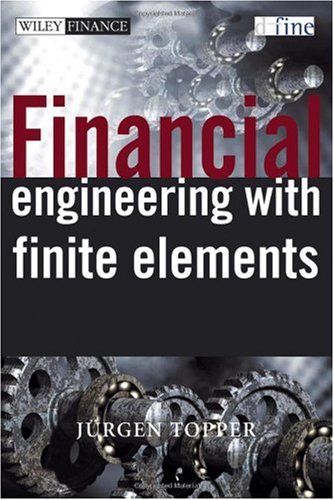
Financial Engineering with Finite Elements The Wiley Finance Series 1st Edition by Juergen Topper ISBN 978-0471486909 0471486906


Original price was: $50.00.$35.00Current price is: $35.00.
Financial Engineering with Finite Elements The Wiley Finance Series 1st Edition by Juergen Topper- Ebook PDF Instant Download/Delivery: 978-0471486909, 0471486906
Full download Financial Engineering with Finite Elements The Wiley Finance Series 1st Edition after payment
Product details:
ISBN 10: 0471486906
ISBN 13: 978-0471486909
Author: Juergen Topper
Die Preisbildung bei derivativen Finanzinstrumenten war schon immer ein äußerst komplexes und zeitaufwändiges Unterfangen.
Der technologische Fortschritt jedoch hat eine schnellere und genauere Preisbildungsmethode mittels mathematischer Modelle ermöglicht.
“Financial Engineering with Finite Elements” erläutert, wie mit der Finite Elemente Methode – einem numerischen Berechnungsverfahren – der Optionspreis schneller und genauer bestimmt werden kann.
Der Schwerpunkt liegt dabei eindeutig auf der praktischen Anwendung dieses mathematischen Verfahrens.
“Financial Engineering with Finite Elements” ist das erste Buch, das sich mit der Anwendung der Finite Elemente Methode auf die Finanzmärkte beschäftigt.
Table of contents:
PART I: PRELIMINARIES.
1. Introduction.
2. Some Prototype Models.
2.1 Optimal Price Policy of a Monopolist.
2.2 The Black-Scholes Option Pricing Model.
2.3 Pricing American Options.
2.4 Multi-Asset Options with Stochastic Correlation.
2.5 The Steady-State Distribution of the Vasicek Interest Rate Process.
2.6 Notes.
3. The Conventional Approach: Finite Differences.
3.1 General Considerations for Numerical Computations.
3.2 Ordinary Initial-Value-Problems.
3.3 Ordinary Two-Point Boundary-Value-Problems.
3.4 Initial-Boundary-Value-Problems.
3.5 Notes.
PART II: FINITE ELEMENTS.
4. Static 1D Problems.
4.1 Basic Features of Finite Element Methods.
4.2 The Method of Weighted Residuals –
One Element Solutions.
4.3 The Ritz Variational Method.
4.4 The Method of Weighted Residuals – a More General View.
4.5 Multi-Element Solutions.
4.6 Case Studies.
4.7 Convergence.
4.8 Notes.
5. Dynamic 1D Problems.
5.1 Derivation of Element Equations.
5.2 Case Studies.
6. Static 2D Problems.
6.1 Introduction and Overview.
6.2 Construction of a Mesh .
6.3 The Galerkin Method.
6.4 Case Studies.
6.5 Notes.
7. Dynamic 2D Problems.
7.1 Derivation of Element Equations.
7.2 Case Studies.
8. Static 3D Problems.
8.1 Derivation of Element Equations: The Collocation Method.
8.2 Case Studies.
8.3 Notes.
9. Dynamic 3D Problems.
9.1 Derivation of Element Equations: The Collocation Method.
9.2 Case Studies.
10. Nonlinear Problems.
10.1 Introduction.
10.2 Case Studies.
10.3 Notes.
PART III: OUTLOOK.
11. Future Directions of Research .
PART IV: APPENDICES.
A: Some Useful Results from Analysis.
A.1 Important Theorems from Calculus.
A.2 Basic Numerical Tools.
A.3 Differential Equations.
A.4 Calculus of Variations.
B: Some Useful Results from Stochastics.
B.1 Some Important Distributions.
B.2 Some Important Processes.
B.3 Results.
B.4 Notes.
C: Some Useful Results from Linear Algebra.
C.1 Some Basic Facts.
C.2 Errors and Norms.
C.3 Ill-Conditioning.
C.4 Solving Linear Algebraic Systems.
C.5 Notes.
D: A Quick Introduction to PDE2D.
People also search for:
is financial engineering engineering
what are financial elements
what is financial engineering
what is financial engineering degree
financial engineering requirements
Tags: Juergen Topper, Financial Engineering, Finite Elements, The Wiley