
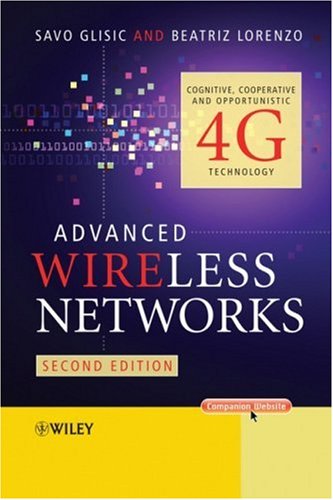
Advanced wireless networks Cognitive cooperative and opportunistic 4G technology 2nd Edition by Savo Glisic, Beatriz Lorenzo ISBN 047074250X 9780470742501


Original price was: $50.00.$35.00Current price is: $35.00.
Advanced wireless networks Cognitive cooperative and opportunistic 4G technology 2nd Edition by Savo Glisic, Beatriz Lorenzo – Ebook PDF Instant Download/Delivery: 047074250X, 9780470742501
Full download Advanced wireless networks Cognitive cooperative and opportunistic 4G technology 2nd Edition after payment
Product details:
ISBN 10: 047074250X
ISBN 13: 9780470742501
Author: Savo Glisic, Beatriz Lorenzo
With 40% new material the new edition of Advanced Wireless Networks provides a comprehensive representation of the key issues in 4G wireless networks., With 40% new material the new edition of Advanced Wireless Networks provides a comprehensive representation of the key issues in 4G wireless networks. Focussing on cognitive, cooperative and opportunistic paradigms to provide further increase in network efficiency, the book explores and addresses issues in wireless internet, mobile cellular and WLAN, as well as sensor, ad hoc, bio-inspired, active and cognitive networks. It examines the problem of cross-layer optimisation and network information theory as well as adaptability and reconfigurability in wireless networks. This book is an integral description of future wireless networks and the interconnection between their elements. The information is presented in a logical order within each chapter making it ideal for all levels of reader including researchers involved in modelling and analysis of future networks as well as engineers working in the area. Each chapter starts with introductory material and gradually includes more sophisticated models and mathematical tools concluding with a comprehensive list of references. Fully updated throughout with five new chapters on Opportunistic Communications; Relaying and Mesh Networks; Topology Control; Network Optimization; and Cognitive Radio Resource Management Unifies the latest research on cognitive, cooperative and opportunistic paradigms in wireless communications Provides efficient analytical tools for network analysis Discusses security issues, an essential element of working with wireless networks Supports advanced university and training courses in the field Companion website containing extra appendix on Queuing theory
Table of contents:
1 Fundamentals.
1.1 4G Networks and Composite Radio Environment.
1.2 Protocol Boosters.
1.3 Hybrid 4G Wireless Network Protocols.
1.4 Green Wireless Networks.
References.
2 Physical Layer and Multiple Access.
2.1 Advanced Time Division Multiple Access-ATDMA.
2.2 Code Division Multiple Access.
2.3 Orthogonal Frequency Division Multiplexing.
2.4 Multicarrier CDMA.
2.5 Ultrawide Band Signal.
2.6 MIMO Channels and Space Time Coding.
References.
3 Channel Modeling for 4G.
3.1 Macrocellular Environments (1.8 GHz).
3.2 Urban Spatal Radio Channels in Macro/MicroCell Environment (2.154 GHz).
3.3 MIMO Channels in Micro- and PicoCell Environment (1.71/2.05 GHz).
3.4 Outdoor Mobile Channel (5.3 GHz).
3.5 Microcell Channel (8.45 GHz).
3.6 Wireless MIMO LAN Environments (5.2 GHz).
3.7 Indoor WLAN Channel (17 GHz).
3.8 Indoor WLAN Channel (60 GHz).
3.9 UWB Channel Model.
References.
4 Adaptive and Reconfigurable Link Layer.
4.1 Link Layer Capacity of Adaptive Air Interfaces.
4.2 Adaptive Transmission in Ad Hoc Networks.
4.3 Adaptive Hybrid ARQ Schemes for Wireless Links.
4.4 Stochastic Learning Link Layer Protocol.
4.5 Infrared Link Access Protocol.
References.
5 Adaptive Medium Access Control.
5.1 WLAN Enhanced Distributed Coordination Function.
5.2 Adaptive MAC for WLAN with Adaptive Antennas.
5.3 MAC for Wireless Sensor Networks.
5.4 MAC for Ad Hoc Networks.
References.
6 Teletraffic Modeling and Analysis.
6.1 Channel Holding Time in PCS Networks.
References.
7 Adaptive Network Layer.
7.1 Graphs and Routing Protocols.
7.2 Graph Theory.
7.3 Routing with Topology Aggregation.
7.4 Network and Aggregation Models.
References.
8 Effective Capacity.
8.1 Effective Traffic Source Parameters.
8.2 Effective Link Layer Capacity.
References.
9 Adaptive TCP Layer.
9.1 Introduction.
9.2 TCP Operation and Performance.
9.3 TCP for Mobile Cellular Networks.
9.4 Random Early Detection Gateways for Congestion Avoidance.
9.5 TCP for Mobile Ad Hoc Networks.
References.
10 Crosslayer Optimization.
10.1 Introduction.
10.2 A Cross-Layer Architecture for Video Delivery.
References.
11 Mobility Management.
11.1 Introduction.
11.2 Cellular Systems with Prioritized Handoff.
11.3 Cell Residing Time Distribution.
11.4 Mobility Prediction in Pico- and MicroCellular Networks.
Appendix: Distance Calculation in an Intermediate Cell.
References.
12 Adaptive Resource Management.
12.1 Channel Assignment Schemes.
12.2 Resource Management in 4G.
12.3 Mobile Agent-based Resource Management.
12.4 CDMA Cellular Multimedia Wireless Networks.
12.5 Joint Data Rate and Power Management.
12.6 Dynamic Spectra Sharing in Wireless Networks.
References.
13 Ad Hoc Networks.
13.1 Routing Protocols.
13.2 Hybrid Routing Protocol.
13.3 Scalable Routing Strategies.
13.4 Multipath Routing.
13.5 Clustering Protocols.
13.6 Cashing Schemes for Routing.
13.7 Distributed QoS Routing.
References.
14 Sensor Networks.
14.1 Introduction.
14.2 Sensor Networks Parameters.
14.3 Sensor Networks Architecture.
14.4 Mobile Sensor Networks Deployment.
14.5 Directed Diffusion.
14.6 Aggregation in Wireless Sensor Networks.
14.7 Boundary Estimation.
14.8 Optimal Transmission Radius in Sensor Networks.
14.9 Data Funneling.
14.10 Equivalent Transport Control Protocol in Sensor Networks.
References.
15 Security.
15.1 Authentication.
15.2 Security Architecture.
15.3 Key Management.
15.4 Security Management in GSM Networks.
15.5 Security Management in UMTS.
15.6 Security Architecture for UMTS/WLAN Interworking.
15.7 Security in Ad Hoc Networks.
15.8 Security in Sensor Networks.
References.
16 Active Networks.
16.1 Introduction.
16.2 Programable Networks Reference Models.
16.3 Evolution to 4G Wireless Networks.
16.4 Programmable 4G Mobile Network Architecture.
16.5 Cognitive Packet Networks.
16.6 Game Theory Models in Cognitive Radio Networks.
16.7 Biologically Inspired Networks.
References.
17 Network Deployment.
17.1 Cellular Systems with Overlapping Coverage.
17.2 Imbedded Microcell in CDMA Macrocell Network.
17.3 Multitier Wireless Cellular Networks.
17.4 Local Multipoint Distribution Service.
17.5 Self-organization in 4G Networks.
References.
18 Network Management.
18.1 The Simple Network Management Protocol.
18.2 Distributed Network Management.
18.3 Mobile Agent-based Network Management.
18.4 Ad Hoc Network Management.
References.
19 Network Information Theory.
19.1 Effective Capacity of Advanced Cellular Networks.
19.2 Capacity of Ad Hoc Networks.
19.3 Information Theory and Network Architectures.
19.4 Cooperative Transmission in Wireless Multihop Ad Hoc Networks.
19.5 Network Coding.
19.6 Capacity of Wireless Networks Using MIMO Technology.
19.7 Capacity of Sensor Networks with Many-to-One Transmissions.
References.
20 Energy-efficient Wireless Networks.
20.1 Energy Cost Function.
20.2 Minimum Energy Routing.
20.3 Maximizing Network Lifetime.
20.4 Energy-efficient MAC in Sensor Networks.
References.
21 Quality-of-Service Management.
21.1 Blind QoS Assessment System.
21.2 QoS Provisioning in WLAN.
21.3 Dynamic Scheduling on RLC/MAC Layer.
21.4 QoS in OFDMA-based Broadband Wireless Access Systems.
21.5 Predictive Flow Control and QoS.
People also search for:
advanced wireless network co. ltd
advanced wireless networking
a wireless channel is coursera
a wireless network
cognitive wireless network
Tags: Savo Glisic, Beatriz Lorenzo, Advanced wireless networks, cooperative and opportunistic