
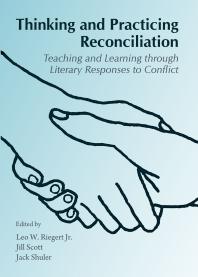
Thinking and Practicing Reconciliation Teaching and Learning through Literary Responses to Conflict 1st Edition by Leo Riegert, Jill Scott ISBN 1443850489 978-1443850483

Original price was: $50.00.$35.00Current price is: $35.00.
Thinking and Practicing Reconciliation Teaching and Learning through Literary Responses to Conflict 1st Edition by Leo W. Riegert, Jill Scott – Ebook PDF Instant Download/Delivery: 1443850489, 978-1443850483
Full download Thinking and Practicing Reconciliation Teaching and Learning through Literary Responses to Conflict 1st Edition after payment
Product details:
ISBN 10: 1443850489
ISBN 13: 978-1443850483
Author: Leo W. Riegert, Jill Scott
Thinking and Practicing Reconciliation asserts that literary representations of conflict offer important insights into processes of resolution and practices of reconciliation, and that it is crucial to bring these debates into the post-secondary classroom. The essays collected here aim to help teachers think deeply about the ways in which we can productively integrate literature on/as reconciliation into our curricula. Until recently, scholarship on teaching and learning in higher education has not been widely accepted as equal to research in other fields. This volume seeks to establish that serious analysis of pedagogical practices is not only a worthy and legitimate academic pursuit, but also that it is crucial to our professional development as researcher-educators. The essays in this volume take seriously both the academic study of literature dealing with the aftermath of gross human-rights violations and the teaching of this literature. The current generation of college-aged students is deeply affected by the proximity of violence in our global world. This collection recognizes educators’ responsibility to enable future generations to analyze conflict – whether local or global – and participate in constructive discourses of resolution. Ultimately, Thinking and Practicing Reconciliation charts a course from theory to practice and offers new perspectives on the very human endeavor of storytelling as a way to address human-rights injustices. In their focus on pedagogical strategies and frameworks, the essays in this volume also demonstrate that, as educators, our engagement with students can indeed produce practices of reconciliation that start in the classroom and move beyond it.
Table of contents:
Part I: Theory
- Introduction: The Language of Reconciliation; Evolving Terminology and the Ethics of Teaching – Jill Scott
- Never Again: Preventing Genocide and Promoting Reconciliation with Interventionist Pedagogy – Joy Arbor
- Crossing the Line: Writing and Reading Holocaust Testimonies – Sarah Gendron
- Apologizing for Genocide: The Subtleties, Significance, and Complexity of Contrition in Rwanda’s Reconciliation – Emil B. Towner
Part II: Reading
- Discursive Strategies in Australian Reconciliation and Alex Miller’s Landscape of Farewell – Sheila Collingwood-Whittick
- Teaching the Troubles: Responses to Literary Violence in Irish Poetry – Anne Goarzin
- Is Not the Truth the Truth? Reconciling Truths in Gillian Slovo’s Every Secret Thing and the Practice of Reconciliation in South Africa – Modhumita Roy
- Literary Peace Research and Spectacular Reconciliation from Homer to Heinrich von Kleist – Jean Wilson
Part III: Practice
- Gathering Voices: Teaching Truth, Justice, and Reconciliation in Chilean Literature – Elena M. De Costa
- From Thinking to Practicing Reconciliation: Telling the Stories of Rwanda – Catherine T. Nerney
- Dynamic Memories of Slavery: Towards a Pedagogy of Reconciliation – Jack Shuler
- Dialogue in the Shadow of Atrocity: Writing, Reading, and Teaching the Holocaust – Leo W. Riegert Jr
People also search for:
reconciliation practice problems
thinking beyond reconciliation
practice of reconciliation
reconciliation process relationships
reconciliation a relationship
Tags:
Leo Riegert,Jill Scott,Thinking and Practicing,Reconciliation Teaching,Learning through Literary