
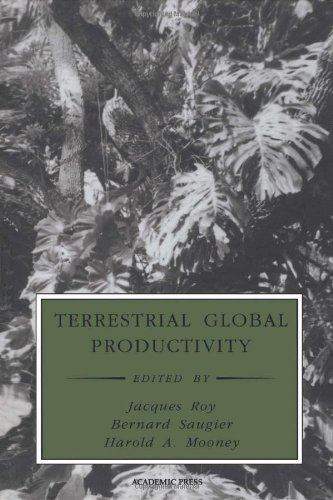
Terrestrial Global Productivity Physiological Ecology 1st Edition by Jacques Roy, Harold Mooney, Bernard Saugier ISBN 978-0125052900 0125052901


Original price was: $50.00.$35.00Current price is: $35.00.
Terrestrial Global Productivity Physiological Ecology 1st Edition by Jacques Roy, Harold A. Mooney, Bernard Saugier- Ebook PDF Instant Download/Delivery: 978-0125052900, 0125052901
Full download Terrestrial Global Productivity Physiological Ecology 1st Edition after payment
Product details:
ISBN 10: 0125052901
ISBN 13: 978-0125052900
Author: Jacques Roy, Harold A. Mooney, Bernard Saugier
As the global climate changes, there are concomitant changes in global biological productivity. This book is devoted to the assessment of terrestrial Net Primary Productivity (“the total amount of energy acquired by green plants during photosynthesis, minus the energy lost through respiration”–APDS&T, pp. 1457). The book is comprised of three major sections. The first section is a review of the processes that operate globally to influence productivity–these are the initial conditions of any model of primary productivity. The second section is comprised of chapters that assess the contribution of particular ecosystems to global productivity. The final major section contains chapters of a synthetic nature that describe attempts to model global productivity. This book should appeal to both ecologists and environmental scientists.
Table of contents:
1. Terrestrial Primary Productivity: Definitions and Milestones
Jacques Roy and Bernard Saugier
Part I – Component Processes
2. Canopy Photosynthesis: History, Measurements, and Models
Dennis D. Baldocchi and Jeffrey S. Amthor
I. Introduction
II. History
III. Current Theoretical Concepts
IV. Processes: Response of Canopy Photosynthesis to External Forcings
V. Canopy Photosynthesis in the Future
VI. Research Directions
References
3. Terrestrial Higher Plant Respiration and Net Primary Production
Jeffrey S. Amthor and Dennis D. Baldocchi
I. Plant Respiration in Relation to Terrestrial Ecosystem Net Primary Production
II. Regulation of Respiration Rate
III. The Fundamental (Semi) Mechanistic Model of Plant Respiration
IV. Respiration following and during Photosynthesis
V. Respiration in Leaves, Stems, and Roots
VI. Respiration in Comparison to Photosynthesis at the Ecosystem Scale
VII. Optimum Leaf Area Index: Does It Exist?
VIII. Big Trees and Declining Forest Net Primary Production
IX. Respiratory Responses to Environmental Change: The Future
X. Summary
References
4. Phenology, Growth, and Allocation in Global Terrestrial Productivity
Robert B. Jackson, Martin J. Lechowicz, Xia Li, and Harold A. Mooney
I. Introduction
II. Phenology
III. Growth and Allocation
IV. Future Directions
V. Summary and Conclusions
References
5. From Plant Soil: Litter Production and Decomposition
Richard Joffre and Göran I. Ågren
I. Introduction
II. Litter Inputs: Quantity and Quality
III. From Plant Organic Matter to Soil Organic Matter
IV. Research Needs
V. Concluding Remarks
References
6. Herbivory and Trophic Interactions
Sam J. McNaughton
I. Introduction
II. Herbivores and Trophic Relations in Global Evolutionary Context
III. Herbivory and the Environment
IV. Plant Architecture
V. Tri-trophic Interactions
VI. Trophic Interactions and Plant Community Composition
VII. Grazing and Detritus Food Webs in a Global Biome Context
VIII. Resolving a Dilemma: Remote Sensing, Herbivory, and Trophic Interactions
IX. Conclusions
References
7. Water, Nitrogen, Rising Atmospheric CO₂, and Terrestrial Productivity
Denis Loustau, Bruce Hungate, and Bert G. Drake
I. Introduction
II. The Constraints
III. Effects of Water Regime on Net Primary Production
IV. Effects of CO₂ on NPP and NEP
V. Interactions between CO₂ and Nutrients
VI. Interactions between Water Regime and CO₂ Concentrations
VII. Interactions between CO₂, Water, and Nitrogen
References
8. How Does Biodiversity Control Primary Productivity?
Jacques Roy
I. Introduction
II. Productivity and Species Diversity at Different Spatial Scales
III. Impact of Plant Species and Functional Group Diversity on Intensity of Ecosystem Fluxes
IV. Mechanisms Relating Plant Diversity and Flux Intensity
V. Impact of Plant Diversity on the Stability of Ecosystem Fluxes
VI. Conclusions and Perspectives
References
Part II – Ecosystem Productive Performance
9. Productivity of Arctic Ecosystems
Gaius Shaver and Sven Jonasson
I. Introduction
II. Environment
III. Primary Production and Net Ecosystem Production
IV. Environmental Controls, Direct and Indirect
V. Effects of Species Composition
VI. Short- versus Long-Term Controls
VII. Priorities for New Research
References
10. Productivity of Boreal Forests
Paul G. Jarvis, Bernard Saugier, and E.-Detlef Schulze
I. Introduction
II. Nature and Extent of Boreal Forests
III. Recent Research Programs
IV. Biophysical Properties
V. Evaporation, Transpiration, and Climate
VI. Biomass and Productivity
VII. Production Processes
VIII. Stand Annual Carbon Balance
IX. Radiation Use Efficiency
X. Regional Production and Sensitivity to Global Change
XI. Summary
References
11. Productivity of Evergreen and Deciduous Temperate Forests
Peter B. Reich and Paul Bolstad
I. Nature and Extent of Temperate Forests
II. Productivity Values
III. Control on ANPP Due to Water, Soils, Disturbance, and Vegetation Type
IV. Component and Total Carbon Flux and Scaling Relations
V. Human Impacts on Production
VI. Summary
References
12. Productivity of Temperate Grasslands
Osvaldo E. Sala
I. Introduction
II. Productivity Patterns and Controls
III. Secondary Productivity Patterns and Control
IV. Grassland Primary Production, Carbon Balance, and Global Change
References
13. Productivity of Agro-ecosystems
Jan Goudriaan, J. J. Rob Goot, and Peter W. J. Uithol
I. Introduction
II. Potential and Actual Net Primary Production
III. Primary Productivity of Agriculture
IV. Time Trends in Productivity, Nitrogen Uptake, and Fertilizer Use
V. Who Consumes the Production?
VI. Discussion
VII. Summary
References
14. Hierarchy and Productivity of Mediterranean-Type Ecosystems
Serge Rambal
I. Nature and Extent of Mediterranean-Type Ecosystems
II. Productivity in Mediterranean-Type Ecosystems
III. Scaling Up Leaf Production
IV. Environmental Limitations on NPP
V. The Threats of Global Change
VI. Summary
References
15. Productivity of Deserts
James R. Ehleringer
I. Nature and Extent of Deserts
II. Standing Biomass and Aboveground Net Primary Productivity Rates
III. Seasonality Components of Net Primary Production
IV. Human Impacts on Primary Productivity in Desert Regions
V. Anticipated Impacts of Global Change on Deserts
VI. Conclusions
References
16. Productivity of Tropical Savannas and Grasslands
Jo I. House and David O. Hall
I. Introduction
II. Definition
III. Extent
IV. Plant Composition: Structural and Functional Variability
V. Estimates of Biomass and Productivity
VI. Biophysical Properties, Fluxes, and Efficiencies
VII. Environmental Determinants
VIII. Human Influence
IX. Climate Change
X. Summary
References
17. Productivity of Tropical Rain Forests
John Grace, Yadvinder Malhi, Niro Higuchi, and Patrick Meir
I. The Nature and Extent of Tropical Rain Forests
II. Production Values
III. Components of Production
IV. Estimate of Global Productivity
V. Human and Environmental Impacts
VI. Research Needs
References
Part III – Global Productivity
18. Determining Present Patterns of Global Productivity
Wolfgang Cramer, Richard J. Olson, Stephen D. Prince, and Jonathan M. O. Scurlock
I. Introduction
II. The Nature of Available NPP Observations
III. Assessing Productivity at the Continental to Global Scale
IV. Outlook: Development of an Improved Database
References
19. Integrating Global Models of Terrestrial Primary Productivity
Philippe Ciais, Pierre Friedlingstein, Andrew Friend, and David S. Schimel
I. Introduction
II. Different Nature and Purposes of Global Models
III. Modeling Biospheric Processes
IV. Indirect Constraints on NPP from Remote-Sensed and Atmospheric Observations
V. Concluding Remarks
References
20. Reconstructing and Modeling Past Changes in Terrestrial Primary Productivity
Joël Guiot, I. Colin Prentice, Changhui Peng, Dominique Jolly, Fouzia Laarif, and Ben Smith
I. Introduction
II. Reconstruction of Vegetation Composition and NPP from Paleodata
III. Global Simulation of Vegetation and NPP
IV. Conclusions
References
21. Global Terrestrial Productivity and Carbon Balance
Richard A. Houghton
I. Introduction
II. Carbon Fluxes, 1850 to 1990
III. Carbon Fluxes, 1980 to 1995
IV. Future Changes in Carbon Storage and NPP Likely as a Result of Human Activity
V. Conclusions
References
22. Predicting the Future Productivity and Distribution of Global Terrestrial Vegetation
F. Ian Woodward, Mark R. Lomas, and Susan E. Lee
I. Introduction
II. Methods
III. Model Projections
IV. Model Projections for the 1860s to the 2090s
V. Summary
References
23. Estimations of Global Terrestrial Productivity: Converging toward a Single Number?
Bernard Saugier, Jacques Roy, and Harold A. Mooney
I. Introduction
II. Synthesis of Biome Data
III. Comparison of NPP and Phytomass Estimated by Different Methods
IV. Global Change-Induced Variations in NPP and NEP
V. Conclusions
References
Index
Previous Volumes in Series
People also search for:
j2000 terrestrial time
global terrestrial net primary production
8 major terrestrial biomes
8 terrestrial biomes
7 terrestrial biomes
Tags: Jacques Roy, Harold Mooney, Bernard Saugier, Terrestrial Global, Productivity Physiological