
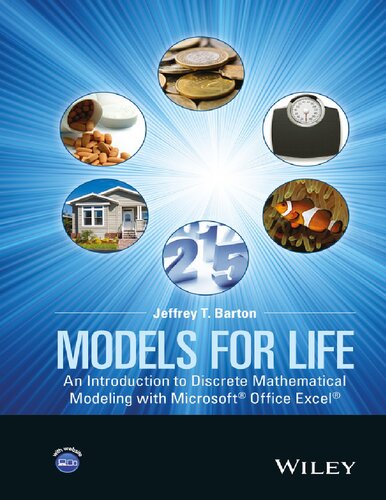
Models For Life An Introduction To Discrete Mathematical Modelling With Microsoft Office Excel 1st Edition by Jeffrey Barton ISBN 978-1119039754 1119039754
Original price was: $50.00.$35.00Current price is: $35.00.
Models For Life An Introduction To Discrete Mathematical Modelling With Microsoft Office Excel 1st Edition by Jeffrey T. Barton- Ebook PDF Instant Download/Delivery: 978-1119039754, 1119039754
Full download Models For Life An Introduction To Discrete Mathematical Modelling With Microsoft Office Excel 1st Edition after payment
Product details:
ISBN 10: 1119039754
ISBN 13: 978-1119039754
Author: Jeffrey T. Barton
Features an authentic and engaging approach to mathematical modeling driven by real-world applications
With a focus on mathematical models based on real and current data, Models for Life: An Introduction to Discrete Mathematical Modeling with Microsoft® Office Excel® guides readers in the solution of relevant, practical problems by introducing both mathematical and Excel techniques.
The book begins with a step-by-step introduction to discrete dynamical systems, which are mathematical models that describe how a quantity changes from one point in time to the next. Readers are taken through the process, language, and notation required for the construction of such models as well as their implementation in Excel. The book examines single-compartment models in contexts such as population growth, personal finance, and body weight and provides an introduction to more advanced, multi-compartment models via applications in many areas, including military combat, infectious disease epidemics, and ranking methods. Models for Life: An Introduction to Discrete Mathematical Modeling with Microsoft® Office Excel® also features:
A modular organization that, after the first chapter, allows readers to explore chapters in any order
Numerous practical examples and exercises that enable readers to personalize the presented models by using their own data
Carefully selected real-world applications that motivate the mathematical material such as predicting blood alcohol concentration, ranking sports teams, and tracking credit card debt
References throughout the book to disciplinary research on which the presented models and model parameters are based in order to provide authenticity and resources for further study
Relevant Excel concepts with step-by-step guidance, including screenshots to help readers better understand the presented material
Both mathematical and graphical techniques for understanding concepts such as equilibrium values, fixed points, disease endemicity, maximum sustainable yield, and a drug’s therapeutic window
A companion website that includes the referenced Excel spreadsheets, select solutions to homework problems, and an instructor’s manual with solutions to all homework problems, project ideas, and a test bank
The book is ideal for undergraduate non-mathematics majors enrolled in mathematics or quantitative reasoning courses such as introductory mathematical modeling, applications of mathematics, survey of mathematics, discrete mathematical modeling, and mathematics for liberal arts. The book is also an appropriate supplement and project source for honors and/or independent study courses in mathematical modeling and mathematical biology.
Jeffrey T. Barton, PhD, is Professor of Mathematics in the Mathematics Department at Birmingham-Southern College. A member of the American Mathematical Society and Mathematical Association of America, his mathematical interests include approximation theory, analytic number theory, mathematical biology, mathematical modeling, and the history of mathematics.
Table of contents:
1. Density-Independent Population Models
1.1. Exponential Growth
1.2. Exponential Growth with Stocking or Harvesting
1.3. Two Fundamental Excel Techniques
1.4. Explicit Formulas
1.5. Equilibrium Values and Stability
2. Personal Finance
2.1. Compound Interest and Savings
2.2. Borrowing for Major Purchases
2.3. Credit Cards
2.4. The Time Value of Money: Present Value
2.5. Car Leases
3. Combat Models
3.1. Lanchester Combat Model
3.2. Phase Plane Graphs
3.3. The Lanchester Model with Reinforcements
3.4. Hughes Aimed Fire Salvo Model
3.5. Armstrong Salvo Model with Area Fire
4. The Spread of Infectious Diseases
4.1. The S–I–R Model
4.2. S–I–R with Vital Dynamics
4.3. Determining Parameters from Real Data
4.4. S–I–R with Vital Dynamics and Routine Vaccinations
5. Density-Dependent Population Models
5.1. The Discrete Logistic Model
5.2. Logistic Growth with Allee Effects
5.3. Logistic Growth with Harvesting
5.4. The Discrete Logistic Model and Chaos
5.5. The Ricker Model
6. Blood Alcohol Concentration and Pharmacokinetics
6.1. Blood Alcohol Concentration
6.2. The Widmark Model
6.3. The Wagner Model
6.4. Alcohol Consumption Patterns
6.5. More General Drug Elimination
6.6. The Volume of Distribution
6.7. Common Drugs
7. Ranking Methods
7.1. Introduction to Markov Models
7.2. Ranking Sports Teams
7.3. Google PageRank
8. Body Weight and Body Composition
8.1. Constant Calorie Expenditure
8.2. Variable Calorie Expenditure
8.3. Health Metrics
8.4. Body Composition
8.5. The Body Composition Model for Body Weight
8.6. Points-Based Systems: The Weight Watchers Model
Appendix A: The Geometric Series Formula
Appendix B: Lanchester’s Square Law and the Fractional Exchange Ratio
Appendix C: Derivation of the FER = 1 Line for the Hughes Salvo Model
Appendix D: The Waiting Time Principle
Appendix E: Creating Cobweb Diagrams in Excel
Appendix F: Proportion of Total Credit Distributed Does Not Exceed 1
People also search for:
models and modeling an introduction
a models life
models of my life pdf
a model you use in your everyday life
a modelers life podcast
Tags: Jeffrey Barton, Models For Life, An Introduction, Discrete Mathematical Modelling