
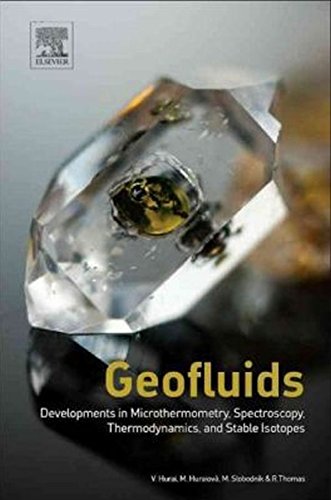
Geofluids developments in microthermometry spectroscopy thermodynamics and stable isotopes 1st Edition by Vratislav Hurai, Monika Huraiová, Marek Slobodník, Rainer Thomas ISBN 9780128032428 0128032428


Original price was: $50.00.$35.00Current price is: $35.00.
Geofluids developments in microthermometry spectroscopy thermodynamics and stable isotopes 1st Edition by Vratislav Hurai, Monika Huraiová, Marek Slobodník, Rainer Thomas – Ebook PDF Instant Download/Delivery: 9780128032428, 0128032428
Full download Geofluids developments in microthermometry spectroscopy thermodynamics and stable isotopes 1st Edition after payment
Product details:
ISBN 10: 0128032428
ISBN 13: 9780128032428
Author: Vratislav Hurai, Monika Huraiová, Marek Slobodník, Rainer Thomas
Geofluids: Developments in Microthermometry, Spectroscopy, Thermodynamics, and Stable Isotopes is the definitive source on paleofluids and the migration of hydrocarbons in sedimentary basins—ideal for researchers in oil and gas exploration.
There’s been a rapid development of new non-destructive analytical methods and interdisciplinary research that makes it difficult to find a single source of content on the subject of geofluids. Geoscience researchers commonly use multiple tools to interpret geologic problems, particularly if the problems involve fluid-rock interaction. This book perfectly combines the techniques of fluid inclusion microthermometry, stable isotope analyses, and various types of spectroscopy, including Raman analysis, to contribute to a thorough approach to research. Through a practical and intuitive step-by-step approach, the authors explain sample preparation, measurements, and the interpretation and analysis of data related to thermodynamics and mineral-fluid equilibria.
Table of contents:
- Preface
- List of Abbreviations
- Constants:
- Chapter 1: General Characteristics of Geofluids
- Abstract
- 1.1 Brief History of Geofluid Observation and Research
- 1.2 Entrapment of Fluids in Minerals
- 1.3 Basic State Properties of Geofluids
- 1.4 Changes in Fluid Inclusions
- Chapter 2: Phase Diagrams
- Abstract
- 2.1 Unary Systems
- 2.2 Properties of Water
- 2.3 Aqueous Systems with Salts
- 2.4 Aqueous Systems with Gases
- 2.5 Gas Mixtures
- 2.6 Hydrocarbons
- 2.7 Silicate Melt
- Chapter 3: Equations of State
- Abstract
- 3.1 Behavior of Ideal Gas
- 3.2 Equations of State for Geofluids
- Chapter 4: Fluid and Melt Inclusion Microthermometry
- Abstract
- 4.1 Observation and Imaging
- 4.2 Sample Handling and Storage
- 4.3 Calculating Volumetric Phase Ratios
- 4.4 Calculating Fluid Inclusion Volumes
- 4.5 Evaluating Trapping Modes of Fluid Inclusions
- 4.6 Measuring Temperatures of Phase Transitions
- Suggested Further Reading
- Chapter 5: Interpretation of Microthermometric Data
- Abstract
- 5.1 Calculating Densities and Isochores
- 5.2 Calculating Fluid and Melt Viscosities
- 5.3 P–T Estimates
- 5.4 Calculating Depths and Geothermal Gradients
- 5.5 Trend Analysis
- Suggested Further Reading
- Chapter 6: Fluid Thermodynamics
- Abstract
- 6.1 Thermodynamic Laws
- 6.2 Free Energy of Reaction
- 6.3 Gas Fugacity
- 6.4 Calculating the Fluid Composition from Thermodynamic Data
- 6.5 Calculating Phase Diagrams and Mineral-Fluid Equilibria
- Chapter 7: Raman and Infrared Spectroscopic Analysis
- Abstract
- 7.1 Fundamentals
- 7.2 Gases and Their Mixtures
- 7.3 Aqueous Fluids
- 7.4 Graphite and Carbonaceous Substances
- 7.5 Petroleum and Bitumen
- 7.6 Silicate Melts
- 7.7 Magmatic Volatiles and Fluxing Species
- 7.8 Raman Mapping and Modeling
- Chapter 8: Miscellaneous Spectrometric and Chromatographic Methods
- Abstract
- 8.1 Crush-Leach Analysis of Aqueous Inclusions
- 8.2 Bulk Gas Analysis
- 8.3 Laser Ablation Analysis
- 8.4 Selected Applications
- Suggested Further Reading
- Chapter 9: Stable Isotope Geochemistry of Geofluids
- Abstract
- 9.1 Terminology and Principles
- 9.2 Stable Isotope Composition of Geofluid Reservoirs
- 9.3 Stable Isotopes in Fluid Inclusions
- 9.4 Stable Isotope Thermometry
- 9.5 Isotope Fractionation in Open and Closed Systems
- 9.6 Magmatic Devolatilization–Crystallization
- 9.7 Hydrothermal Devolatilization–Precipitation
- 9.8 Fluid–Rock Interaction
- 9.9 Hydrothermal Alteration
- 9.10 Fluid Mixing and Infiltration
- 9.11 Isotope Fractionation Trends in Natural Hydrothermal Carbonates
- 9.12 Interpretation of Stable Isotopes and Fluid Inclusions in Siderite and Magnesite Deposits of Western Carpathians
- Suggested Further Reading
- Appendix I: Eutectic and Peritectic Points of Aqueous Systems with Salts
- Appendix II: Selected Equations of State
- H2O
- CO2
- CH4
- H2O–NaCl
- H2O–NaCl–KCl
- H2O–NaCl–KCl–CaCl2
- H2O–CH4
- H2O–CO2–NaCl
- CO2–CO–CH4–H2–H2S–N2
- Appendix III: Optical Properties of Fluid Inclusion Phases
- Appendix IV: Stable Isotope Fractionation Factors
- Appendix V: Raman Bands Sorted by Vibrations
- Appendix VI: Raman Bands Sorted by Name
- Appendix VII: Data Sources, Computer Programs, Websites
- References
- Index
People also search for:
geofluids ut
geofluids impact factor
a geothermal heat pump is one in which
geofluid geothermal
geothermal energy and geofluids
Tags: Vratislav Hurai, Monika Huraiová, Marek Slobodník, Rainer Thomas, Geofluids developments, microthermometry spectroscopy, stable isotopes