
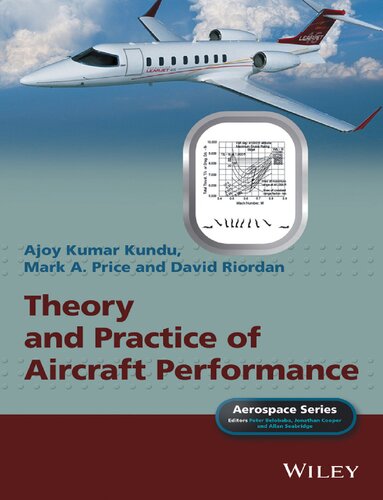
Theory and Practice of Aircraft Performance 1st Edition by Ajoy Kumar Kundu, Mark Price, David Riordan ISBN 1119074175 978-1119074175


Original price was: $50.00.$35.00Current price is: $35.00.
Theory and Practice of Aircraft Performance 1st Edition by Ajoy Kumar Kundu, Mark A. Price, David Riordan – Ebook PDF Instant Download/Delivery: 1119074175, 978-1119074175
Full download Theory and Practice of Aircraft Performance 1st Edition after payment
Product details:
ISBN 10: 1119074175
ISBN 13: 978-1119074175
Author: Ajoy Kumar Kundu, Mark A. Price, David Riordan
Textbook introducing the fundamentals of aircraft performance using industry standards and examples: bridging the gap between academia and industry
Provides an extensive and detailed treatment of all segments of mission profile and overall aircraft performance
Considers operating costs, safety, environmental and related systems issues
Includes worked examples relating to current aircraft (Learjet 45, Tucano Turboprop Trainer, Advanced Jet Trainer and Airbus A320 types of aircraft)
Suitable as a textbook for aircraft performance courses
Table of contents:
Introduction
1.1 Overview
1.2 Brief Historical Background
1.2.1 Flight in Mythology
1.2.2 Fifteenth to Nineteenth Centuries
1.2.3 From 1900 to World War I (1914)
1.2.4 World War I (1914–1918)
1.2.5 The Inter‐War Period: the Golden Age (1918–1939)
1.2.6 World War II (1939–1945)
1.2.7 Post World War II
1.3 Current Aircraft Design Status
1.3.1 Current Civil Aircraft Trends
1.3.2 Current Military Aircraft Trends
1.4 Future Trends
1.4.1 Trends in Civil Aircraft
1.4.2 Trends in Military Aircraft
1.4.3 Forces and Drivers
1.5 Airworthiness Requirements
1.6 Current Aircraft Performance Analyses Levels
1.7 Market Survey
1.8 Typical Design Process
1.8.1 Four Phases of Aircraft Design
1.9 Classroom Learning Process
1.10 Cost Implications
1.11 Units and Dimensions
1.12 Use of Semi‐empirical Relations and Graphs
1.13 How Do Aircraft Fly?
1.13.1 Classification of Flight Mechanics
1.14 Anatomy of Aircraft
1.14.1 Comparison between Civil and Military Design Requirements
1.15 Aircraft Motion and Forces
1.15.1 Motion – Kinematics
1.15.2 Forces – Kinetics
1.15.3 Aerodynamic Parameters – Lift, Drag and Pitching Moment
1.15.4 Basic Controls – Sign Convention
References
Aerodynamic and Aircraft Design Considerations
2.1 Overview
2.2 Introduction
2.3 Atmosphere
2.3.1 Hydrostatic Equations and Standard Atmosphere
2.3.2 Non‐standard/Off‐standard Atmosphere
2.3.3 Altitude Definitions – Density Altitude (Off‐standard)
2.3.4 Humidity Effects
2.3.5 Greenhouse Gases Effect
2.4 Airflow Behaviour: Laminar and Turbulent
2.4.1 Flow Past an Aerofoil
2.5 Aerofoil
2.5.1 Subsonic Aerofoil
2.5.2 Supersonic Aerofoil
2.6 Generation of Lift
2.6.1 Centre of Pressure and Aerodynamic Centre
2.6.2 Relation between Centre of Pressure and Aerodynamic Centre
2.7 Types of Stall
2.7.1 Buffet
2.8 Comparison of Three NACA Aerofoils
2.9 High‐Lift Devices
2.10 Transonic Effects – Area Rule
2.10.1 Compressibility Correction
2.11 Wing Aerodynamics
2.11.1 Induced Drag and Total Aircraft Drag
2.12 Aspect Ratio Correction of 2D‐Aerofoil Characteristics for 3D‐Finite Wing
2.13 Wing Definitions
2.13.1 Planform Area
2.13.2 Wing Aspect Ratio
2.13.3 Wing‐Sweep Angle
2.13.4 Wing Root and Tip Chords
2.13.5 Wing‐Taper Ratio
2.13.6 Wing Twist
2.13.7 High/Low Wing
2.13.8 Dihedral/Anhedral Angles
2.14 Mean Aerodynamic Chord
2.15 Compressibility Effect: Wing Sweep
2.16 Wing‐Stall Pattern and Wing Twist
2.17 Influence of Wing Area and Span on Aerodynamics
2.17.1 The Square‐Cube Law
2.17.2 Aircraft Wetted Area vs. Wing Planform Area
2.17.3 Additional Wing Surface Vortex Lift – Strake/Canard
2.17.4 Additional Surfaces on Wing – Flaps/Slats and High‐Lift Devices
2.17.5 Other Additional Surfaces on Wing
2.18 Empennage
2.18.1 Tail‐arm
2.18.2 Horizontal Tail
2.18.3 Vertical Tail
2.18.4 Tail‐Volume Coefficients
2.19 Fuselage
2.19.1 Fuselage Axis/Zero‐Reference Plane
2.19.2 Fuselage Dimensions and Ratios
2.20 Nacelle and Intake
2.20.1 Large Commercial/Military Logistic and Old Bombers Nacelle Group
2.20.2 Small Civil Aircraft Nacelle Position
2.20.3 Intake/Nacelle Group (Military Aircraft)
2.20.4 Futuristic Aircraft Nacelle Positions
2.21 Speed Brakes and Dive Brakes
3 Air Data Measuring Instruments, Systems and Parameters 109
3.1 Overview 109
3.2 Introduction 109
3.3 Aircraft Speed 110
3.3.1 Definitions Related to Aircraft Velocity 111
3.3.2 Theory Related to Computing Aircraft Velocity 112
3.3.3 Aircraft Speed in Flight Deck Instruments 116
3.3.4 Atmosphere with Wind Speed (Non‐zero Wind) 117
3.3.5 Calibrated Airspeed 118
3.3.6 Compressibility Correction (∆V c ) 120
3.3.7 Other Position Error Corrections 122
3.4 Air Data Instruments 122
3.4.1 Altitude Measurement – Altimeter 123
3.4.2 Airspeed Measuring Instrument – Pitot‐Static Tube 125
3.4.3 Angle‐of‐Attack Probe 126
3.4.4 Vertical Speed Indicator 126
3.4.5 Temperature Measurement 127
3.4.6 Turn‐Slip Indicator 127
3.5 Aircraft Flight‐Deck (Cockpit) Layout 128
3.5.1 Multifunctional Displays and Electronic Flight Information Systems 129
3.5.2 Combat Aircraft Flight Deck 131
3.5.3 Head‐Up Display (HUD) 132
3.6 Aircraft Mass (Weights) and Centre of Gravity 133
3.6.1 Aircraft Mass (Weights) Breakdown 133
3.6.2 Desirable CG Position 134
3.6.3 Weights Summary – Civil Aircraft 136
3.6.4 CG Determination – Civil Aircraft 137
3.6.5 Bizjet Aircraft CG Location – Classroom Example 138
3.6.6 Weights Summary – Military Aircraft 138
3.6.7 CG Determination – Military Aircraft 138
3.6.8 Classroom Worked Example – Military AJT CG Location 138
3.7 Noise Emissions 141
3.7.1 Airworthiness Requirements 142
3.7.2 Summary 145
3.8 Engine‐Exhaust Emissions 145
3.9 Aircraft Systems 146
3.9.1 Aircraft Control System 146
3.9.2 ECS: Cabin Pressurization and Air‐Conditioning 148
3.9.3 Oxygen Supply 149
3.9.4 Anti‐icing, De‐icing, Defogging and Rain Removal System 149
3.10 Low Observable (LO) Aircraft Configuration 150
3.10.1 Heat Signature 150
3.10.2 Radar Signature 150
References 152
4 Equations of Motion for a Flat Stationary Earth 153
4.1 Overview 153
4.2 Introduction 154
4.3 Definitions of Frames of Reference (Flat Stationary E arth) and Nomenclature Used 154
4.3.1 Notation and Symbols Used in this Chapter 157
4.4 Eulerian Angles 158
4.4.1 Transformation of Eulerian Angles 159
4.5 Simplified Equations of Motion for a Flat Stationary Earth 161
4.5.1 Important Aerodynamic Angles 161
4.5.2 In Pitch Plane (Vertical XZ Plane) 162
4.5.3 In Yaw Plane (Horizontal Plane) – Coordinated Turn 164
4.5.4 In Pitch‐Yaw Plane – Coordinated Climb‐Turn (Helical Trajectory) 165
4.5.5 Discussion on Turn 166
Reference 167
5 Aircraft Load 169
5.1 Overview 169
5.2 Introduction 169
5.2.1 Buffet 170
5.2.2 Flutter 170
5.3 Flight Manoeuvres 171
5.3.1 Pitch Plane (X‐Z) Manoeuvre 171
5.3.2 Roll Plane (Y‐Z) Manoeuvre 171
5.3.3 Yaw Plane (Y‐X) Manoeuvre 171
5.4 Aircraft Loads 171
5.5 Theory and Definitions 172
5.5.1 Load Factor, n 172
5.6 Limits – Loads and Speeds 173
5.6.1 Maximum Limit of Load Factor 174
5.7 V‐n Diagram174 5.7.1 Speed Limits 175
5.7.2 Extreme Points of the V‐n Diagram 175
5.7.3 Low Speed Limit 177
5.7.4 Manoeuvre Envelope Construction 178
5.7.5 High Speed Limit 179
5.8 Gust Envelope 179
5.8.1 Gust Load Equations 180
5.8.2 Gust Envelope Construction 182
Reference 183
6 Stability Considerations Affecting Aircraft Performance 185
6.1 Overview 185
6.2 Introduction 185
6.3 Static and Dynamic Stability 186
6.3.1 Longitudinal Stability – Pitch Plane (Pitch Moment, M)188
6.3.2 Directional Stability – Yaw Plane (Yaw Moment, N)188
6.3.3 Lateral Stability – Roll Plane (Roll Moment, L)189 6.4 Theory 192
6.4.1 Pitch Plane 192
6.4.2 Yaw Plane 195
6.4.3 Roll Plane 196
6.5 Current Statistical Trends for Horizontal and Vertical Tail Coefficients197 6.6 Inherent Aircraft Motions as Characteristics of Design 198
6.6.1 Short‐Period Oscillation and Phugoid Motion 198
6.6.2 Directional/Lateral Modes of Motion 200
6.7 Spinning 202
6.8 Summary of Design Considerations for Stability 203
6.8.1 Civil Aircraft 203
6.8.2 Military Aircraft – Non‐linear Effects 204
6.8.3 Active Control Technology (ACT) – Fly‐by‐Wire 205
References 207
7 Aircraft Power Plant and Integration 209
7.1 Overview 209
7.2 Background 209
7.3 Definitions 214
7.4 Air‐Breathing Aircraft Engine Types 215
7.4.1 Simple Straight‐through Turbojets 215
7.4.2 Turbofan – Bypass Engine 216
7.4.3 Afterburner Jet Engines 216
7.4.4 Turboprop Engines 218
7.4.5 Piston Engines 218
7.5 Simplified Representation of Gas Turbine (Brayton/Joule) Cycle 219
7.6 Formulation/Theory – Isentropic Case 221
7.6.1 Simple Straight‐through Turbojets 221
7.6.2 Bypass Turbofan Engines 222
7.6.3 Afterburner Jet Engines 224
7.6.4 Turboprop Engines 226
7.7 Engine Integration to Aircraft – Installation Effects 226
7.7.1 Subsonic Civil Aircraft Nacelle and Engine Installation 227
7.7.2 Turboprop Integration to Aircraft 229
7.7.3 Combat Aircraft Engine Installation 230
7.8 Intake/Nozzle Design 231
7.8.1 Civil Aircraft Intake Design 231
7.8.2 Military Aircraft Intake Design 232
7.9 Exhaust Nozzle and Thrust Reverser 233
7.9.1 Civil Aircraft Exhaust Nozzles 233
7.9.2 Military Aircraft TR Application and Exhaust Nozzles 233
7.10 Propeller 234
7.10.1 Propeller‐Related Definitions 236
7.10.2 Propeller Theory 237
7.10.3 Propeller Performance – Practical Engineering Applications 243
7.10.4 Propeller Performance – Three‐ to Four‐Bladed 246
References 246
8 Aircraft Power Plant Performance 247
8.1 Overview 247
8.2 Introduction 248
8.2.1 Engine Performance Ratings 248
8.2.2 Turbofan Engine Parameters 249
8.3 Uninstalled Turbofan Engine Performance Data – Civil Aircraft 250
8.3.1 Turbofans with BPR around 4 252
8.3.2 Turbofans with BPR around 5–6 252
8.4 Uninstalled Turbofan Engine Performance Data – Military Aircraft 254
8.5 Uninstalled Turboprop Engine Performance Data 255
8.5.1 Typical Turboprop Performance 257
8.6 Installed Engine Performance Data of Matched Engines to Coursework Aircraft 257
8.6.1 Turbofan Engine (Smaller Engines for Bizjets – BPR ≈ 4)257 8.6.2 Turbofans with BPR around 5–6 (Larger Jets) 260
8.6.3 Military Turbofan (Very Low BPR)260 8.7 Installed Turboprop Performance Data 261
8.7.1 Typical Turboprop Performance 261
8.7.2 Propeller Performance – Worked Example 262
8.8 Piston Engine 264
8.9 Engine Performance Grid 267
8.9.1 Installed Maximum Climb Rating (TFE 731‐20 Class Turbofan) 269
8.9.2 Maximum Cruise Rating (TFE731‐20 Class Turbofan) 270
8.10 Some Turbofan Data 272
Reference 273
9 Aircraft Drag 275
9.1 Overview 275
9.2 Introduction 275
9.3 Parasite Drag Definition 277
9.4 Aircraft Drag Breakdown (Subsonic) 278
9.5 Aircraft Drag Formulation 279
9.6 Aircraft Drag Estimation Methodology 281
9.7 Minimum Parasite Drag Estimation Methodology 281
9.7.1 Geometric Parameters, Reynolds Number and Basic C F Determination 282
9.7.2 Computation of Wetted Area 283
9.7.3 Stepwise Approach to Computing Minimum Parasite Drag 283
9.8 Semi‐Empirical Relations to Estimate Aircraft Component Parasite Drag 284
9.8.1 Fuselage 284
9.8.2 Wing, Empennage, Pylons and Winglets 287
9.8.3 Nacelle Drag 289
9.8.4 Excrescence Drag 293
9.8.5 Miscellaneous Parasite Drags 294
9.9 Notes on Excrescence Drag Resulting from Surface Imperfections 295
9.10 Minimum Parasite Drag 296
9.11 ΔCDp Estimation 296
9.12 Subsonic Wave Drag 296
9.13 Total Aircraft Drag 298
9.14 Low‐Speed Aircraft Drag at Takeoff and Landing 298
9.14.1 High‐Lift Device Drag 298
9.14.2 Dive Brakes and Spoilers Drag 302
9.14.3 Undercarriage Drag 302
9.14.4 One‐Engine Inoperative Drag 303
9.15 Propeller‐Driven Aircraft Drag 304
9.16 Military Aircraft Drag 304
9.17 Supersonic Drag 305
9.18 Coursework Example – Civil Bizjet Aircraft 306
9.18.1 Geometric and Performance Data 306
9.18.2 Computation of Wetted Areas, Re and Basic C F 309
9.18.3 Computation of 3D and Other Effects 310
9.18.4 Summary of Parasite Drag 314
9.18.5 ΔC Dp
Estimation 314
9.18.6 Induced Drag 314
9.18.7 Total Aircraft Drag at LRC 314
9.19 Classroom Example – Subsonic Military Aircraft (Advanced Jet Trainer) 315
9.19.1 AJT Specifications 317
9.19.2 CAS Variant Specifications 318
9.19.3 Weights 319
9.19.4 AJT Details 319
9.20 Classroom Example – Turboprop Trainer 319
9.20.1 TPT Specification 320
9.20.2 TPT Details 321
9.20.3 Component Parasite Drag Estimation 322
9.21 Classroom Example – Supersonic Military Aircraft 325
9.21.1 Geometric and Performance Data for the Vigilante RA‐C5 Aircraft 325
9.21.2 Computation of Wetted Areas, Re and Basic C F 326
9.21.3 Computation of 3D and Other Effects to Estimate Component C Dpmin 327
9.21.4 Summary of Parasite Drag 329
Estimation 329
9.21.6 Induced Drag 330
9.21.7 Supersonic Drag Estimation 330
9.21.8 Total Aircraft Drag 332
9.22 Drag Comparison 332
9.23 Some Concluding Remarks and Reference Figures 334
References 338
10 Fundamentals of Mission Profile, Drag Polar and Aeroplane Grid 339
10.1 Overview 339
10.2 Introduction 340
10.2.1 Evolution in Aircraft Performance Capabilities 341
10.2.2 Levels of Aircraft Performance Analyses 342
10.3 Civil Aircraft Mission (Payload–Range) 342
10.3.1 Civil Aircraft Classification and Mission Segments 344
10.4 Military Aircraft Mission 345
10.4.1 Military Aircraft Performance Segments 347
10.5 Aircraft Flight Envelope 349
10.6 Understanding Drag Polar 351
10.6.1 Actual Drag Polar 351
10.6.2 Parabolic Drag Polar 351
10.6.3 Comparison between Actual and Parabolic Drag Polar 352
10.7 Properties of Parabolic Drag Polar 354
10.7.1 The Maximum and Minimum Conditions Applicable to Parabolic Drag Polar 354
10.7.2 Propeller‐Driven Aircraft 359
10.8 Classwork Examples of Parabolic Drag Polar 363
10.8.1 Bizjet Market Specifications 363
10.8.2 Turboprop Trainer Specifications 363
10.8.3 Advanced Jet Trainer Specifications 365
10.8.4 Comparison of Drag Polars 366
10.9 Bizjet Actual Drag Polar 366
10.9.1 Comparing Actual with Parabolic Drag Polar 367
10.9.2 (Lift/Drag) and (Mach × Lift/Drag) Ratios 368
10.9.3 Velocity at Minimum (D/V) 369
10.9.4 (Lift/Drag) max , C L @ (L/D)max and V Dmin 369
10.9.5 Turboprop Trainer (TPT) Example – Parabolic Drag Polar 370
10.9.6 TPT (Lift/Drag) max , C L@(L/D)max and V Dmin 370
10.9.7 TPT (ESHP) min_reqd and V Pmin 371
10.9.8 Summary for TPT 372
10.10 Aircraft and Engine Grid 372
10.10.1 Aircraft and Engine Grid (Jet Aircraft) 373
10.10.2 Classwork Example – Bizjet Aircraft and Engine Grid 374
10.10.3 Aircraft and Engine Grid (Turboprop Trainer) 376
References 378
11 Takeoff and Landing 379
11.1 Overview 379
11.2 Introduction 380
11.3 Airfield Definitions 380
11.3.1 Stopway (SWY) and Clearway (CWY) 381
11.3.2 Available Airfield Definitions 382
11.3.3 Actual Field Length Definitions 383
11.4 Generalized Takeoff Equations of Motion 384
11.4.1 Ground Run Distance 386
11.4.2 Time Taken for the Ground Run S G 388
11.4.3 Flare Distance and Time Taken from V R to V 2 388
11.4.4 Ground Effect 389
11.5 Friction – Wheel Rolling and Braking Friction Coefficients 389
11.6 Civil Transport Aircraft Takeoff 391
11.6.1 Civil Aircraft Takeoff Segments 391
11.6.2 Balanced Field Length (BFL) – Civil Aircraft 395
11.6.3 Flare to 35 ft Height (Average Speed Method) 396
11.7 Worked Example – Bizjet 396
11.7.1 All‐Engine Takeoff 398
11.7.2 Flare from V R to V 2 398
11.7.3 Balanced Field Takeoff – One Engine Inoperative 399
11.8 Takeoff Presentation 404
11.8.1 Weight, Altitude and Temperature Limits 405
11.9 Military Aircraft Takeoff 405
11.10 Checking Takeoff Field Length (AJT)406 11.10.1 AJT Aircraft and Aerodynamic Data 406
11.10.2 Takeoff with 8° Flap 408
11.11 Civil Transport Aircraft Landing 409
11.11.1 Airfield Definitions 409
11.11.2 Landing Performance Equations 412
11.11.3 Landing Field Length for the Bizjet 414
11.11.4 Landing Field Length for the AJT 416
11.12 Landing Presentation 417
11.13 Approach Climb and Landing Climb 418
11.14 Fuel Jettisoning 418
References 418
12 Climb and Descent Performance 419
12.1 Overview 419
12.2 Introduction 420
12.2.1 Cabin Pressurization 421
12.2.2 Aircraft Ceiling 421
12.3 Climb Performance 422
12.3.1 Climb Performance Equations of Motion 423
12.3.2 Accelerated Climb 423
12.3.3 Constant EAS Climb 425
12.3.4 Constant Mach Climb 427
12.3.5 Unaccelerated Climb 428
12.4 Other Ways to Climb (Point Performance) – Civil Aircraft 428
12.4.1 Maximum Rate of Climb and Maximum Climb Gradient 428
12.4.2 Steepest Climb 432
12.4.3 Economic Climb at Constant EAS 433
12.4.4 Discussion on Climb Performance 434
12.5 Classwork Example – Climb Performance (Bizjet) 435
12.5.1 Takeoff Segments Climb Performance (Bizjet) 435
12.5.2 En‐Route Climb Performance (Bizjet) 439
12.5.3 Bizjet Climb Schedule 440
12.6 Hodograph Plot 440
12.6.1 Aircraft Ceiling 443
12.7 Worked Example – Bizjet 443
12.7.1 Bizjet Climb Rate at Normal Climb Speed Schedule 443
12.7.2 Rate of Climb Performance versus Altitude 444
12.7.3 Bizjet Ceiling 444
12.8 Integrated Climb Performance – Computational Methodology 444
12.8.1 Worked Example – Initial En‐Route Rate of Climb (Bizjet) 446
12.8.2 Integrated Climb Performance (Bizjet) 447
12.8.3 Turboprop Trainer Aircraft (TPT) 447
12.9 Specific Excess Power (SEP) – High‐Energy Climb 447
12.9.1 Specific Excess Power Characteristics 450
12.9.2 Worked Example of SEP Characteristics (Bizjet) 450
12.9.3 Example of AJT 453
12.9.4 Supersonic Aircraft 453
12.10 Descent Performance 454
12.10.1 Glide 457
12.10.2 Descent Properties 458
12.10.3 Selection of Descent Speed 458
12.11 Worked Example – Descent Performance (Bizjet) 459
12.11.1 Limitation of Maximum Descent Rate 460
References 462
14 Aircraft Mission Profile
14.1 Overview
14.2 Introduction
14.3 Payload‐Range Capability
14.3.1 Reserve Fuel
14.4 The Bizjet Payload‐Range Capability
14.4.1 Long‐Range Cruise (LRC) at Constant Altitude
14.4.2 High‐Speed Cruise (HSC) at Constant Altitude and Speed
14.4.3 Discussion on Cruise Segment
14.5 Endurance (Bizjet)
14.6 Effect of Wind on Aircraft Mission Performance
14.7 Engine Inoperative Situation at Climb and Cruise – Drift‐Down Procedure
14.7.1 Engine Inoperative Situation at Climb
14.7.2 Engine Inoperative Situation at Cruise (Figure 14.5)
14.7.3 Point of No‐Return and Equal Time Point
14.7.4 Engine Data
14.7.5 Drift‐Down in Cruise
14.8 Military Missions
14.8.1 Military Training Mission Profile – Advanced Jet Trainer (AJT)
14.9 Flight Planning by the Operators
15 Manoeuvre Performance
15.1 Overview
15.2 Introduction
15.3 Aircraft Turn
15.3.1 In Horizontal (Yaw) Plane – Sustained Coordinated Turn
15.3.2 Maximum Conditions for Turn in Horizontal Plane
15.3.3 Minimum Radius of Turn in Horizontal Plane
15.3.4 Turning in Vertical (Pitch) Plane
15.3.5 In Pitch‐Yaw Plane – Climbing Turn in Helical Path
15.4 Classwork Example – AJT
15.5 Aerobatics Manoeuvre
15.5.1 Lazy‐8 in Horizontal Plane
15.5.2 Chandelle
15.5.3 Slow Roll
15.5.4 Hesitation Roll
15.5.5 Barrel Roll
15.5.6 Loop in Vertical Plane
15.5.7 Immelmann – Roll at the Top in the Vertical Plane
15.5.8 Stall Turn in Vertical Plane
15.5.9 Cuban‐Eight in Vertical Plane
15.5.10 Pugachev’s Cobra Movement
15.6 Combat Manoeuvre
15.6.1 Basic Fighter Manoeuvre
15.7 Discussion on Turn
16 Aircraft Sizing and Engine Matching
16.1 Overview
16.2 Introduction
16.3 Theory
16.3.1 Sizing for Takeoff Field Length – Two Engines
16.3.2 Sizing for the Initial Rate of Climb (All Engines Operating)
16.3.3 Sizing to Meet Initial Cruise
16.3.4 Sizing for Landing Distance
16.4 Coursework Exercises: Civil Aircraft Design (Bizjet)
16.4.1 Takeoff
16.4.2 Initial Climb
16.4.3 Cruise
16.4.4 Landing
16.5 Sizing Analysis: Civil Aircraft (Bizjet)
16.5.1 Variants in the Family of Aircraft Design
16.5.2 Example: Civil Aircraft
16.6 Classroom Exercise – Military Aircraft (AJT)
16.6.1 Takeoff
16.6.2 Initial Climb
16.6.3 Cruise
16.6.4 Landing
16.6.5 Sizing for Turn Requirement of 4 g at Sea‐Level
16.7 Sizing Analysis – Military Aircraft
16.7.1 Single Seat Variants
16.8 Aircraft Sizing Studies and Sensitivity Analyses
16.8.1 Civil Aircraft Sizing Studies
16.8.2 Military Aircraft Sizing Studies
16.9 Discussion
16.9.1 The AJT
17 Operating Costs
17.1 Overview
17.2 Introduction
17.3 Aircraft Cost and Operational Cost
17.3.1 Manufacturing Cost
17.3.2 Operating Cost
17.4 Aircraft Direct Operating Cost (DOC)
17.4.1 Formulation to Estimate DOC
17.4.2 Worked Example of DOC – Bizjet
17.5 Aircraft Performance Management (APM)
17.5.1 Methodology
17.5.2 Discussion – the Broader Issues
18 Miscellaneous Considerations
18.1 Overview
18.2 Introduction
18.3 History of the FAA
18.3.1 Code of Federal Regulations
18.3.2 The Role of Regulation
18.4 Flight Test
18.5 Contribution of the Ground Effect on Takeoff
18.6 Flying in Adverse Environments
18.6.1 Adverse Environment as Loss of Visibility
18.6.2 Adverse Environment Due to Aerodynamic and Stability/Control Degradation
18.7 Bird Strikes
18.8 Military Aircraft Flying Hazards and Survivability
18.9 Relevant Civil Aircraft Statistics
18.9.1 Maximum Takeoff Mass versus Operational Empty Mass
18.9.2 MTOM versus Fuel Load, M f
18.9.3 MTOM versus Wing Area, S W
18.9.4 MTOM versus Engine Power
18.9.5 Empennage Area versus Wing Area
18.9.6 Wing Loading versus Aircraft Span
18.10 Extended Twin‐Engine Operation (ETOP)
18.11 Flight and Human Physiology
People also search for:
theory and practice of aircraft performance pdf
aircraft performance theory and practice
aircraft performance theory and practice for pilots
flight theory and aerodynamics a practical guide for operational safety
flight theory and aerodynamics 4th edition
Tags:
Ajoy Kumar Kundu,Mark Price,David Riordan,Theory and Practice,Aircraft Performance