
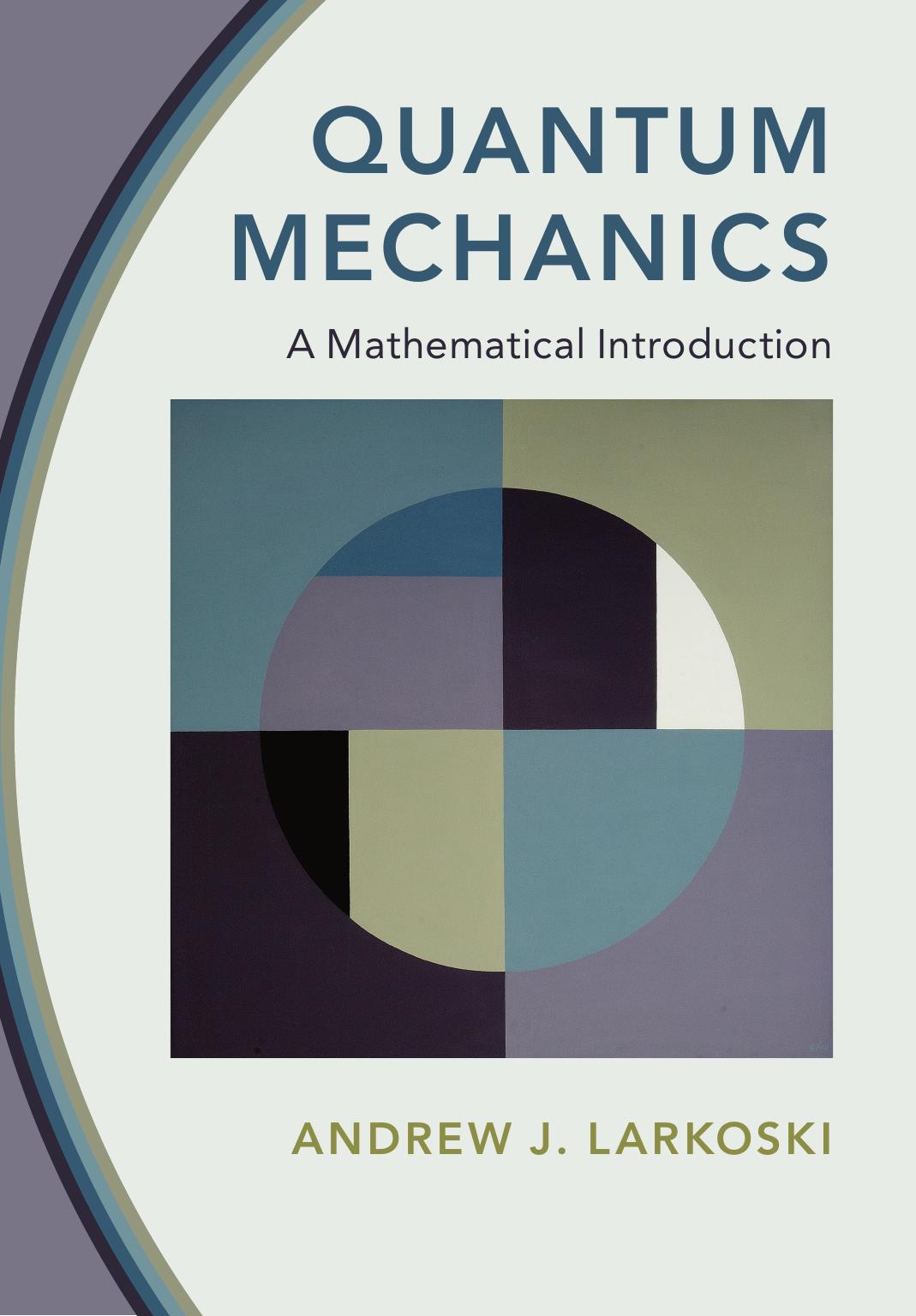
Quantum Mechanics A Mathematical Introduction 1st Edition by Andrew Larkoski ISBN 978-1009100502 1009100505


Original price was: $50.00.$35.00Current price is: $35.00.
Quantum Mechanics A Mathematical Introduction 1st Edition by Andrew J. Larkoski – Ebook PDF Instant Download/Delivery: 978-1009100502, 1009100505
Full download Quantum Mechanics A Mathematical Introduction 1st Edition after payment
Product details:
ISBN 10: 1009100505
ISBN 13: 978-1009100502
Author: Andrew J. Larkoski
This original and innovative textbook takes the unique perspective of introducing and solving problems in quantum mechanics using linear algebra methods, to equip readers with a deeper and more practical understanding of this fundamental pillar of contemporary physics. Extensive motivation for the properties of quantum mechanics, Hilbert space, and the Schrödinger equation is provided through analysis of the derivative, while standard topics like the harmonic oscillator, rotations, and the hydrogen atom are covered from within the context of operator methods. Advanced topics forming the basis of modern physics research are also included, such as the density matrix, entropy, and measures of entanglement. Written for an undergraduate audience, this book offers a unique and mathematically self-contained treatment of this hugely important topic. Students are guided gently through the text by the author’s engaging writing style, with an extensive glossary provided for reference and numerous homework problems to expand and develop key concepts. Online resources for instructors include a fully worked solutions manual and lecture slides.
Table of contents:
1 Introduction
1.1 Structure of This Book
1.2 Fundamental Hypothesis of Quantum Mechanics
2 Linear Algebra
2.1 Invitation: The Derivative Operator
2.2 Linearity
2.3 Matrix Elements
2.4 Eigenvalues
2.5 Properties of the Derivative as a Linear Operator
2.6 Orthonormality of Complex-Valued Vectors
Exercises
3 Hilbert Space
3.1 The Hilbert Space
3.2 Unitary Operators
3.3 Hermitian Operators
3.4 Dirac Notation
3.5 Position Basis and Continuous-Dimensional Hilbert Spaces
3.6 The Time Derivative
3.7 The Born Rule
Exercises
4 Axioms of Quantum Mechanics and their Consequences
4.1 The Schrödinger Equation
4.2 Time Evolution of Expectation Values
4.3 The Uncertainty Principle
4.4 The Density Matrix: A First Look
Exercises
5 Quantum Mechanical Example: The Infinite Square Well
5.1 Hamiltonian of the Infinite Square Well
5.2 Correspondence with Classical Mechanics
Exercises
6 Quantum Mechanical Example: The Harmonic Oscillator
6.1 Representations of the Harmonic Oscillator Hamiltonian
6.2 Energy Eigenvalues of the Harmonic Oscillator
6.3 Uncertainty and the Ground State
6.4 Coherent States
Exercises
7 Quantum Mechanical Example: The Free Partide
7.1 Two Disturbing Properties of Momentum Eigenstates
7.2 Properties of the Physical Free Particle
7.3 Scattering Phenomena
7.4 The S-matrix
7.5 Three Properties of the S-matrix
Exercises
8 Rotations in Three Dimensions
8.1 Review of One-Dimensional Transformations
8.2 Rotations in Two Dimensions in Quantum Mechanics
8.3 Rotations in Three Dimensions Warm-Up: Two Surprising Properties
8.4 Unitary Operators for Three-Dimensional Rotations
8.5 The Angular Momentum Hilbert Space
8.6 Specifying Representations: The Casimir of Rotations
8.7 Quantum Numbers and Conservation Laws
Exercises
9 The Hydrogen Atom
9.1 The Hamiltonian of the Hydrogen Atom
9.2 The Ground State of Hydrogen
9.3 Generating All Bound States: The Laplace-Runge-Lenz Vector
9.4 Quantizing the Hydrogen Atom
9.5 Energy Eigenvalues with Spherical Data
9.6 Hydrogen in the Universe
Exercises
10 Approximation Techniques
10.1 Quantum Mechanics Perturbation Theory
10.2 The Variational Method
10.3 The Power Method
10.4 The WKB Approximation
Exercises
11 ThePathIntegral
11.1 Motivation and Interpretation of the Path Integral
11.2 Derivation of the Path Integral
11.3 Derivation of the Schrödinger Equation from the Path Integral
11.4 Calculating the Path Integral
11.5 Example: The Path Integral of the Harmonic Oscillator Exercises
12 The Density Matrix
12.1 Description of a Quantum Ensemble
12.2 Entropy
12.3 Some Properties of Entropy
12.4 Quantum Entanglement
12.5 Quantum Thermodynamics and the Partition Function
Exercises
13 Why Quantum Mechanics?
13.1 The Hilbert Space as a Complex Vector Space
13.2 The Measurement Problem
13.3 Decoherence, or the Quantum-to-Classical Transition
People also search for:
quantum mechanics a mathematical
quantum mechanics a mathematical introduction pdf
quantum mechanics a mathematical introduction larkoski pdf
quantum mechanics a mathematical introduction andrew j. larkoski
a mathematical journey to quantum mechanics
Tags: Andrew Larkoski, Quantum Mechanics, Mathematical Introduction