
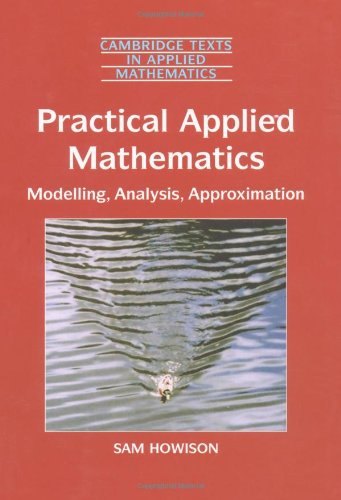
Practical applied mathematics modelling analysis approximation 1st Edition by Sam Howison ISBN 0521603692 978-0521603690


Original price was: $50.00.$35.00Current price is: $35.00.
Practical applied mathematics modelling analysis approximation 1st Edition by Sam Howison – Ebook PDF Instant Download/Delivery: 0521603692, 978-0521603690
Full download Practical applied mathematics modelling analysis approximation 1st Edition after payment
Product details:
ISBN 10: 0521603692
ISBN 13: 978-0521603690
Author: Sam Howison
Drawing from an exhaustive variety of mathematical subjects, including real and complex analysis, fluid mechanics and asymptotics, this book demonstrates how mathematics can be intelligently applied within the specific context to a wide range of industrial uses. The volume is directed to undergraduate and graduate students.
Table of contents:
I Modelling techniques
1 The basics of modelling
1.1 Introduction
1.2 What do we mean by a model?
1.3 Principles of modelling
1.3.1 Example: inviscid fluid mechanics
1.3.2 Example: viscous fluids
1.4 Conservation laws
1.5 Conclusion
1.6 Exercises
2 Units, dimensions and dimensional analysis
2.1 Introduction
2.2 Units and dimensions
2.2.1 Example: heat flow
2.3 Electric fields and electrostatics
2.4 Exercises
3 Non-dimensionalisation
3.1 Nondimensionalisation
3.1.1 Example: advection-diffusion
3.1.2 Example: the damped pendulum
3.1.3 Example: beams and strings
3.2 The Navier–Stokes equations
3.2.1 Water in the bathtub
3.3 Buckingham’s Pi-theorem
3.4 Exercises
4 Case studies: hair modelling and cable laying
4.1 The Euler–Bernoulli model for a beam
4.2 Hair modelling
4.3 Cable-laying
4.4 Modelling and analysis
4.4.1 Boundary conditions
4.4.2 Effective forces and nondimensionalisation
4.5 Exercises
5 Case study: the thermistor (1)
5.1 Thermistors
5.1.1 A black box model
5.1.2 A simple model for heat flow
5.2 Nondimensionalisation
5.3 A thermistor in a circuit
5.3.1 The one-dimensional model
5.4 Sources and further reading
6 Case study: electrostatic painting
6.1 Electrostatic painting
6.2 Field equations
6.3 Boundary conditions
6.4 Nondimensionalisation
6.5 Exercises
II Mathematical techniques
7 Partial differential equations
7.1 First-order equations
7.2 Example: Poisson processes
7.3 Shocks
7.3.1 The Rankine–Hugoniot conditions
7.4 Nonlinear equations
7.5 Second-order linear equations in two variables
7.6 Exercises
8 Case study: traffic modelling
8.1 Simple models for traffic flow
8.2 Traffic jams and other discontinuous solutions
8.3 More sophisticated models
8.4 Exercises
9 Distributions
9.1 Introduction
9.2 A point force on a stretched string; impulses
9.3 Informal definition of the delta and Heaviside functions
9.4 Examples
9.4.1 A point force on a wire revisited
9.4.2 Continuous and discrete probability
9.4.3 The fundamental solution of the heat equation
9.5 Balancing singularities
9.5.1 The Rankine–Hugoniot conditions
9.5.2 Case study: cable-laying
9.6 Green’s functions
9.6.1 Ordinary differential equations
9.6.2 Partial differential equations
9.7 Exercises
10 Theory of distributions
10.1 Test functions
10.2 The action of a test function
10.3 Definition of a distribution
10.4 Further properties of distributions
10.5 The derivative of a distribution
10.6 Extensions of the theory of distributions
10.6.1 More variables
10.6.2 Fourier transforms
10.7 Exercises
11 Case study: the pantograph
11.1 What is a pantograph?
11.2 The model
11.2.1 What happens at the contact point?
11.3 Impulsive attachment
11.4 Solution near a support
11.5 Solution for a whole span
11.6 Exercises
III Asymptotic techniques
12 Asymptotic expansions
12.1 Introduction
12.2 Order notation
12.2.1 Asymptotic sequences and expansions
12.3 Convergence and divergence
12.4 Exercises
13 Regular perturbation expansions
13.1 Introduction
13.2 Example: stability of a spacecraft in orbit
13.3 Linear stability
13.3.1 Stability of critical points in a phase plane
13.3.2 Example: a system which is neutrally stable but nonlinearly stable (or unstable)
13.4 Example: the pendulum
13.5 Small perturbations of a boundary
13.5.1 Example: flow past a nearly circular cylinder
13.5.2 Example: water waves
13.6 Caveat expandator
13.7 Exercises
14 Case study: electrostatic painting (2)
14.1 Small parameters in the electropaint model
14.2 Exercises
15 Case study: piano tuning
15.1 The notes of a piano
15.2 Tuning an ideal piano
15.3 A real piano
15.4 Exercises
16 Boundary layers
16.1 Introduction
16.2 Functions with boundary layers; matching
16.2.1 Matching
16.3 Examples from ordinary differential equations
16.4 Cable laying
16.5 Examples for partial differential equations
16.5.1 Large Peclet number heat flow
16.5.2 Traffic flow with small anticipation
16.5.3 A thin elliptical conductor in a uniform electric field
16.6 Exercises
17 Case study: the thermistor (2)
17.1 Exercises
18 ‘Lubrication theory’ analysis
People also search for:
applied mathematics class 12 practical file
applied mathematics practical file
applied mathematics practical applications
what is practical math
what is applied mathematics
Tags:
Sam Howison,Practical applied,mathematics modelling