
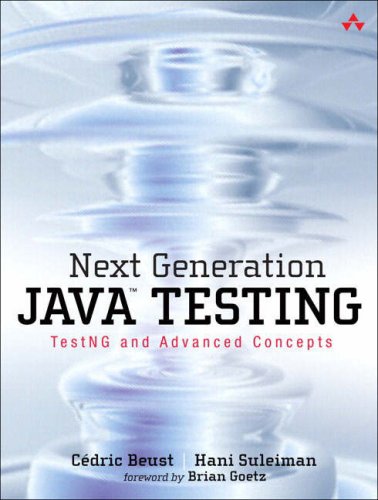
Next Generation Java Testing TestNG and Advanced Concepts 1st Edition by Cã©Dric Beust, Hani Suleiman ISBN 978-0321503107 0321503104


Original price was: $50.00.$35.00Current price is: $35.00.
Next Generation Java Testing TestNG and Advanced Concepts 1st Edition by Cã©Dric Beust, Hani Suleiman – Ebook PDF Instant Download/Delivery: 978-0321503107, 0321503104
Full download Next Generation Java Testing TestNG and Advanced Concepts 1st Edition after payment
Product details:
ISBN 10: 0321503104
ISBN 13: 978-0321503107
Author: Cã©Dric Beust, Hani Suleiman
Enterprise Java developers must achieve broader, deeper test coverage, going beyond unit testing to implement functional and integration testing with systematic acceptance. Next Generation Java™ Testing introduces breakthrough Java testing techniques and TestNG, a powerful open source Java testing platform.
Cédric Beust, TestNG’s creator, and leading Java developer Hani Suleiman, present powerful, flexible testing patterns that will work with virtually any testing tool, framework, or language. They show how to leverage key Java platform improvements designed to facilitate effective testing, such as dependency injection and mock objects. They also thoroughly introduce TestNG, demonstrating how it overcomes the limitations of older frameworks and enables new techniques, making it far easier to test today’s complex software systems.
Pragmatic and results-focused, Next Generation Java™ Testing will help Java developers build more robust code for today’s mission-critical environments.
This book
Illuminates the tradeoffs associated with testing, so you can make better decisions about what and how to test
Introduces TestNG, explains its goals and features, and shows how to apply them in real-world environments
Shows how to integrate TestNG with your existing code, development frameworks, and software libraries
Demonstrates how to test crucial code features, such as encapsulation, state sharing, scopes, and thread safety
Shows how to test application elements, including JavaEE APIs, databases, Web pages, and XML files
Presents advanced techniques: testing partial failures, factories, dependent testing, remote invocation, cluster-based test farms, and more
Walks through installing and using TestNG plug-ins for Eclipse, and IDEA
Contains extensive code examples
Whether you use TestNG, JUnit, or another testing framework, the testing design patterns presented in this book will show you how to improve your tests by giving you concrete advice o
Table of contents:
Chapter 1
Getting Started
Beyond JUnit 3
Stateful Classes
Parameters
Base Classes
Exceptions Are Not That Exceptional
Running Tests
Real-World Testing
Configuration Methods
Dependencies
Epiphanies
JUnit 4
Designing for Testability
Object-Oriented Programming and Encapsulation
The Design Patterns Revolution
Identifying the Enemy
Recommendations
TestNG
Annotations
Tests, Suites, and Configuration Annotations
Groups
testng.xml
Conclusion
Chapter 2
Testing Design Patterns
Testing for Failures
Reporting Errors
Runtime and Checked Exceptions
Testing Whether Your Code Handles Failures Gracefully
When Not to Use expectedExceptions
testng-failed.xml
Factories
@Factory
org.testng.ITest
Data-Driven Testing
Parameters and Test Methods
Passing Parameters with testng.xml
Passing Parameters with @DataProvider
Parameters for Data Providers
The Method Parameter
The ITestContext Parameter
Lazy Data Providers
Pros and Cons of Both Approaches
Supplying the Data
Data Provider or Factory?
Tying It All Together
Asynchronous Testing
Testing Multithreaded Code
Concurrent Testing
threadPoolsize, invocationCount, and timeOut
Concurrent Running
Turning on the Parallel Bit
Performance Testing
Algorithm Complexity
Testing Complexity
Mocks and Stubs
Mocks versus Stubs
Designing for Mockability
Mock Libraries
Selecting the Right Strategy
Mock Pitfalls
Dependent Testing
Dependent Code
Dependent Testing with TestNG
Deciding Whether to Depend on Groups or on Methods
Dependent Testing and Threads
Failures of Configuration Methods
Inheritance and Annotation Scopes
The Problem
Pitfalls of Inheritance
Test Groups
Syntax
Groups and Runtime
Running Groups
Using Groups Effectively
Code Coverage
A Coverage Example
Coverage Metrics
Coverage Tools
Implementation
Beware!
A Guide to Successful Coverage
Conclusion
Chapter 3
Enterprise Testing
A Typical Enterprise Scenario
Participants
Testing Methodology
Issues with the Current Approach
A Concrete Example
Goals
where
Test Implementation
Testing for Success
Building Test Data
Test Setup Issues
Error Handling
Emerging Unit Tests
Coping with In-Container Components
Putting It All Together
Exploring the Competing Consumers Pattern
The Pattern
The Test
The Role of Refactoring
A Concrete Example
An In-Container Approach
Conclusion
Chapter 4
Java EE Testing
In-Container versus Out-of-Container Testing
In-Container Testing
Creating a Test Environment
Identifying Tests
Registering Tests
Registering a Results Listener
Java Naming and Directory Interface (JNDI)
Understanding JNDI’s Bootstrapping
Spring’s SimpleNamingContextBuilder
Avoiding JNDI
Java Database Connectivity (JDBC)
c3p0
Commons DBCP
Spring
Java Transaction API (JTA)
Java Open Transaction Manager (JOTM)
Atomikos TransactionEssentials
Java Messaging Service (JMS)
Creating a Sender/Receiver Test
Using ActiveMQ for Tests
Java Persistence API (JPA)
Configuring the Database
Configuring the JPA Provider
Writing the Test
Simulating a Container
Using Spring as the Container
Enterprise Java Beans 3.0 (EJB3)
Message-Driven Beans
Session Beans
Another Spring Container
Disadvantages of a Full Container
Java API for XML Web Services (JAX-WS)
Recording Requests
Setting Up the Test Environment
Creating the Service Test
XPath Testing
Testing Remote Services
Servlets
In-Container Testing
Mock/Stub Objects
Refactoring
Embedded Container
In-Memory Invocation
XML
Using dom4j
Using XMLUnit
Conclusion
Chapter 5
Integration
Spring
Spring’s Test Package Features
Test Class Hierarchy
Guice
The Issue with Spring
Enter Guice
A Typical Dependency Scenario
The Object Factory
Guice Configuration
Guice-Based Test
Grouping Test Dependencies
Injecting Configuration
DbUnit
Configuration
Usage
Verifying Results
HtmlUnit
Configuration
Usage
Selenium
Swing UI Testing
Testing Approach
Configuration
Usage
Tests for Painting Code
Continuous Integration
Why Bother?
CI Server Features
TestNG Integration
Conclusion
Chapter 6
Extending TestNG
The TestNG API
org.testng.TestNG, ITestResult, ITestListener,
ITestNGMethod
A Concrete Example
The XML API
Synthetic XML Files
BeanShell
BeanShell Overview
TestNG and BeanShell
Interactive Execution
Method Selectors
Annotation Transformers
Annotation History
Pros and Cons
Using TestNG Annotation Transformers
Possible Uses of Annotation Transformers
Reports
Default Reports
The Reporter API
The Report Plug-in API
Writing Custom Annotations
Implementation
Testing
Conclusion
Chapter 7
Digressions
Motivation
The TestNG Philosophy
The Care and Feeding of Exceptions
Stateful Tests
Immutable State
Mutable State
The Pitfalls of Test-Driven Development
TDD Promotes Microdesign over Macrodesign
TDD Is Hard to Apply
Extracting the Good from Test-Driven Development
Testing Private Methods
Testing versus Encapsulation
The Power of Debuggers
Logging Best Practices
The Value of Time
Conclusion
People also search for:
next generation java testing testng and advanced concepts pdf
next generation java testing testng and advanced concepts
next generation testing
next generation sequencing genetic testing
nextgen testing framework
Tags: Cã©Dric Beust, Hani Suleiman, Next Generation, Java Testing TestNG, Advanced Concepts