
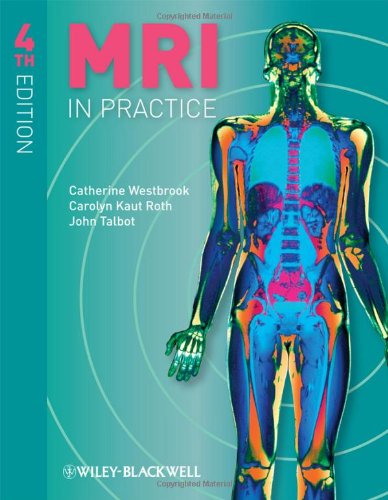
MRI in Practice 4th Edition by Catherine Westbrook ISBN 9781444337433 978-1444337433


Original price was: $50.00.$35.00Current price is: $35.00.
MRI in Practice 4th Edition by Catherine Westbrook – Ebook PDF Instant Download/Delivery: 9781444337433, 978-1444337433
Full download MRI in Practice 4th Edition after payment
Product details:
ISBN 10: 9781444337433
ISBN 13: 978-1444337433
Author: Catherine Westbrook
Since the first edition was published in 1993, the book has become the standard text for radiographers, technologists, radiology residents, radiologists and even sales representatives on the subject of magnetic resonance imaging. This text is essential reading on postgraduate courses. Furthermore MRI in Practice has come to be known as the number one reference book and study guide in the areas of MR instrumentation, principles, pulse sequences, image acquisition, and imaging parameters for the advanced level examination for MRI offered by the American Registry for Radiologic Technologists (ARRT) in the USA.
The book explains in clear terms the theory that underpins magnetic resonance so that the capabilities and operation of MRI systems can be fully appreciated and maximized. This third edition captures recent advances, and coverage includes: parallel imaging techniques and new sequences such as balanced gradient echo.
Building on the success of the first three editions, the fourth edition has been fully revised and updated. It also now has a companion website which hosts animated versions of a selection of illustrations in the book to aid with the reader’s comprehension of some of the more difficult concepts. The website also hosts over 200 interactive self-assessment exercises to help the reader test their understanding.
Table of contents:
1 Foreword
2 Preface to the Fourth Edition
3 Acknowledgments
4 Basic principles
5 Introduction
6 Atomic structure
7 Motion in the atom
8 MR active nuclei
9 The hydrogen nucleus
10 Alignment
11 Precession
12 The Larmor equation
13 Resonance
14 The MR signal
15 The free induction decay signal (FID)
16 Relaxation
17 T1 recovery
18 T2 decay
19 Pulse timing parameters
20 Image weighting and contrast
21 Introduction
22 Image contrast
23 Contrast mechanisms
24 Relaxation in different tissues
25 T1 contrast
26 T2 contrast
27 Proton density contrast
28 Weighting
29 T2* decay
30 Introduction to pulse sequences
31 Encoding and image formation
32 Encoding
33 Introduction
34 Gradients
35 Slice selection
36 Frequency encoding
37 Phase encoding
38 Sampling
39 Data collection and image formation
40 K space description
41 K space filling
42 Fast Fourier transform (FFT)
43 Important facts about K space
44 K space traversal and gradients
45 Options that fill K space
46 Types of acquisition
47 Parameters and trade-offs
48 Introduction
49 Signal to noise ratio (SNR)
50 Contrast to noise ratio (CNR)
51 Spatial resolution
52 Scan time
53 Trade-offs
54 Decision making
55 Volume imaging
56 Pulse sequences
57 Introduction
58 Spin echo pulse sequences
59 Conventional spin echo
60 Fast or turbo spin echo
61 Inversion recovery
62 Fast inversion recovery
63 STIR short tau inversion recovery
64 FLAIR fluid attenuated inversion recovery
65 IR prep sequences
66 Gradient echo pulse sequences
67 Conventional gradient echo
68 The steady state and echo formation
69 Coherent gradient echo
70 Incoherent gradient echo (spoiled)
71 Steady state free precession (SSFP)
72 Balanced gradient echo
73 Fast gradient echo
74 Single shot imaging techniques
75 Parallel imaging techniques
76 Flow phenomena
77 Introduction
78 The mechanisms of flow
79 Flow phenomena
80 Time of flight phenomenon
81 Entry slice phenomenon
82 Intra-voxel dephasing
83 Flow phenomena compensation
84 Even echo rephasing
85 Gradient moment rephasing (nulling)
86 Spatial pre-saturation
87 Artefacts and their compensation
88 Introduction
89 Phase mismapping
90 Aliasing or wrap around
91 Chemical shift artefact
92 Out of phase artefact (chemical misregistration)
93 Truncation artefact
94 Magnetic susceptibility artefact
95 Cross-excitation and cross-talk
96 Zipper artefact
97 Shading artefact
98 Moiré artefact
99 Magic angle
100 Vascular and cardiac imaging
101 Introduction
102 Conventional MRI vascular imaging techniques
103 Magnetic resonance angiography (MRA)
104 Cardiac MRI
105 Cardiac gating
106 Peripheral gating
107 Pseudo-gating
108 Multiphase cardiac imaging
109 Ciné
110 SPAMM
111 Instrumentation and equipment
112 Introduction
113 Magnetism
114 Permanent magnets
115 Electromagnets
116 Superconducting electromagnets
117 Fringe fields
118 Shim coils
119 Gradient coils
120 Radio frequency (RF)
121 Patient transportation system
122 MR computer systems and the user interface
123 MRI safety
124 Introduction
125 Government guidelines
126 Safety terminology
127 Hardware and magnetic field considerations
128 Radio frequency fields
129 Gradient magnetic fields
130 The main magnetic field
131 Projectiles
132 Siting considerations
133 MRI facility zones
134 Safety education
135 Protecting the general public from the fringe field
136 Implants and prostheses
137 Devices and monitors in MRI
138 Pacemakers
139 Patient conditions
140 Safety policy
141 Safety tips
142 Contrast agents in MRI
143 Introduction
144 Mechanism of action of contrast agents
145 Molecular tumbling
146 Dipole–dipole interactions
147 Magnetic susceptibility
148 Relaxivity
149 Gadolinium safety
150 Other contrast agents
151 Current applications of gadolinium contrast agents
152 Conclusion
153 Functional imaging techniques
154 Introduction
155 Diffusion weighted imaging (DWI)
156 Perfusion imaging
157 Susceptibility weighting (SWI)
158 Functional imaging (fMRI)
159 Interventional MRI
160 MR spectroscopy (MRS)
161 Whole body imaging
162 MR microscopy (MRM)
163 Glossary
164 Index
People also search for:
mri master
mri angus
mri callmax
mri ascend
my mri buddy
Tags:
Catherine Westbrook,MRI in Practice