
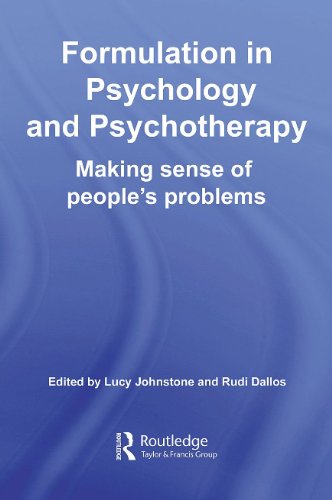
Formulation in Psychology and Psychotherapy Making Sense of People s Problems 1st Edition by Lucy Johnstone 0203087267 9781583918999


Original price was: $50.00.$35.00Current price is: $35.00.
Formulation in Psychology and Psychotherapy: Making Sense of People’s Problems 1st Edition by Lucy Johnstone – Ebook PDF Instant Download/Delivery: 0203087267, 9781583918999
Full download Formulation in Psychology and Psychotherapy: Making Sense of People’s Problems 1st Edition after payment
Product details:
ISBN 10: 0203087267
ISBN 13: 9781583918999
Author: Lucy Johnstone
The first edition of Formulation in Psychology and Psychotherapy caught the wave of growing interest in formulation in a clinical context. This completely updated and revised edition summarises recent practice, research, developments and debates while retaining the features that made the first a leading text in the field. It contains new chapters on personal construct formulation, formulation in health settings, and the innovative practice of using formulation in teams. The book sees formulation as a dynamic process which explores personal meaning collaboratively and reflectively, taking account of relational and social contexts. Two case studies, one adult and one child, illustrate the use of formulation from the perspectives of expert clinicians from six different theoretical positions. The book encourages the reader to take a constructively critical perspective on the many philosophical, professional and ethical debates raised by the process of formulating people’s problems. Among the issues explored are: The social and political context of formulation Formulation in relation to psychiatric diagnosis The limitations of formulation Controversies and debates about formulation This readable and comprehensive guide to the field provides a clear, up to date and thought-provoking overview of formulation from a number of perspectives, essential for clinicians working in all areas of mental health and social care, psychology, therapy and counselling.
Formulation in Psychology and Psychotherapy 1st Table of contents:
1 Introduction to formulation
Formulation in psychology and psychotherapy
What do we mean by formulation?
Team formulation
Differences and common factors in formulation
What is the purpose of a formulation?
Psychodynamic
Cognitive-behavioural
Systemic
Integrative
How did the concept of formulation arise?
Psychodynamic approaches
Cognitive-behavioural approaches
Systemic approaches
Other therapeutic traditions
Best practice in formulation
Conclusion
Jack
Janet
References
2 Case formulation in cognitive behavioural therapy A principle-driven approach
A principled approach to CBT case conceptualisation
Jack
Principle 1: levels of conceptualisation
Presenting issues
Perpetuating factors
Precipitating factors
Predisposing factors: quantity of events
Predisposing factors: quality of events
Principle 2: collaborative empiricism
Principle 3: include client strengths and conceptualise resilience
Janet
Levels of conceptualisation
Collaborative empiricism
Strengths and resilience
Reflections
Conclusions
Key characteristics of CBT formulation
Acknowledgements
References
3 Psychodynamic formulation Looking beneath the surface
What is a psychodynamic approach?
Core features of a psychodynamic approach
The dynamic perspective
The developmental perspective
The structural perspective
The adaptive perspective
Jack: a psychodynamic formulation
A prince betrayed and disinherited
Reflection on the formulation
Towards intervention
Janet: a psychodynamic formulation
A girl unheld
Reflections
Key characteristics of a psychodynamic formulation
References
4 Systemic formulation Mapping the family dance
The systemic approach
Symptoms and family processes
Core systemic concepts
Formulation in systemic practice
Exploration of the problem
Progressive hypothesising
Family therapy and social constructionism
Use of self-reflective formulation
A proposed model of systemic formulation
Jack: a systemic formulation
Deconstructing the problem
Problem-maintaining patterns and feedback loops
Beliefs and explanations
Transitions, emotions, attachments
Contextual factors
Summary
Synthesis: a systemic formulation for Jack
Janet: a systemic formulation
Deconstructing the problems
Problem-maintaining patterns and feedback loops
Beliefs and explanations
Transitions, emotions and attachments
Contextual factors
Synthesis: a systemic formulation for Janet
First formulation
Second formulation
Comments
The politics of formulation
Key characteristics of a systemic formulation
References
5 Formulation and narrative therapy Telling a different story
Formulation and narrative therapy
Theoretical influences on the development of narrative therapy
Relating these ideas to social constructionism
The assumptions of narrative therapy
Stretching the notion of formulation
Preamble to the case examples
Jack: a narrative therapy formulation
Externalising conversations: naming the problem
Tracing the history of the problem
Exploring the effects of the problem
Situating the problem in context: deconstruction
Unique outcomes
Tracing the history and meaning of the unique outcomes and naming an alternative story
Re-membering conversations
Therapeutic documents
Expanding the conversation: leagues and teams
Outsider-witness groups and definitional ceremonies
To formulate or not to formulate?
Janet: a narrative therapy formulation
The context of the referral
Collaboration
Externalisation
Key characteristics of a narrative therapy approach to formulation
Acknowledgements
Notes
References
6 Reformulating the impact of social inequalities Power and social justice
What is a social inequalities approach?
What are social inequalities?
Social inequalities and mental health
Critical evaluation of the ‘evidence base’
Power and inequality
Reflecting real-life diversity and recognising difference
Making Jack more visible: critical formulation
Collaborative formulation: situating Jack’s experiences
Dialogue: ‘A few lines about a world of trouble’
Critical reflections on the discussion
Masculinity as problematic
Formulating power
Social justice and empowerment potentials
Making Janet more visible: critical formulation
Femininity as problematic
Formulating power
Restoring meaning through making socio-cultural context visible
Reflexive practice
Key characteristics of formulation from a social inequalities perspective
Acknowledgements
References
7 Formulation in personal and relational construct psychology Seeing the world through clients’ eyes
Personal Construct Psychology
Personal construct formulation
Diagnostic constructs
Covert construing
Structure of construing
Strategies of construing
Control
‘Emotions’
Dependency
Content of construing
Developments in the personal construct view of disorder
Relational extension of PCP
Relationality and levels of interpersonal construing
Personal construct assessment methods
Interviews
Self-characterisation
Repertory grid technique
Qualitative grids and the ‘bowtie’
Tracing of construct implications
Jack and Janet
Jack
Validational history
Jack’s constructs
Structure and process of construing
Constructs of transition
Towards intervention
Janet
Monadic construing
Dyadic construing
Triadic construing
Discussion
Key characteristics of Personal Construct Psychology formulation
Acknowledgements
References
8 Integrative formulation in theory
Integrative formulations
Eclecticism
Conceptual synthesis
Some reflections: implicit integration in practice
Weerasekera’s framework
Jack: formulation using Weerasekera’s framework
Assessment
Advantages and limitations of the Weerasekera framework and the 4 Ps
Integrative formulating: towards some principles in practice
Integration through formulating in the therapeutic relationship
Formulating as an active process
Personal meaning as the central integrating factor in formulation
Personal development and integration
Checklist of best practice integrative formulation
Summary
References
9 Integrative formulation in practice A dynamic, multi-level approach
Formulating and the therapeutic relationship
Hypothetical conversation with Jack
Attachment Narrative Therapy (ANT) formulation
Integration based on a conceptual synthesis of complementary models
Connections and differences between systemic, attachment and narrative therapeutic models
ANT formulation for Jack
Jack
Attachments and systemic processes
Cultural contexts and narratives
Integration
Implications for interventions
The context in which we practise
Summary
Key characteristics of integrative formulation
References
10 Using formulation in teams
Defining the team formulation approach
Co-constructing a team formulation in response to a particular request
Facilitating regular formulation meetings for the whole team
Integrating formulation into the work of the team and the service at every level
What do we know about the benefits of team formulation?
Jack: a tentative team formulation
Comment on the team formulation
Intervention plan based on the team formulation
Team formulation letter to Jack
Reflection on the team formulation and intervention plan
Essential characteristics of a team formulation
Transference and counter-transference between service user and team
An attachment perspective on the way the client uses/ interacts with the psychiatric service as a whole
Psychological framing of medical interventions
Psychological framing of ‘symptoms’ including ‘psychosis’
Awareness of social factors, such as class, gender, housing, employment etc
Influence of the ‘mental patient’ role
Possible role of trauma and abuse
Possible re-traumatising role of services
Team formulation in practice
Useful concepts in team formulation
Facilitating a formulation meeting
Team formulation for culture change
Summary
Acknowledgements
References
11 Using integrative formulation in health settings
Challenges and considerations in formulation in health settings
Additional theoretical influences on health formulation
Health beliefs and illness representations
Coping theory
Cultural/societal context
Cognitive development and health-related understanding
Janet: a perspective from the health context
Towards intervention
Reflections
Key characteristics of formulation in health settings
References
12 Controversies and debates about formulation
Jack and Janet: the formulations
Formulations: are they evidence-based?
Formulations: truth versus usefulness
Formulations: useful to whom?
Useful to the client?
Harmful to the client?
Useful to the therapist?
Useful to professions?
Formulation versus psychiatric diagnosis
Are formulations individualising?
What would a formulation-based system look like?
Can anyone construct formulations? Do we need them at all?
So what are formulations then?
People also search for Formulation in Psychology and Psychotherapy 1st:
psychological formulation guide
clinical psychology practice
lucy johnstone books
therapy and psychotherapy frameworks
understanding client problems
Tags: Formulation, Psychology, Psychotherapy, Making Sense, Lucy Johnstone