
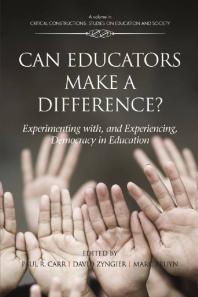
Can Educators Make a Difference Experimenting with and Experiencing Democracy in Education 1st Edition by Paul R Carr, David Zyngier, Marc Pruyn ISBN 1617358150 9781617358159


Original price was: $50.00.$35.00Current price is: $35.00.
Can Educators Make a Difference Experimenting with and Experiencing Democracy in Education 1st Edition by Paul R. Carr; David Zyngier; Marc Pruyn – Ebook PDF Instant Download/Delivery: 1617358150, 9781617358159
Full download Can Educators Make a Difference Experimenting with and Experiencing Democracy in Education 1st Edition after payment
Product details:
ISBN 10: 1617358150
ISBN 13: 9781617358159
Author: Paul R. Carr; David Zyngier; Marc Pruyn
As the title of this book suggests, how we understand, perceive and experience democracy may have a significant effect on how we actually engage in, and with, democracy. Within the educational context, this is a key concern, and forms the basis of the research presented in this volume within a critical, comparative analysis. The Global Doing Democracy Research Project (GDDRP), which currently has some 70 scholars in over 20 countries examining how educators do democracy, provides the framework in which diverse scholars explore a host of concerns related to democracy and democratic education, including the impact of neoliberalism, political literacy, critical engagement, teaching and learning for and about democracy, social justice, and the meaning of power/power relations within the educational context. Ultimately, the contributors of this book collectively ask: can there be democracy without a critically engaged education, and, importantly, what role do educators play in this context and process? Why many educators in diverse contexts believe that they are unable, dissuaded and/or prevented from doing thick democratic education is problematized in this book but the authors also seek to illustrate that, despite the challenges, barriers and concerns about doing democracy in education, something can, and should, be done to develop, cultivate and ingratiate schools and society with more meaningful democratic practices and processes. This book breaks new ground by using a similar empirical methodology within a number of international contexts to gage the democratic sentiments and actions of educators, which raises a host of questions about epistemology, teacher education, policy development, pedagogy, institutional cultures, conscientization, and the potential for transformational change in education.
Table of contents:
Chapter 1. Introducing the Global Doing Democracy Research Project
(Seeking to Understand the Perspectives, Experiences and Perceptions of Teachers in Relation to Democracy in Education)
Chapter 2. Democracy, Critical Pedagogy, and the Education of Educators
Chapter 3. Re-Discovering Democracy
(Putting Action Back into Active Citizenship and Praxis Back into Practice)
Chapter 4. Can We Teach Deep Democracy — And Can It Make a Difference?
Chapter 5. Getting Beyond Flat-Out Bored
(The Challenges and Possibilities of Creating a Democratic Space for Social Justice Education in Public Schools)
Chapter 6. Preservice Teachers’ Conceptions of Democratic Essence
(Interpretations of Democratic Principles and Their Connections to Social Justice, Economic Class, and Spirituality/Religion)
Chapter 7. What Kind of Citizenship for What Kind of Democracy?
(Are We Spectators of Everyday Events or Protagonists in History?)
Chapter 8. Teacher Education and Democracy
(Preparing Teachers in Metropolitan Buenos Aires)
Chapter 9. Education for Democracy in Peruvian Society
Chapter 10. Doing Democracy in Education
(Perspectives of Malaysian Principals)
Chapter 11. Critical Multicultural Social Studies for Thick Democracy
(Theory and Practice)
People also search for:
can substitute teaching count as student teaching
how do teachers make a difference
educators make a difference
how can teachers make a difference
does education make a difference in salary for teachers
Tags: Paul R Carr, David Zyngier, Marc Pruyn, Democracy, Education, Educators