
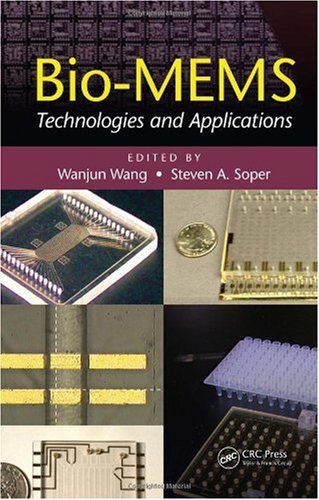
Bio MEMS Technologies and Applications 1st Edition by Wanjun Wang, Steven A Soper ISBN 0849335329 9780849335327


Original price was: $50.00.$35.00Current price is: $35.00.
Bio MEMS Technologies and Applications 1st Edition by Wanjun Wang, Steven A Soper – Ebook PDF Instant Download/Delivery: 0849335329, 9780849335327
Full download Bio MEMS Technologies and Applications 1st Edition after payment
Product details:
ISBN 10: 0849335329
ISBN 13: 9780849335327
Author: Wanjun Wang, Steven A Soper
This book considers both the unique characteristics of biological samples and the challenges of microscale engineering. Divided into three main sections, it first examines fabrication technologies using non-silicon processes, which are suitable for the materials more commonly used in medical/biological analyses. These include UV lithography, LIGA, nanoimprinting, and hot embossing. Attention then shifts to microfluidic components and sensing technologies for sample preparation, delivery, and analysis in microchannels and microchambers. The final section outlines various applications and systems at the leading edge of Bio-MEMS technology in a variety of areas such as drug delivery and proteomics.
Bio MEMS Technologies and Applications 1st Table of contents:
1 Introduction
1.1 Main Contents and Organization of the Book
1.1.1 Microfabrication Technologies
1.1.2 Microfluidic Devices and Components for Bio-MEMS
1.1.3 Sensing Technologies and Bio-MEMS Applications (Chapters 10, 11, 12, 13, 14, 15, and 16)
1.2 Suggestions for Using This Book as a Textbook
Part I Basic Bio-MEMS Fabrication Technologies
2 UV Lithography of Ultrathick SU-8 for Microfabrication of High-Aspect-Ratio Microstructures and Applications in Microfluidic and Optical Components
2.1 Introduction
2.2 Numerical Study of Diffraction Compensation and Wavelength Selection
2.2.1 Diffraction Caused by Air Gap and Wavelength Dependence of the UV Absorption Rate of SU-8
2.2.2 Numerical Analysis of Diffraction and the Absorption Spectrum on UV Lithography of Ultrathick SU-8 Resist
2.2.3 Development with One-Direction Agitation Force
2.3 Experimental Results Using Filtered Light Source and Air Gap Compensation for Diffraction
2.4 Basic Steps for Uv Lithography of Su-8 and Some Processing Tips
2.4.1 Pretreat for the Substrate
2.4.2 Spin-Coating SU-8
2.4.3 Soft Bake
2.4.4 Exposure
2.4.5 Postexposure Bake (PEB)
2.4.6 Development
2.5 Tilted Lithography of Su-8 and Its Application
2.5.1 Micromixer/Reactor
2.5.2 Three-Dimensional Hydrofocus Component for Microcytometer
2.5.3 Out-of-Plane Polymer Refractive Microlens, Microlens Array, Fiber Bundle Aligner
2.6 Conclusions
References
3 The LIGA Process: A Fabrication Process for High-Aspect-Ratio Microstructures in Polymers, Metals, and Ceramics
3.1 The Liga Process: A Brief History
3.2 The Liga Process: A Brief Introduction
3.3 Deep X-Ray Lithography Process
3.3.1 Synchrotron Light, Beamlines, and Scanner
3.3.2 X-Ray Mask
3.3.3 Resist Application and X-Ray Exposure
3.4 High-Aspect-Ratio Liga Structures
3.4.1 Electroplating of DXRL Microstructures
3.4.1.1 Basic Principle of Electrodeposition
3.4.1.1.1 Galvanostatic and Potentiostatic Plating
3.4.1.2 Electroplating Rate and Calculation of the Deposition Thickness
3.4.1.2.1 Surface Uniformity of Electroplated Metals
3.4.2 Nickel Electroplating and Solutions
3.4.3 Electroplating Quality and Influential Factors
3.4.3.1 Internal Stress
3.4.3.1.1 Current Density
3.4.3.1.2 Temperature
3.4.3.1.3 pH Value
3.4.3.1.4 Agitation
3.4.3.1.5 Filtration
3.5 Molding of Liga Microstructures
3.6 Application of Liga Microstructures
3.6.1 Mold Insert Fabrication
3.6.2 Precision Parts by Direct LIGA
3.6.2.1 Safety-and-Arming Switch
3.6.2.2 Nanobarcodes
3.6.2.3 Harmonic Drive® Microgears
3.6.2.4 Polymer Chips for Bio-MEMS Applications
3.6.2.5 Regenerators for Cryocoolers and Stirling Cycle Heat Engines
3.6.2.6 Examples of Precision Parts (HT Micro)
3.7 Summary
Acknowledgment
References
4 Nanoimprinting Technology for Biological Applications
4.1 Introduction
4.2 Overview of Nil Technology
4.2.1 NIL Process
4.2.2 Polymer Flow during NIL
4.2.3 Biocompatibility of the Resist
4.2.4 Stamps with Nanostructures
4.2.5 Antiadhesive Layer Coating
4.3 Nil in Biological Applications
4.3.1 Nanofluidic Devices
4.3.2 Engineering Nanopores
4.3.3 Chemical Nanopatterning
4.3.4 Protein Nanopatterning
4.4 Outlook
Acknowledgment
References
5 Hot Embossing for Lab-on-a-Chip Applications
5.1 Introduction
5.2 Polymers
5.2.1 Material Properties
5.2.2 Polymethylmethacrylate and Polycarbonate
5.2.3 Cyclic Olefin Copolymer
5.3 Master Fabrication
5.3.1 Micromachining Methods
5.3.2 Bulk Micromachining
5.3.3 Surface Micromachining
5.4 Hot Embossing
5.4.1 Conventional Hot Embossing Process
5.4.2 Examples of Embossed Structures
5.4.3 Hot Embossing with Polymer Masters
5.5 Conclusions
References
Part II Microfluidic Devices and Components for Bio-MEMS
6 Micropump Applications in Bio–MEMS
6.1 Introduction
6.2 Background
6.3 Fabrication Processes
6.4 Mechanical Micropumps
6.4.1 Actuation Sources
6.4.1.1 External Actuators
6.4.1.2 Electromagnetic Actuation
6.4.1.3 Piezoelectric Actuation
6.4.1.4 Pneumatic Actuation
6.4.1.5 Shape Memory Alloy
6.4.1.6 Integrated Actuators
6.4.1.7 Electrostatic Actuation
6.4.1.8 Thermopneumatic Actuation
6.4.1.9 Bimetallic Thermal Actuation
6.4.2 Positive Displacement Pumps
6.4.2.1 Positive Displacement Pumps with Integrated Check Valves
6.4.3 Fixed-Geometry Rectification Micropumps
6.4.4 Peristaltic Pumps
6.4.5 Acoustic Streaming
6.5 Nonmechanical Micropumps
6.5.1 Electroosmotic Flow Micropumps
6.5.2 Electrowetting
6.5.3 Marangoni Pumps
6.5.4 Buoyancy-Driven Flows
6.6 Conclusions
References
7 Micromixers
7.1 Introduction
7.2 Some Basic Considerations
7.3 Passive Micromixers
7.3.1 Pressure-Driven Passive Micromixers
7.3.2 Electrically Driven Passive Micromixers
7.4 Active Micromixers
7.5 Multiphase Micromixers
7.6 Performance Metrics for Microscale Mixer Design and Evaluation
7.7 Design Methodology for Optimal Diffusion-Based Micromixers for Batch Production Applications
References
8 Microfabricated Devices for Sample Extraction, Concentrations, and Related Sample Processing Technologies
8.1 Introduction
8.2 Sample Extraction and Concentrations
8.2.1 Solid-Phase Extraction Techniques on Microchips
8.2.2 Field Amplification Stacking Techniques on Microchips
8.2.3 Field-Amplified Injection on Microchips
8.2.4 Stacking of Neutral Analytes
8.2.5 Isotachophoresis for Sample Preconcentration
8.3 Derivatization of Samples
8.3.1 Labeling and Complexation on Microchips
8.3.2 Postcolumn Reactors for Derivatization
8.3.3 Precolumn Reactor Derivatization
8.3.4 Postcolumn Reactors for Chemiluminescence on Microchips
8.3.5 Miniaturized Flow Injection Analysis (µFIA)
8.4 Microfabricated Dialysis Devices
8.4.1 Microfabricated Single-Stage Microdialysis Device for Fast Desalting of Biological Samples
8.4.2 Microfabrcated Dual-Stage Microdialysis Device for Rapid Fractionation and Cleanup of Complex Biological Samples
8.4.3 Application to Complex Cellular Samples
8.5 Conclusions
Acknowledgments
References
9 Bio-MEMS Devices in Cell Manipulation: Microflow Cytometry and Applications
9.1 Conventional Cytometers
9.2 Microflow Cytometers
9.2.1 Particle Focusing Systems
9.2.1.1 Hydrodynamic Focusing
9.2.1.2 Small Constriction
9.2.1.3 Dielectrophoretic Focusing
9.2.2 Detection Systems
9.2.2.1 Optical Detection
9.2.2.2 Impedance Detection
9.2.3 Sorting and Counting
9.3 Summary
References
Part III Sensing Technologies for Bio-MEMS Applications
10 Coupling Electrochemical Detection with Microchip Capillary Electrophoresis
10.1 Introduction
10.2 Motivations for Electrochemical Detection
10.3 Historical Development
10.4 Instrumental Development
10.5 Electrode Configurations
10.5.1 Off-Chip Detection
10.5.2 Microfabricated Electrodes
10.5.3 Other Electrode Configurations
10.6 Detection Modes
10.6.1 Amperometry
10.6.2 Pulsed Electrochemical Detection
10.6.3 Conductivity
10.6.4 Other Electrochemical Detection Modes
10.7 Dual Electrochemical Detection and Ecd Coupled to Other Detection Modes
10.8 Decouplers
10.9 Electrode Materials and Designs
10.9.1 Thin-Film Metallic Electrodes
10.9.2 Carbon Electrodes
10.10 Conclusions and Future Directions
Acknowledgments
References
11 Culture-Based Biochip for Rapid Detection of Environmental Mycobacteria
11.1 Introduction
11.2 Culture-Based Approach
11.3 Paraffin Deposition and Patterning
11.3.1 Paraffins
11.3.2 Paraffin Deposition
11.3.3 Paraffin Patterning
11.4 Testing of Paraffin Surfaces with Microorganisms
11.5 Microfluidic Culture-Based Biochip
11.5.1 Microchannel Fabrication
11.5.2 Adhesive Bonding
11.5.3 Challenging Biochip with Mycobacteria
11.6 Conclusions
Acknowledgments
References
12 MEMS for Drug Delivery
12.1 Introduction
12.2 Human Skin and Microneedles
12.3 In-Plane Silicon Microneedles
12.4 In-Plane Metallic Microneedles
12.5 Out-of-Plane Silicon Microneedles
12.6 Out-of-Plane Metallic and Polymeric Microneedles
12.7 Mechanical Robustness of the Microneedles
12.8 Microreservoir Devices for Drug Delivery
12.9 Biocompatibility and Biofouling of Mems Drug Delivery Devices
References
13 Microchip Capillary Electrophoresis Systems for DNA Analysis
13.1 Introduction
13.2 Optimization of Dna Sequencing Separations
13.3 Parallel Dna Separations in Microchips
13.4 Integrated Microchips for Dna Analysis
13.5 Phase-Changing Sacrificial Layers for Polymer Microchip Fabrication
13.6 Conclusions
Acknowledgment
References
14 Bio-MEMS Devices for Proteomics
14.1 Introduction
14.2 Microarrays and Immunoassays
14.2.1 Peptide and Protein Microarrays
14.2.2 Immunoassays
14.3 Bottom-Up Proteomics
14.3.1 Overview of Proteomics Methodologies
14.3.2 Bio-MEMS in Bottom-Up Proteomics
14.3.2.1 One-Dimensional Analyte Separations
14.3.2.2 Two-Dimensional Analyte Separations
14.3.2.3 Modifications to Fluidic Networks
14.3.2.4 Sample Purification and Preconcentration
14.3.2.5 Bio-MEMS-Compatible Enzyme Reactors
14.4 Integrated Bio-Mems Approaches in Proteomics
14.4.1 Integrated High-Throughput Devices Using MALDI-MS
14.4.2 Integrated High-Throughput Devices Using ESI-MS
14.5 Summary
References
15 Single-Cell and Single-Molecule Analyses Using Microfluidic Devices
15.1 Introduction
15.1.1 What Is a Cell?
15.1.2 The Molecular Makeup of Cells
15.1.3 Single–Molecule Analysis
15.1.4 Why Analyze Single Cells or Single Molecules?
15.2 Single-Cell Analysis Using Microfluidic Devices
15.2.1 Cell Sorting and Capture
15.2.2 Cell Lysis
15.2.3 Cellular Physiology and Signaling
15.2.4 Molecular Analysis of Cells
15.2.5 Organelle Manipulation in Microfluidics
15.3 Single-Molecule Detection in Microfluidic Devices
15.3.1 DNA Fragment Sizing
15.3.2 Sequencing of Single DNA Molecules
15.3.3 Other SMD Bioassays On-Chip
15.3.4 Submicrometer-Sized Fluidic Channels
15.3.5 Selection of the Right Substrate Material for SMD
15.4 Concluding Remarks
References
16 Pharmaceutical Analysis Using Bio-MEMS
16.1 Advantages of the Microworld for Pharmaceutical and Biomedical Analysis
16.2 Basic Components of Bio-Mems and Lab-on-a-Chip Devices for Pharmaceutical Analysis
16.3 Challenges of Pharmaceutical Bio-Mems
16.4 Applications: Clinical Chemistry and Bioanalysis
16.4.1 Clinical Chemistry
16.4.2 Therapeutic Drug Monitoring
16.4.3 High-Throughput Screening
16.5 Conclusion
People also search for Bio MEMS Technologies and Applications 1st:
bio mems technologies and applications
uses and applications of biotechnology
applications of biomedical engineering
bio mems devices
bio mems applications
Tags: Wanjun Wang, Steven A Soper, MEMS, Technologies