
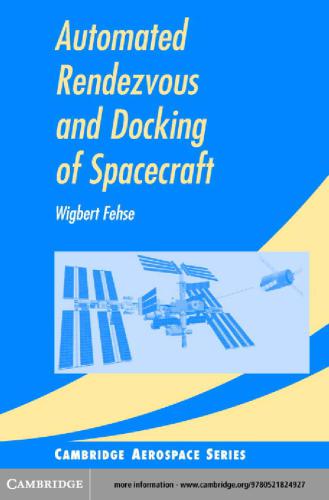
Automated Rendezvous and Docking of Spacecraft 1st Edition by Wigbert Fehse ISBN 978-0521089869 0521089867


Original price was: $50.00.$35.00Current price is: $35.00.
Automated Rendezvous and Docking of Spacecraft 1st Edition by Wigbert Fehse- Ebook PDF Instant Download/Delivery: 978-0521089869, 0521089867
Full download Automated Rendezvous and Docking of Spacecraft 1st Edition after payment
Product details:
ISBN 10: 0521089867
ISBN 13: 978-0521089869
Author: Wigbert Fehse
This definitive reference for space engineers provides an overview of the major issues governing approach and mating strategies, and system concepts for rendezvous & docking/berthing (RVD/B). These concerns are addressed and explained in a way that aerosp
Table of contents:
1 Introduction
1.1 Background
1.2 The complexity of the rendezvous process
1.3 Objective and scope
2 The phases of a rendezvous mission
2.1 Launch and orbit injection
2.1.1 The launch window
2.1.2 Definition of orbit plane and other orbit parameters
2.1.3 Launch operations flexibility
2.1.4 Vehicle state at end of launch phase
2.2 Phasing and transfer to near target orbit
2.2.1 Objective of phasing and state at end of phasing
2.2.2 Correction of time deviations and orbit parameters
2.2.3 Coordinate frames during rendezvous
2.2.4 Forward/backward phasing
2.2.5 Different phasing strategy for each mission
2.2.6 Location of the initial aim point
2.2.7 Strategy with entry gate instead of aim point
2.2.8 Final accuracy of open loop manoeuvres
2.3 Far range rendezvous operations
2.3.1 Objectives and goals of far range rendezvous
2.3.2 Relative navigation during rendezvous
2.3.3 Trajectory elements/time-flexible elements
2.3.4 Communication with the target station
2.4 Close range rendezvous operations
2.4.1 Closing
2.4.2 Final approach to contact
2.5 Mating: docking or berthing
2.5.1 Objectives and end conditions of the mating phase
2.5.2 Capture issues
2.6 Departure
2.6.1 Objectives and end conditions of the departure phase
2.6.2 Constraints and issues during departure
3 Orbit dynamics and trajectory elements
3.1 Reference frames.
3.1.1 Earth-centred equatorial frame Feq
3.1.2 Orbital plane frame Fop
3.1.3 Spacecraft local orbital frame Flo
3.1.4 Spacecraft attitude frame Fa
3.1.5 Spacecraft geometric frames Fge
3.2 Orbit dynamics
3.2.1 Orbital motion around a central body
3.2.2 Orbit corrections
3.2.3 The equations of motion in the target reference frame
3.3 Discussion of trajectory types
3.3.1 Free drift motions
3.3.2 Impulsive manoeuvres
3.3.3 Continuous thrust manoeuvres
3.4 Final remark on the equations of motion
3.4.1 Examples for combined cases
4 Approach safety and collision avoidance
4.1 Trajectory safety – trajectory deviations
4.1.1 Failure tolerance and trajectory design requirements
4.1.2 Design rules for trajectory safety
4.1.3 Causes of deviations from the planned trajectory
4.2 Trajectory disturbances
4.2.1 Drag due to residual atmosphere
4.2.2 Disturbances due to geopotential anomaly
4.2.3 Solar pressure
4.2.4 Dynamic interaction of thruster plumes between chaser and target
4.3 Trajectory deviations generated by the spacecraft systems
4.3.1 Trajectory deviations due to navigation errors
4.3.2 Trajectory deviations due to thrust errors
4.3.3 Trajectory deviations due to thruster failures
4.4 Protection against trajectory deviations
4.4.1 Active trajectory protection
4.4.2 Passive trajectory protection
4.5 Collision avoidance manoeuvres
5 The drivers for the approach strategy
5.1 Overview of constraints on the approach strategy
5.2 Launch and phasing constraints
5.2.1 The drift of nodes
5.2.2 Adjustment of arrival time
5.3 Geometrical and equipment constraints
5.3.1 Location and direction of target capture interfaces
5.3.2 Range of operation of rendezvous sensors
5.4 Synchronisation monitoring needs
5.4.1 Sun illumination
5.4.2 Communication windows
5.4.3 Crew activities
5.4.4 Time-flexible elements in phasing and approach
5.5 Onboard resources and operational reserves
5.6 Approach rules defined by the target
5.7 Examples of approach strategies
5.7.1 Approach strategy, example 1
5.7.2 Approach strategy, example 2
5.7.3 Approach strategy, example 3
6 The onboard rendezvous control system
6.1 Tasks and functions
6.2 Guidance, navigation and control
6.2.1 The navigation filter
6.2.2 The guidance function
6.2.3 The control function
6.3 Mode sequencing and equipment engagement
6.4 Fault identification and recovery concepts
6.5 Remote interaction with the automatic system
6.5.1 Interaction with the GNC functions
6.5.2 Manual state update for the automatic GNC system
6.5.3 Automatic GNC system with man-in-the-loop
7 Sensors for rendezvous navigation
7.1 Basic measurement requirements and concepts
7.1.1 Measurement requirements
7.1.2 Measurement principles
7.2 RF-sensors
7.2.1 Principles of range and range-rate measurement
7.2.2 Principles of direction and relative attitude measurement
7.2.3 Measurement environment, disturbances
7.2.4 General assessment of RF-sensor application
7.2.5 Example: the Russian Kurs system
7.3 Absolute and relative satellite navigation
7.3.1 Description of the navigation satellite system setup
7.3.2 Navigation processing at the user segment
7.3.3 Functional principle of differential GPS and relative GPS
7.3.4 Measurement environment, disturbances
7.3.5 General assessment of satellite navigation for RVD
7.4 Optical rendezvous sensors
7.4.1 Scanning laser range finder
7.4.2 Camera type of rendezvous sensor
7.4.3 Measurement environment, disturbances
7.4.4 General assessment of optical sensors for rendezvous
8 Mating systems
8.1 Basic concepts of docking and berthing
8.1.1 Docking operations
8.1.2 Berthing operations
8.1.3 Commonalities and major differences between docking and berthing
8.2 Types of docking and berthing mechanisms
8.2.1 Design driving requirements
8.2.2 Central vs. peripheral docking mechanisms
8.2.3 Androgynous design of docking mechanisms
8.2.4 Unpressurised docking/berthing mechanisms
8.2.5 Examples of docking and berthing mechanisms
8.3 Contact dynamics/capture
8.3.1 Momentum exchange at contact
8.3.2 Shock attenuation dynamics
8.3.3 Example case for momentum exchange and shock attenuation
8.3.4 Devices for shock attenuation and alignment for capture
8.3.5 Capture devices
8.3.6 The interface between the GNC and the mating system
8.4 Elements for final connection
8.4.1 Structural latches
8.4.2 Seals
9 Space and ground system setup
9.1 Functions and tasks of space and ground segments
9.1.1 General system setup for a rendezvous mission
9.1.2 Control responsibilities and control hierarchy
9.2 Ground segment monitoring and control functions for RVD
9.2.1 The concept of supervisory control
9.2.2 The functions of a support tool for ground operators
9.2.3 Monitoring and control functions for the target crew
9.3 Communication constraints
9.3.1 Data transfer reliability
9.3.2 Data transmission constraints
10 Verification and validation
10.1 Limitations of verification and validation
10.2 RVD verification/validation during development
10.2.1 Features particular to rendezvous and docking
10.2.2 Verification stages in the development life-cycle
10.3 Verification methods and tools
10.3.1 Mission definition and feasibility phase
10.3.2 Design phase
10.3.3 Development phase
10.3.4 Verification methods for operations and tools for remote operators
10.3.5 Flight item manufacture phase
10.4 Modelling of spacecraft items and orbital environment
10.4.1 Modelling of environment simulation for RV-control system test
10.4.2 Modelling for contact dynamics simulation
10.5 Validation of models, tools and facilities
10.5.1 Validation of GNC environment simulation models
People also search for:
automated rendezvous and docking
automated rendezvous and docking of spacecraft pdf
automated rendezvous and docking of spacecraft fehse
autonomous rendezvous and docking
automated rendezvous and docking of spacecraft
Tags: Wigbert Fehse, Automated Rendezvous, Docking of Spacecraft