
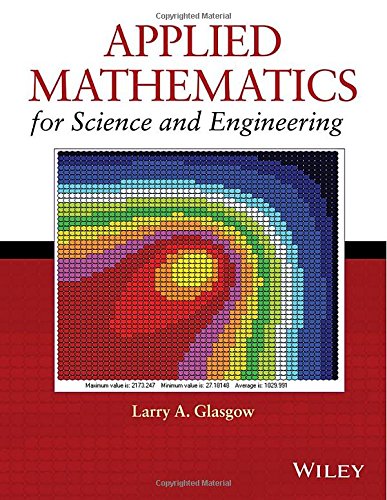
Applied Mathematics for Science and Engineering 1st Edition by Larry Glasgow ISBN 1118749928 978-1118749920


Original price was: $50.00.$35.00Current price is: $35.00.
Applied Mathematics for Science and Engineering 1st Edition by Larry A. Glasgow – Ebook PDF Instant Download/Delivery: 1118749928, 978-1118749920
Full download Applied Mathematics for Science and Engineering 1st Edition after payment
Product details:
ISBN 10: 1118749928
ISBN 13: 978-1118749920
Author: Larry A. Glasgow
Prepare students for success in using applied mathematics for engineering practice and post-graduate studies
- Moves from one mathematical method to the next sustaining reader interest and easing the application of the techniques
- Uses different examples from chemical, civil, mechanical and various other engineering fields
- Based on a decade’s worth of the authors lecture notes detailing the topic of applied mathematics for scientists and engineers
- Concisely writing with numerous examples provided including historical perspectives as well as a solutions manual for academic adopters
Table of contents:
-
Problem Formulation and Model Development
1.1 Introduction
1.2 Algebraic Equations from Vapor–Liquid Equilibria (VLE)
1.3 Macroscopic Balances: Lumped-Parameter Models
1.4 Force Balances: Newton’s Second Law of Motion
1.5 Distributed Parameter Models: Microscopic Balances
1.6 Using the Equations of Change Directly
1.7 A Contrast: Deterministic Models and Stochastic Processes
1.8 Empiricisms and Data Interpretation
1.9 Conclusion
1.10 Problems
1.11 References -
Algebraic Equations
2.1 Introduction
2.2 Elementary Methods
2.3 Newton–Raphson (Newton’s Method of Tangents)
2.4 Regula Falsi (False Position Method)
2.5 Dichotomous Search
2.6 Golden Section Search
2.7 Simultaneous Linear Algebraic Equations
2.8 Crout’s (or Cholesky’s) Method
2.9 Matrix Inversion
2.10 Iterative Methods of Solution
2.11 Simultaneous Nonlinear Algebraic Equations
2.12 Pattern Search for Solution of Nonlinear Algebraic Equations
2.13 Sequential Simplex and the Rosenbrock Method
2.14 An Example of a Pattern Search Application
2.15 Algebraic Equations with Constraints
2.16 Conclusion
2.17 Problems
2.18 References -
Vectors and Tensors
3.1 Introduction
3.2 Manipulation of Vectors
3.3 Force Equilibrium
3.4 Equating Moments
3.5 Projectile Motion
3.6 Dot and Cross Products
3.7 Differentiation of Vectors
3.8 Gradient, Divergence, and Curl
3.9 Green’s Theorem
3.10 Stokes’ Theorem
3.11 Conclusion
3.12 Problems
3.13 References -
Numerical Quadrature
4.1 Introduction
4.2 Trapezoid Rule
4.3 Simpson’s Rule
4.4 Newton–Cotes Formulae
4.5 Roundoff and Truncation Errors
4.6 Romberg Integration
4.7 Adaptive Integration Schemes
4.8 Simpson’s Rule
4.9 Gaussian Quadrature and the Gauss–Kronrod Procedure
4.10 Integrating Discrete Data
4.11 Multiple Integrals (Cubature)
4.12 Monte Carlo Methods
4.13 Conclusion
4.14 Problems
4.15 References -
Analytic Solution of Ordinary Differential Equations
5.1 An Introductory Example
5.2 First-Order Ordinary Differential Equations
5.3 Nonlinear First-Order Ordinary Differential Equations
5.4 Solutions with Elliptic Integrals and Elliptic Functions
5.5 Higher-Order Linear ODEs with Constant Coefficients
5.6 Use of the Laplace Transform for Solution of ODEs
5.7 Higher-Order Equations with Variable Coefficients
5.8 Bessel’s Equation and Bessel Functions
5.9 Power Series Solutions of Ordinary Differential Equations
5.10 Regular Perturbation
5.11 Linearization
5.12 Conclusion
5.13 Problems
5.14 References -
Numerical Solution of Ordinary Differential Equations
6.1 An Illustrative Example
6.2 The Euler Method
6.3 Modified Euler Method
6.4 Runge–Kutta Methods
6.5 Simultaneous Ordinary Differential Equations
6.6 Some Potential Difficulties Illustrated
6.7 Limitations of Fixed Step-Size Algorithms
6.8 Richardson Extrapolation
6.9 Multistep Methods
6.10 Split Boundary Conditions
6.11 Finite-Difference Methods
6.12 Stiff Differential Equations
6.13 Backward Differentiation Formula (BDF) Methods
6.14 Bulirsch–Stoer Method
6.15 Phase Space
6.16 Summary
6.17 Problems
6.18 References -
Analytic Solution of Partial Differential Equations
7.1 Introduction
7.2 Classification of Partial Differential Equations and Boundary Conditions
7.3 Fourier Series
7.4 A Preview of the Utility of Fourier Series
7.5 The Product Method (Separation of Variables)
7.6 Parabolic Equations
7.7 Elliptic Equations
7.8 Application to Hyperbolic Equations
7.9 The Schrödinger Equation
7.10 Applications of the Laplace Transform
7.11 Approximate Solution Techniques
7.12 Galerkin MWR Applied to a PDE
7.13 The Rayleigh–Ritz Method
7.14 Collocation
7.15 Orthogonal Collocation for Partial Differential Equations
7.16 The Cauchy–Riemann Equations, Conformal Mapping, and Solutions for the Laplace Equation
7.17 Conclusion
7.18 Problems
7.19 References -
Numerical Solution of Partial Differential Equations
8.1 Introduction
8.2 Finite-Difference Approximations for Derivatives
8.3 Boundaries with Specified Flux
8.4 Elliptic Partial Differential Equations
8.5 An Iterative Numerical Procedure: Gauss–Seidel
8.6 Improving the Rate of Convergence with Successive Over-Relaxation (SOR)
8.7 Parabolic Partial Differential Equations
8.8 An Elementary Explicit Numerical Procedure
8.9 The Crank–Nicolson Method
8.10 Alternating-Direction Implicit (ADI) Method
8.11 Three Spatial Dimensions
8.12 Hyperbolic Partial Differential Equations
8.13 The Method of Characteristics
8.14 The Leapfrog Method
8.15 Elementary Problems with Convective Transport
8.16 A Numerical Procedure for Two-Dimensional Viscous Flow Problems
8.17 MacCormack’s Method
8.18 Adaptive Grids
8.19 Conclusion
8.20 Problems
8.21 References -
Integro-Differential Equations
9.1 Introduction
9.2 An Example of Three-Mode Control
9.3 Population Problems with Hereditary Influences
9.4 An Elementary Solution Strategy
9.5 VIM: The Variational Iteration Method
9.6 Integro-Differential Equations and the Spread of Infectious Disease
9.7 Examples Drawn from Population Balances
9.8 Particle Size in Coagulating Systems
9.9 Application of the Population Balance to a Continuous Crystallizer
9.10 Conclusion
9.11 Problems
9.12 References -
Time-Series Data and the Fourier Transform
10.1 Introduction
10.2 A Nineteenth-Century Idea
10.3 The Autocorrelation Coefficient
10.4 A Fourier Transform Pair
10.5 The Fast Fourier Transform
10.6 Aliasing and Leakage
10.7 Smoothing Data by Filtering
10.8 Modulation (Beats)
10.9 Some Familiar Examples
10.10 Turbulent Flow in a Deflected Air Jet
10.11 Bubbles and the Gas–Liquid Interface
10.12 Shock and Vibration Events in Transportation
10.13 Conclusion and Some Final Thoughts
10.14 Problems
10.15 References -
An Introduction to the Calculus of Variations and the Finite-Element Method
11.1 Some Preliminaries
11.2 Notation for the Calculus of Variations
11.3 Brachistochrone Problem
11.4 Other Examples
11.5 Minimum Surface Area
11.6 Systems of Particles
11.7 Vibrating String
11.8 Laplace’s Equation
11.9 Boundary-Value Problems
11.10 A Contemporary COV Analysis of an Old Structural Problem
11.11 Flexing of a Rod of Small Cross Section
11.12 The Optimal Column Shape
11.13 Systems with Surface Tension
11.14 The Connection between COV and the Finite-Element Method (FEM)
11.15 Conclusion
11.16 Problems
11.17 References
People also search for:
applied mathematics for business economics and the social sciences
applied mathematics for the managerial life and social sciences
applied mathematics for computer science pdf
applied mathematics for diploma in nautical science pdf
applied mathematics for the managerial life and social sciences pdf