
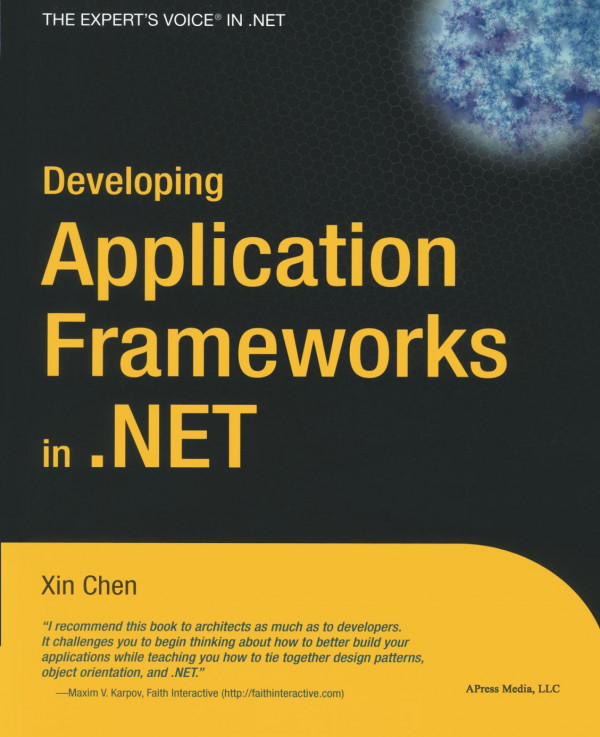
Developing Application Frameworks in NET 1st Edition by Xin Chen ISBN 1590592883 9781590592885


Original price was: $50.00.$35.00Current price is: $35.00.
Developing Application Frameworks in NET 1st Edition by Xin Chen – Ebook PDF Instant Download/Delivery: 1590592883, 9781590592885
Full download Developing Application Frameworks in NET 1st Edition after payment
Product details:
ISBN 10: 1590592883
ISBN 13: 9781590592885
Author: Xin Chen
Application frameworks, which provide a base of common services on which applications are built, offer the benefits of extensibility, modularity, and reusability of both code and design to your applications. This book explains what frameworks are and how they fit into applications, and offers many object-oriented techniques used in application frameworks.
This book also shows you actually how to develop application frameworks through a concrete framework example called Simplified Application Framework (SAF). The SAF framework was developed by author Xin Chen in C#. It consists of common services needed by many applications, such as a class factory service, configuration service, event notification service, security service, and transaction service. This book goes into detail on each of these services to explain its benefits, as well as its design and implementation in C#. Through a discussion of each service, you will also learn about many advanced .NET techniques employed by the framework, such as .NET remoting, reflection, custom attributes, multithreading, and serviced components.
Many of the services discussed in the book also use design patterns as their blueprints. This book discusses these design patterns in-depth and shows how to implement them in a real-world scenario. Accompanying the book are the complete source code of the sample framework and sample executable projects (downloadable via the Internet), allowing readers to actually test out each framework service/component of SAF and learn about the development of frameworks, .NET technologies, and design patterns in a more interactive fashion.
Developing Application Frameworks in NET 1st Table of contents:
Part I: Application Framework Fundamentals
-
Chapter 1: Dissection of an Application Framework
- What Is an Application Framework?
- Why Do We Need Application Frameworks? (Benefits like reusability, extensibility, modularity)
- Components of an Application Framework
- Distinguishing Between Frameworks and Libraries
- Characteristics of a Good Application Framework
- Domain-Specific vs. General-Purpose Frameworks
- Anatomy of a Typical Application Framework
- Challenges in Framework Development
- Summary
-
Chapter 2: An Overview of the Simplified Application Framework (SAF)
- Introducing SAF
- SAF’s Design Goals
- The SAF Architecture
- SAF’s Core Services
- How to Use SAF in Your Applications
- Setting Up the SAF Development Environment
- Summary
Part II: Core Framework Services (The SAF Components)
-
Chapter 3: The Class Factory Service
- What Is a Class Factory?
- Design and Benefits
- Implementation in SAF (using reflection, configuration)
- Integrating with Design Patterns (e.g., Factory Method, Abstract Factory)
- Usage Examples
- Summary
-
Chapter 4: The Configuration Service
- Importance of Configuration Management
- Configuration Storage Options (.NET config files, custom XML, databases)
- Design of the SAF Configuration Service
- Implementation Details
- Advanced Configuration Techniques
- Usage Examples
- Summary
-
Chapter 5: The Event Notification Service
- Event-Driven Architecture in Frameworks
- Publish/Subscribe Pattern
- Design of the SAF Event Service
- Implementation (using delegates, events, custom events)
- Asynchronous Event Handling
- Usage Examples
- Summary
-
Chapter 6: The Security Service
- Security Fundamentals in .NET
- Authentication and Authorization (Forms Authentication, Windows Authentication)
- Role-Based Security
- Design of the SAF Security Service
- Implementation (using custom attributes, security principals)
- Integrating with ASP.NET Security
- Usage Examples
- Summary
-
Chapter 7: The Transaction Service
- Introduction to Transactions (ACID properties)
- Distributed Transactions (.NET Enterprise Services, COM+)
- Design of the SAF Transaction Service
- Implementation (using serviced components, ContextBoundObject)
- Transactional Boundary Definition
- Usage Examples
- Summary
-
Chapter 8: The Logging and Tracing Service
- Importance of Application Monitoring
- Design of the SAF Logging Service
- Implementation (log providers, listeners)
- Integrating with .NET Tracing
- Custom Log Targets
- Usage Examples
- Summary
-
Chapter 9: The Exception Handling Service
- Structured Exception Handling in .NET
- Centralized Exception Management
- Design of the SAF Exception Handling Service
- Implementation (custom exception types, policies)
- Logging Exceptions
- Usage Examples
- Summary
Part III: Advanced Topics and Patterns in Framework Development
-
Chapter 10: Advanced .NET Techniques for Frameworks
- Reflection (dynamic type loading, introspection)
- Custom Attributes
- Serialization
- .NET Remoting (cross-process communication)
- Multithreading and Asynchronous Programming
- Interoperability (COM Interop, P/Invoke)
- Summary
-
Chapter 11: Design Patterns in Application Frameworks
- Overview of Design Patterns (Gang of Four)
- Creational Patterns (e.g., Singleton, Factory Method, Abstract Factory)
- Structural Patterns (e.g., Adapter, Decorator, Facade, Composite)
- Behavioral Patterns (e.g., Observer, Strategy, Command, Template Method)
- How SAF Uses Design Patterns
- Summary
-
Chapter 12: Testing and Documenting Frameworks
- Importance of Testing (Unit Testing, Integration Testing)
- Test-Driven Development (TDD)
- Documentation Strategies for Frameworks
- Providing Samples and Tutorials
- Summary
People also search for Developing Application Frameworks in NET 1st:
developing application frameworks in net
development framework examples
developing applications
framework applications
develop framework meaning
Tags: Xin Chen, Developing, Application